Semaglutide vs Tirzepatide for Weight Loss
Compare semaglutide and tirzepatide for weight loss, nausea, and receptor targets. See what SURMOUNT-5 and the GIP mouse study actually found.

In SURMOUNT-5, adults without diabetes lost an average of 20.2% of body weight with tirzepatide and 13.7% with injectable semaglutide at 72 weeks. Nausea was common with both. Tirzepatide targets GIP and GLP-1 receptors, while semaglutide targets GLP-1 alone. A physician can help weigh those results against your goals, medical history, and tolerability.
How much weight did people lose in the head-to-head trial?
SURMOUNT-5 found an average advantage of 6.5 percentage points for tirzepatide at 72 weeks. The randomized, open-label trial compared maximum tolerated weekly doses in adults with obesity or overweight and a weight-related complication, without diabetes. Both groups lost weight. The result describes the doses and population studied, and individual results vary.
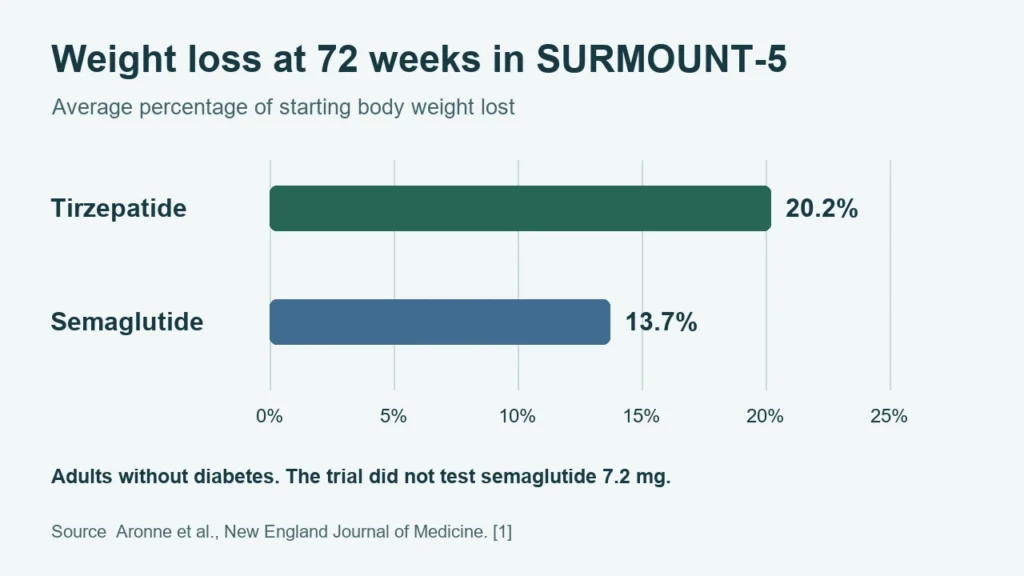
The trial randomized 751 adults. Waist circumference fell by an average of 18.4 cm with tirzepatide and 13.0 cm with semaglutide. Nausea was reported in 43.6% and 44.4%, respectively. Gastrointestinal adverse events led to discontinuation in 2.7% and 5.6%, respectively. Most gastrointestinal events were mild to moderate and occurred during dose increases. The results show similar nausea rates, with differences in some other measures of tolerability. [1]
A U.S. observational study of patients using formulations labeled for type 2 diabetes also found greater on-treatment weight loss with tirzepatide. Estimated 12-month losses were 15.3% versus 8.3%, with no significant difference in the risk of the gastrointestinal events assessed. Those findings are subject to confounding and treatment discontinuation, and do not replace head-to-head randomization. [2]
How do semaglutide and tirzepatide work?
Both medicines act on receptors for gut hormones released after meals. Semaglutide activates the GLP-1 receptor. Tirzepatide activates the GIP and GLP-1 receptors. Both can improve glucose regulation, reduce appetite, and slow stomach emptying. The second target gives tirzepatide a distinct mechanism, though it cannot by itself explain an individual’s response.
| What to compare | Semaglutide | Tirzepatide |
|---|---|---|
| Receptor targets | GLP-1 receptor agonist. Liraglutide also targets this receptor. [3, 4] | Dual GIP and GLP-1 receptor agonist. [5] |
| Weekly injection doses studied in SURMOUNT-5 | Maximum tolerated dose of 1.7 or 2.4 mg. [1] | Maximum tolerated dose of 10 or 15 mg. [1] |
| Average weight loss and nausea during the trial | 13.7% weight loss at 72 weeks. Nausea reported by 44.4%. [1] | 20.2% weight loss at 72 weeks. Nausea reported by 43.6%. [1] |
| Selected FDA-approved uses beyond weight management | Wegovy has a cardiovascular risk-reduction indication for eligible adults with established cardiovascular disease and overweight or obesity. [3] | Zepbound treats moderate to severe obstructive sleep apnea in adults with obesity. [5] |
GLP-1 means glucagon-like peptide-1. GIP means glucose-dependent insulinotropic polypeptide. Both are incretins that help stimulate insulin secretion when glucose is elevated. Native GLP-1 is short-lived in part because it is broken down by DPP-4. Medicines such as semaglutide are engineered to last longer. Laboratory research also shows that tirzepatide engages GIP and GLP-1 receptors differently, including a distinct pattern of signaling at the GLP-1 receptor. Receptor potency alone cannot predict weight loss or side effects. [3–7]
What did the mouse study find about GIP and hunger?
In mice, blocking the GIP receptor weakened the fall in activity of hunger-promoting AgRP neurons after glucose entered the stomach. Blocking the GLP-1 receptor did not prevent that specific response. Experimental agents activating either receptor also quieted the neurons. The study used animal models and experimental analogs, so its findings cannot establish the human mechanism.
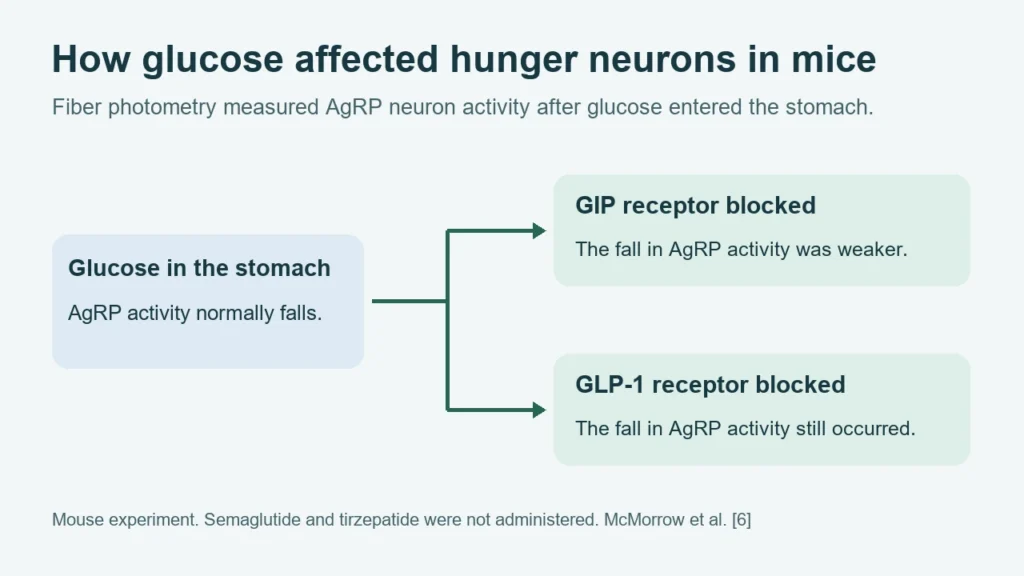
Researchers tracked hypothalamic AgRP neuron activity using fiber photometry. These neurons help drive feeding. GIP receptor blockade weakened the response to glucose and a mixed-nutrient drink. The result concerns a specific circuit and experiment. It does not rule out other ways endogenous GLP-1 contributes to satiety. Earlier animal experiments found weight effects with both activating and blocking GIP receptors under different conditions. [6, 8]
At pharmacological doses, experimental GIP and GLP-1 analogs each inhibited AgRP activity. Combining them inhibited these neurons more strongly than the GLP-1 analog alone at the tested dose. When researchers used light to reactivate the neurons, mice partially resumed eating despite treatment. The study did not administer semaglutide or tirzepatide or establish that GIP makes tirzepatide less nauseating in humans. [6]
Which option should you discuss with your physician?
Consider weight goals, diabetes status, cardiovascular history, sleep apnea, side effects, and whether you can sustain treatment. The FDA later approved a 7.2 mg Wegovy injection for certain adults. SURMOUNT-5 did not test that dose. Ask your physician which approved product and dose fit your health needs and how follow-up will work.
- Review medical history. Tell your physician about prior severe digestive symptoms, pancreatitis or gallbladder history, pregnancy plans, and any personal or family history of medullary thyroid carcinoma or MEN2. Bring a current medication list, especially if you take insulin or a sulfonylurea. [3, 5]
- Plan for tolerability. Ask how dose increases will be handled and when to report nausea, vomiting, constipation, or diarrhea. Seek urgent medical evaluation for severe persistent abdominal pain or inability to keep fluids down. [3, 5]
- Compare the specific products. The FDA approved higher-dose Wegovy in 2026 for certain adults. The original head-to-head trial compared the previously available injectable semaglutide regimen. Review the indication, total cash cost, availability, and follow-up before choosing. [1, 3, 5, 9]
Common questions about PEPLIX HEALTH
Peplix Health is a cash-pay telehealth service managed by Monarch Brands LLC. An independent, board-certified physician reviews your medical history and goals and individualizes treatment and follow-up when appropriate. A state-licensed compounding pharmacy can fill an eligible, patient-specific prescription under applicable Section 503A requirements. Ask which formulation and indication fit your case.
Is tirzepatide always better than semaglutide?
Tirzepatide produced greater average weight loss at the doses tested in SURMOUNT-5. Your physician can consider individual response, specific approved indications, and how each option fits your medical history and preferences. [1, 3, 5, 9]
Does tirzepatide usually cause less nausea?
Nausea rates were similar in SURMOUNT-5. Fewer participants stopped tirzepatide because of gastrointestinal adverse events in that trial. A mouse experiment does not explain how you will tolerate either treatment. [1, 6]
How does Section 503A pharmacy fulfillment work?
Compounded drugs do not undergo FDA premarket review for safety, effectiveness, or quality. Section 503A generally requires a valid prescription for an identified patient and restricts routine compounding of essentially identical copies of commercially available drugs. Ask why compounding would be appropriate and which licensed pharmacy would fill the prescription. [10, 11]
For consultation information, see our weight-loss guide or start an online assessment.
Sources
- Aronne et al. SURMOUNT-5 head-to-head trial.
- Rodriguez et al. U.S. observational comparison of semaglutide and tirzepatide.
- DailyMed. Wegovy prescribing information.
- Novo Nordisk. Saxenda liraglutide prescribing information.
- FDA. Zepbound prescribing information.
- McMorrow et al. Incretin receptor agonism and AgRP neurons in mice.
- Willard et al. Tirzepatide signaling at GIP and GLP-1 receptors.
- Preclinical study. GIP receptor signaling and food intake.
- FDA. Approval of higher-dose injectable Wegovy.
- FDA. Federal provisions for human drug compounding.
- FDA. Compounding policies as national GLP-1 supply stabilizes.
This article is for general education and is not medical advice. Talk with a licensed clinician before starting, stopping or changing any treatment. Compounded medications are not FDA-approved. See our safety information.
Keep reading

Weight Loss
GLP-1 Medications for Weight Loss and Diabetes
Compare semaglutide and tirzepatide for weight loss, learn which GLP-1 pills work, and understand side effects, stopping, and pharmacy fulfillment.

Weight Loss
Compounded semaglutide vs Wegovy and Ozempic
Compare compounded semaglutide with Wegovy and Ozempic on weight loss evidence, cost, dosing safety, and when a 503A pharmacy may fill a prescription.

Weight Loss
GLP-1 Benefits Beyond Weight Loss
Learn how semaglutide and tirzepatide affect blood sugar, heart health, inflammation, food noise, and alcohol cravings. Compare the evidence.