Compounded semaglutide vs Wegovy and Ozempic
Compare compounded semaglutide with Wegovy and Ozempic on weight loss evidence, cost, dosing safety, and when a 503A pharmacy may fill a prescription.

FDA-approved semaglutide has stronger evidence for effectiveness because its specific products and doses were evaluated in clinical trials. Results from those trials cannot tell you whether a compounded preparation will work as well. A licensed clinician may consider compounding when an available approved product cannot meet an individual medical need and applicable requirements are met.
Does compounded semaglutide work as well as Wegovy?
Reliable evidence does not establish that compounded semaglutide works as well as Wegovy. In the STEP 1 trial, participants receiving the studied semaglutide injection lost an average of 14.9% of their starting weight by week 68, compared with 2.4% with placebo. The study did not include a compounded product.
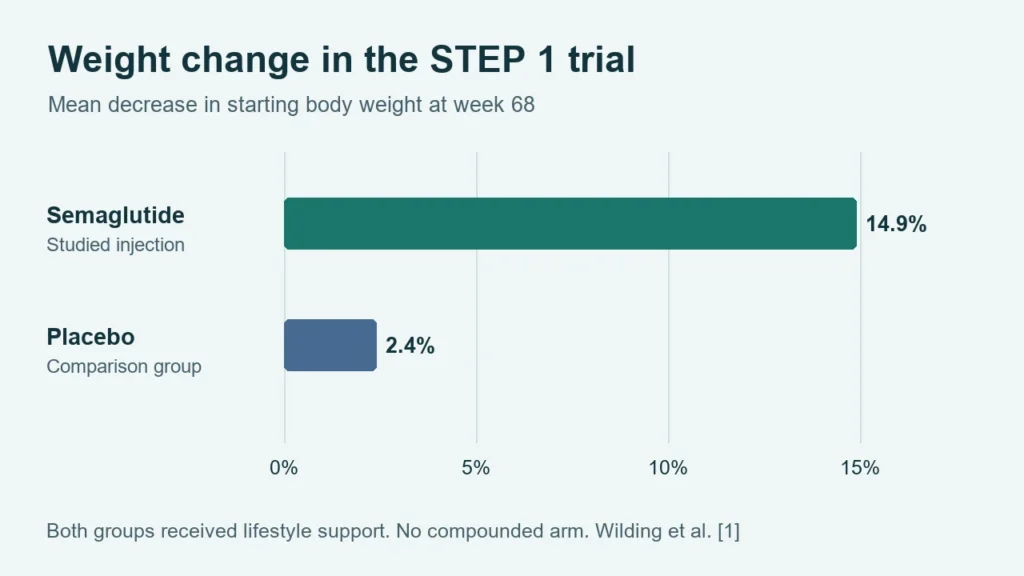
STEP 1 enrolled 1,961 adults with obesity, or overweight with at least one weight-related condition, and excluded people with diabetes. Both groups received lifestyle support. Researchers studied a 2.4 mg weekly injection regimen. Individual outcomes vary with factors such as starting health, dose, tolerability and adherence. The trial average does not predict an individual result. [1]
How does semaglutide affect appetite and blood sugar?
Semaglutide activates receptors for glucagon-like peptide-1 (GLP-1), a hormone released after meals. It increases insulin release and lowers glucagon when blood glucose is elevated. Less glucagon reduces the signal for the liver to release glucose. Semaglutide also acts on pathways involved in appetite and can delay stomach emptying. The medication’s effects last longer than those of the natural hormone. [2,3]
What differs between the approved brands and compounded semaglutide?
Wegovy and Ozempic injections contain semaglutide base and have distinct approved indications and prescribing instructions. A compounded preparation may differ in its ingredients, concentration, container and storage requirements. Using semaglutide base does not establish equivalence to an approved product. FDA does not review compounded drugs for safety, effectiveness or quality before marketing.
| Product | What it is used for | What to know before comparing |
|---|---|---|
| Wegovy injection | Approved for chronic weight management in eligible patients, with other product-specific indications. | Trials support specific approved regimens. Use and dosing depend on the indication. [1,2,4] |
| Ozempic injection | Approved for type 2 diabetes and specified cardiovascular and kidney risk reductions in certain adults. | Use for weight management alone is off label. Insurance may assess coverage by diagnosis. [3] |
| Compounded preparation | A custom formulation considered for an individual clinical need. | Ingredients, concentration and device can vary. Verify the reason for compounding, the pharmacy and instructions. [5–7,14] |
Can semaglutide salts or vitamin B6 change the comparison?
Semaglutide sodium and semaglutide acetate are different active ingredients from the semaglutide base used in approved products. FDA has not established their pharmaceutical or clinical equivalence and says it is unaware of a lawful basis for their use in compounding. Some compounders have added ingredients such as vitamin B6. The safety and effectiveness of these combinations have not been established, and an additive alone does not establish a patient-specific need. [5–7,14]
When can a pharmacy compound semaglutide?
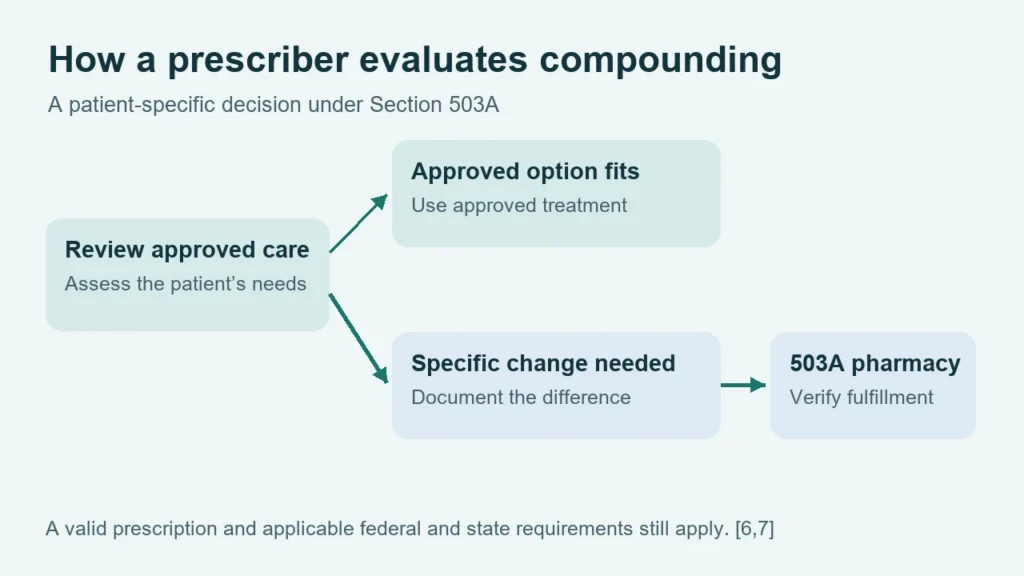
During the national injection shortage, compounding temporarily expanded. FDA declared the semaglutide injection shortage resolved in February 2025, and the shortage-related enforcement discretion periods ended. For a formulation that would otherwise be an essential copy, a prescriber-documented change that makes a significant difference for the identified patient can matter under Section 503A.
How do Sections 503A and 503B differ?
- Section 503A. A licensed pharmacist in a qualifying pharmacy or federal facility, or a licensed physician in applicable circumstances, may compound for an identified patient under federal and state requirements. For a licensed dispensing pharmacy, confirm a valid patient-specific prescription and ask the prescriber to explain any documented significant difference. When bulk ingredients are used, federal conditions include a valid certificate of analysis and manufacture by an FDA-registered establishment. Registration does not confer approval on the finished product. [6,7,9]
- Section 503B. FDA-registered outsourcing facilities operate under a licensed pharmacist’s direct supervision, are subject to current good manufacturing practice and are inspected on a risk-based schedule. Section 503B has distinct limits on bulk ingredients and essential copies. Oversight does not establish equivalence to a branded product. In April 2026, FDA proposed excluding semaglutide from its 503B bulk substances list. [6,7,10,13]
Coverage exclusions, high prices and a local pharmacy being temporarily out of stock are access problems. They do not by themselves establish a significant difference in formulation for an individual patient. Ask about available approved options and whether a specific formulation change would address a medical need. [6–8]
What should you check before paying for semaglutide?
Compare the actual monthly cost of an FDA-approved product under your insurance or a cash-pay program. If your clinician identifies a reason for a compounded preparation, confirm which pharmacy will fill it, what is in the product, how to store it and how to measure the prescribed dose safely.
In 2024, NPR reported branded injections priced above $1,000 per month without coverage and an example of compounded medication at about $300 monthly. Historical quotes are not current prices. Novo Nordisk’s price guide reviewed in November 2026 listed a standard $349 monthly self-pay offer for certain Wegovy injection strengths, subject to eligibility and program terms. Compare current quotes, the price after any introductory offer and any separate visit, lab or shipping fees. [11,12]
- Confirm coverage and stock. Ask about the covered indication, prior authorization, pharmacy stock and expected out-of-pocket costs.
- Verify the pharmacy and label. Confirm state licensure, the active ingredient and any added ingredients, concentration, storage and beyond-use date. Ask the pharmacist about any temperature concern after delivery. [5–7,14]
- Ask for a dosing demonstration. Vial concentrations can differ. Verify the written instructions and matching syringe with the pharmacist. FDA has received reports of dosing errors, including some that required hospitalization. [5]
Common questions about PEPLIX HEALTH
Peplix Health offers cash-pay evaluations for metabolic and weight concerns. Monarch Brands LLC manages nonclinical operations. Independent, board-certified physicians assess medical history, treatment eligibility and risk. If a prescription is appropriate, the clinician individualizes product selection, dosing and monitoring, and explains the available fulfillment options for that patient.
Does an online evaluation guarantee a compounded prescription?
No. The physician’s evaluation determines whether medication is clinically appropriate. If a compounded option is appropriate and legally available, a licensed Section 503A pharmacy can fill a valid prescription under applicable federal and state requirements. [6,7]
Can I switch from a brand pen to a compounded vial on my own?
Discuss any switch or interruption with your prescriber first. Concentrations, devices and instructions can differ. If you use semaglutide to manage diabetes, ask how a change affects your glucose monitoring and other medicines. [3,5]
This guide is for general education and does not replace individualized medical advice.
For consultation information, see our weight-loss guide or start an online assessment.
Sources
- Wilding et al. STEP 1 semaglutide weight management trial
- FDA. Wegovy prescribing information
- FDA. Ozempic prescribing information
- FDA. March 2026 Wegovy HD approval
- FDA. Compounded injectable semaglutide dosing errors
- FDA. GLP-1 compounding policy update, April 2026
- FDA. Compounding provisions under Sections 503A and 503B
- FDA. Semaglutide injection shortage resolution
- FDA. Bulk substances used in Section 503A compounding
- FDA. April 2026 proposed exclusions from the 503B bulk list
- NPR via WUSF. Historical compounded semaglutide pricing
- Novo Nordisk. Wegovy self-pay price guide
- FDA. Compounding oversight and approval questions
- FDA. Safety concerns with unapproved GLP-1 drugs
This article is for general education and is not medical advice. Talk with a licensed clinician before starting, stopping or changing any treatment. Compounded medications are not FDA-approved. See our safety information.
Keep reading

Weight Loss
GLP-1 Medications for Weight Loss and Diabetes
Compare semaglutide and tirzepatide for weight loss, learn which GLP-1 pills work, and understand side effects, stopping, and pharmacy fulfillment.

Weight Loss
GLP-1 Benefits Beyond Weight Loss
Learn how semaglutide and tirzepatide affect blood sugar, heart health, inflammation, food noise, and alcohol cravings. Compare the evidence.

Weight Loss
Semaglutide vs Tirzepatide for Weight Loss
Compare semaglutide and tirzepatide for weight loss, nausea, and receptor targets. See what SURMOUNT-5 and the GIP mouse study actually found.