Minoxidil vs Finasteride vs Dutasteride for Hair Loss
Compare minoxidil, finasteride, and dutasteride for male pattern hair loss, including side effects, approval status, and what to expect.
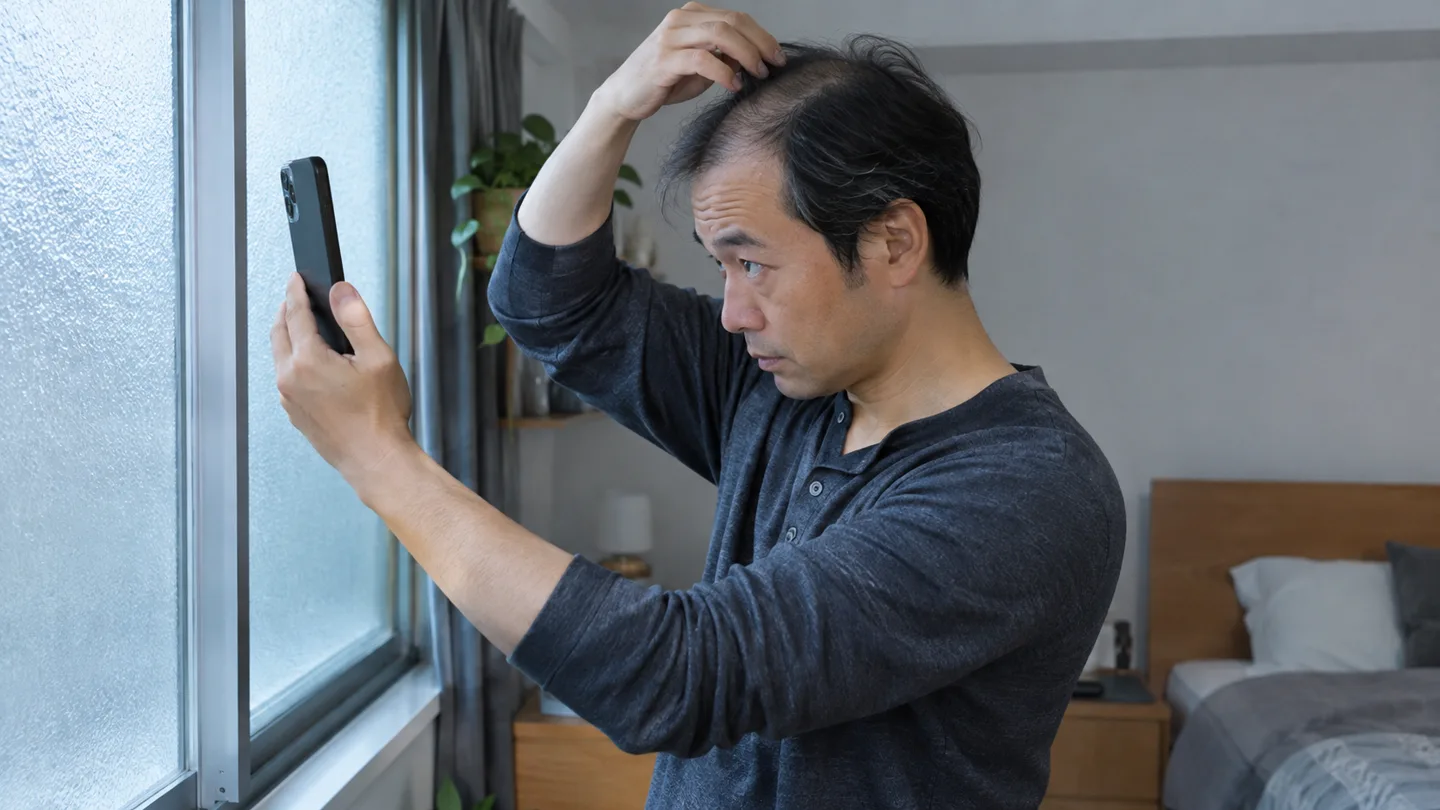
For male pattern hair loss, topical minoxidil helps follicles stay in the growth phase, while finasteride and dutasteride lower DHT. Topical minoxidil and oral finasteride have FDA approval for labeled hair-loss uses. Oral dutasteride is used off-label. The best fit depends on the diagnosis, your preferences, and the risks you are comfortable taking.
How can you tell whether thinning is male pattern hair loss?
A receding hairline that forms an M shape, thinning at the temples, or a gradually less dense crown can point to male pattern hair loss. Some men also notice diffuse thinning. Sudden shedding, round bald patches, scalp pain, or inflammation suggest other possibilities and are worth checking before starting treatment.
Pattern hair loss affects up to around half of men by age 50. In genetically susceptible follicles, DHT shortens the growing phase, and the hairs that grow back become finer and shorter. This can happen even when circulating DHT is normal. Early treatment can preserve hair and may recover some density. [1,2]
How do the three main hair loss medicines differ?
Minoxidil works through the hair cycle, and finasteride and dutasteride reduce the amount of testosterone converted to DHT. Oral and topical versions can differ in absorption, risks, and approval status. Before choosing one, consider what you can use consistently and ask your clinician how the evidence applies to the exact product.
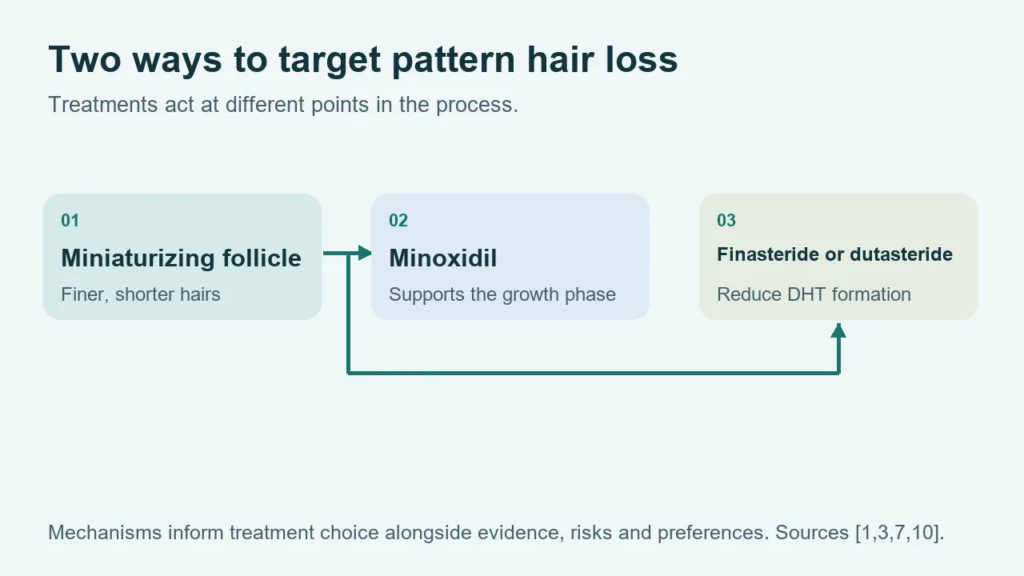
| Medicine | U.S. status and action | Potential trade-offs |
|---|---|---|
| Minoxidil | FDA-approved topical solution or foam for labeled pattern hair loss. Oral tablets are approved for severe, difficult-to-treat hypertension and used off-label for hair loss. | Topical products may itch, sting, or irritate. Oral treatment can cause unwanted body hair, headaches, swelling, dizziness, or palpitations. |
| Finasteride | Oral 1 mg is FDA-approved for male pattern hair loss. Blocks primarily type II 5-alpha reductase. Topical spray has no U.S. approval. | Possible sexual effects include reduced libido, erectile trouble, and ejaculation changes. Depression and persistent sexual symptoms have been reported. Tell your clinician about prostate screening. |
| Dutasteride | Oral capsules are FDA-approved for an enlarged prostate and used off-label for hair loss. Inhibits type I and II 5-alpha reductase and generally reduces DHT more strongly. | Possible sexual and semen effects. Topical formulations lack FDA approval and have less comparative evidence. |
Does switching between oral and topical treatment change results?
Topical minoxidil, the active ingredient in Rogaine, can help retain hair and stimulate growth. Many products for men are used twice daily, but follow the exact label. A trial published online in 2023 compared 5% topical solution with 1 mg oral minoxidil and found no statistically significant difference. Oral minoxidil has systemic risks and requires individualized evaluation. [3–5]
A five-year oral finasteride report found about 90% of assessed men had improved or maintained their hair on photographs. In a separate 24-week topical-spray trial, topical finasteride improved target-area counts versus placebo and gave numerically similar results to oral therapy, without establishing equivalence. Topical finasteride can be absorbed systemically and can transfer to others. [6–8]
Can combining treatments improve the results?
A clinician may pair minoxidil with finasteride because the two work through different pathways. Topical tretinoin has also been studied with minoxidil, partly because it can increase absorption. The supporting trials are small. Results from a specific study cannot show that every compounded mixture works or justify changing the labeled schedule on your own.
- Minoxidil and finasteride. Trials support potential added benefit for selected men. Review the risks and formulation of each ingredient. Oral dutasteride also improved counts in controlled trials, but that does not establish a benefit from combining two DHT blockers. [9,10]
- Minoxidil and tretinoin. A 2007 trial compared once-daily 5% minoxidil plus tretinoin with twice-daily 5% minoxidil alone. Both groups improved, and the study did not establish a general dosing rule. A small older study reported terminal hair regrowth in 66% of participants given a combination over one year. Tretinoin alone has insufficient evidence as a standard hair-loss treatment. [11,12]
Tretinoin is a vitamin A–derived retinoid. Topical products are used for acne or certain signs of photoaging. Oral tretinoin is used for acute promyelocytic leukemia. Isotretinoin is the different oral retinoid used for severe recalcitrant nodular acne. Topical tretinoin can cause redness, stinging, dryness, peeling, pigment changes, and sometimes swelling or blistering. [13,14]
How soon should you assess progress and what else can help?
Take baseline photos in consistent lighting and plan to reassess over months. Results depend on the cause of hair loss and how consistently you treat it. Major stress, restrictive eating, nutrient deficiencies, and medical conditions can contribute to shedding. A clinician can check for these causes and discuss treatment beyond medication where appropriate.
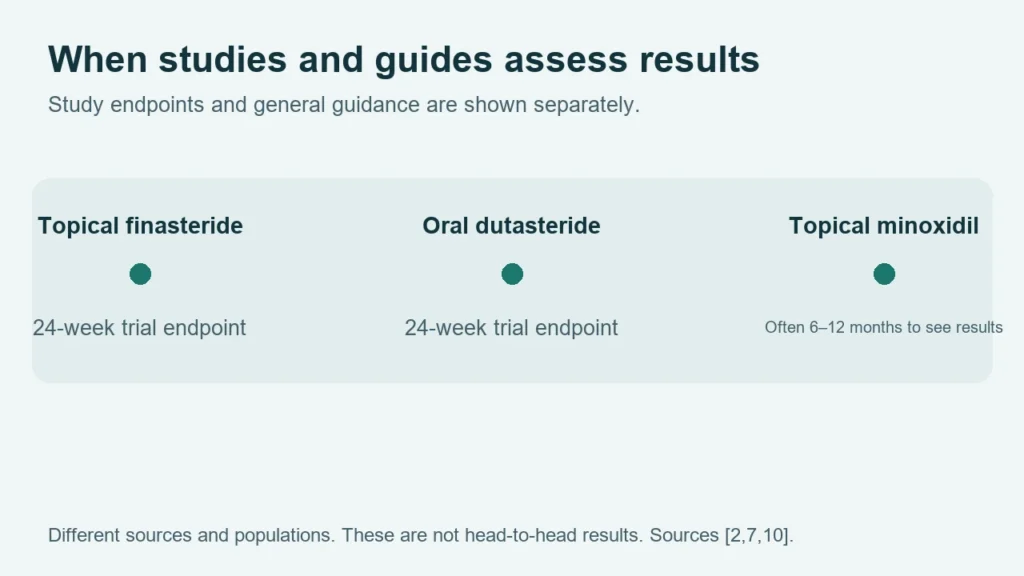
Review photos with your dermatologist and keep taking treatment as directed if it is tolerated. For topical minoxidil, visible changes often take six to twelve months. A finasteride spray trial assessed outcomes at 24 weeks, as did a major oral dutasteride trial. Those study checkpoints are useful context for your own follow-up. [2,7,10]
Adequate protein and a varied diet provide iron, zinc, and vitamins A, B12, C, D, and E. Correcting a deficiency can help in selected cases. High-dose vitamin A can cause shedding, and evidence for extra supplements without deficiency is limited. A clinician may also discuss low-level light devices or other procedures depending on the diagnosis and goals. [2,15]
Common questions about PEPLIX HEALTH
Independent, board-certified physicians can review your pattern of thinning, medical history, and treatment preferences. Monarch Brands LLC manages Peplix Health’s administrative services. Ask whether an in-person scalp examination would help, what follow-up is included, and how your physician would choose an appropriate formulation and dose for your situation.
Who determines whether combination treatment is appropriate?
Your physician considers the diagnosis, potential benefits, side effects, and any other medication you use. Share any history of scalp reactions, sexual side effects, or mood symptoms.
How are compounded hair-loss medicines filled?
A state-licensed pharmacy operating under Section 503A may fill a valid patient-specific prescription when clinically and legally appropriate. Compounded medicines do not have FDA approval. Ask which pharmacy would fill the prescription and how the product should be applied. [16]
This article is educational. Discuss persistent, sudden, or patchy hair loss with a licensed healthcare professional.
For consultation information, see our vitamins and wellness guide or start an online assessment.
Sources
- Endotext — male androgenetic alopecia
- American Academy of Dermatology — male pattern treatment
- Suchonwanit et al. — minoxidil review
- Asilian et al. — oral vs topical minoxidil
- DailyMed — oral minoxidil prescribing information
- Shapiro and Kaufman — long-term oral finasteride data
- Piraccini et al. — topical finasteride phase III trial
- FDA — compounded topical finasteride safety alert
- Chen et al. — finasteride and minoxidil combination review
- Gubelin Harcha et al. — oral dutasteride trial
- Shin et al. — minoxidil with tretinoin randomized trial
- Bazzano et al. — early topical tretinoin study
- MedlinePlus — topical tretinoin
- StatPearls — indications for tretinoin
- Almohanna et al. — nutrients and hair loss
- FDA — compounding and FDA approval
This article is for general education and is not medical advice. Talk with a licensed clinician before starting, stopping or changing any treatment. Compounded medications are not FDA-approved. See our safety information.
Keep reading

Wellness
Krill Oil vs Fish Oil for Omega-3s
Compare krill oil and fish oil for EPA and DHA, absorption, triglycerides, and side effects. Learn what to check on an omega-3 label.

Wellness
Sprinting Benefits and How to Start Sprint Interval Training
Learn how sprint intervals affect fitness and fat oxidation, how to start with controlled efforts, and how to fit sprinting into your week.

Wellness
CoQ10 Benefits, Dosage, and Safety
What does CoQ10 do? Explore the evidence for heart failure, fatigue, and statin symptoms, plus dosage, supplement forms, and interactions.