9 Hair Care Habits for Less Breakage and Thinning
Learn nine hair care habits for less breakage, how to protect your scalp, and when thinning or shedding needs a medical evaluation.

Gentle shampooing, conditioner, less heat, and looser styles can protect fragile strands and reduce damage caused by pulling. A routine can also help manage dandruff. If your part is widening, your hairline is receding, or you’re shedding more than usual, a dermatologist can check for follicle-related causes that need treatment.
How should you wash and condition thinning hair?
Wash when your scalp needs it, shampoo at the roots, and condition after washing. Fine or oily hair often needs more frequent washing than dry, curly, or coily hair. Adjust according to flakes, oil, styling products, and how your hair feels. Gentler handling is particularly important when your hair is damp.
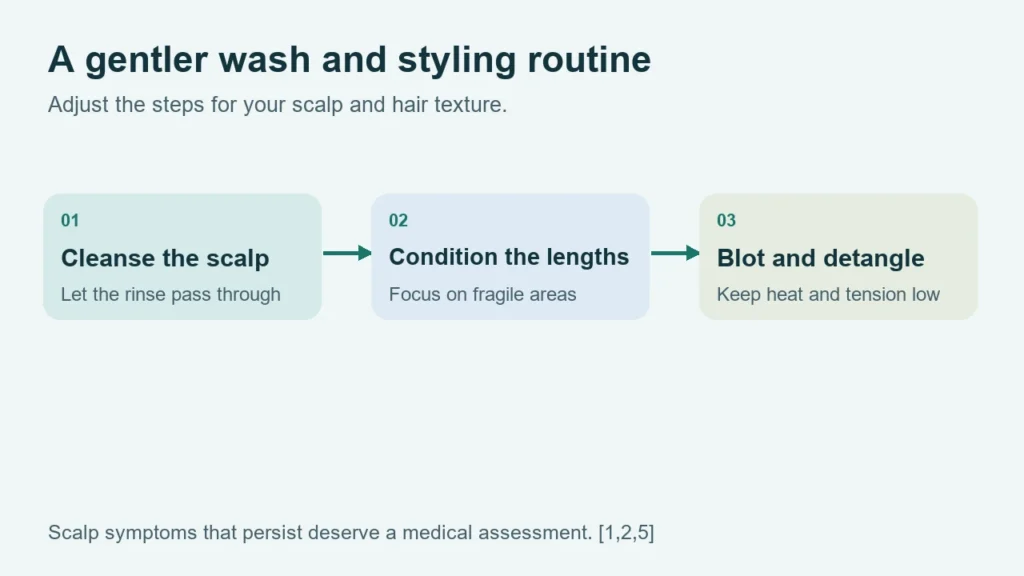
- 1. Match your wash schedule to your scalp. Two or three times a week may suit some people. Fine, straight hair or an oily scalp may need daily washing. Some thick curls and coils can go longer, but AAD guidance suggests washing at least every two to three weeks. Massage shampoo gently into the scalp and let the rinse run through the lengths. [1,2]
- 2. Condition after each shampoo. For fine hair, start at the ends. For dry or curly hair, condition the lengths. Hydrolyzed proteins such as keratin or collagen can form a temporary film. Oils, silicones, or film formers such as polyvinylpyrrolidone (PVP) can improve slip or manageability depending on the formula. [1,3]
- 3. Adjust for porosity and buildup. Porosity describes how readily the shaft takes up water. Low-porosity hair may wet slowly or feel weighed down by rich products. Medium porosity can feel easier to manage, while high-porosity hair wets readily and may lose moisture quickly or break more easily. Natural strand structure, bleaching, and weathering can all influence this. Try a light water-based product if gels, pomades, or waxes leave buildup. A coconut-oil mask may help protect porous lengths from damage. It is a conditioning option. [1,3,4]
How can you protect your scalp and strands between washes?
Treat recurring flakes with a shampoo designed for dandruff and avoid harsh scrubbing. Detangle gently, reduce hot-tool use, and loosen any style that pulls at the scalp. A satin pillowcase or occasional trim can help with friction or split ends. Persistent scalp irritation deserves a closer look from a clinician.
- 4. Treat flakes according to their cause. Ketoconazole or zinc pyrithione shampoos can help with dandruff. Salicylic acid can loosen scale. Scrubs remove surface material through friction, while acids such as salicylic or glycolic acid and some enzymes loosen surface cell buildup. An irritated scalp can react to either approach. Routine weekly exfoliation has no established regrowth benefit. Use scalp products as directed and get persistent itching, redness, or scaling checked. [5]
- 5. Blot and detangle gently. Use a soft towel or cotton T-shirt to absorb water. Straight hair can partly air-dry before combing. Thick curly or coily hair may detangle more easily while damp and conditioned. Use a wide-tooth comb from the ends upward. [1,2]
- 6. Reduce heat and chemical damage. Try air-drying or a cool dryer setting. If you use a hot tool, lower the heat and consider a product labeled as a heat protectant. Some contain silicone or hydrolyzed protein. Space out bleaching, relaxing, perming, and coloring if your hair breaks easily. [1,3,6]
- 7. Keep styles loose and protect fragile ends. Repeated tension from tight ponytails, buns, or braids can injure follicles and lead to permanent traction alopecia. A smooth satin or silk pillowcase may reduce overnight friction. Trim split ends before splits travel farther along the shaft. Both are ways to manage the hair you already have. [3,6,7]
What can help with shedding, and when should you seek care?
Sudden shedding, bald patches, a widening part, or a painful or inflamed scalp deserves evaluation. A routine can reduce breakage, while medical treatment depends on the cause. Tell your dermatologist about recent illness, major stress, weight changes, medicines, and supplements. That history can help distinguish temporary shedding from progressive pattern hair loss.
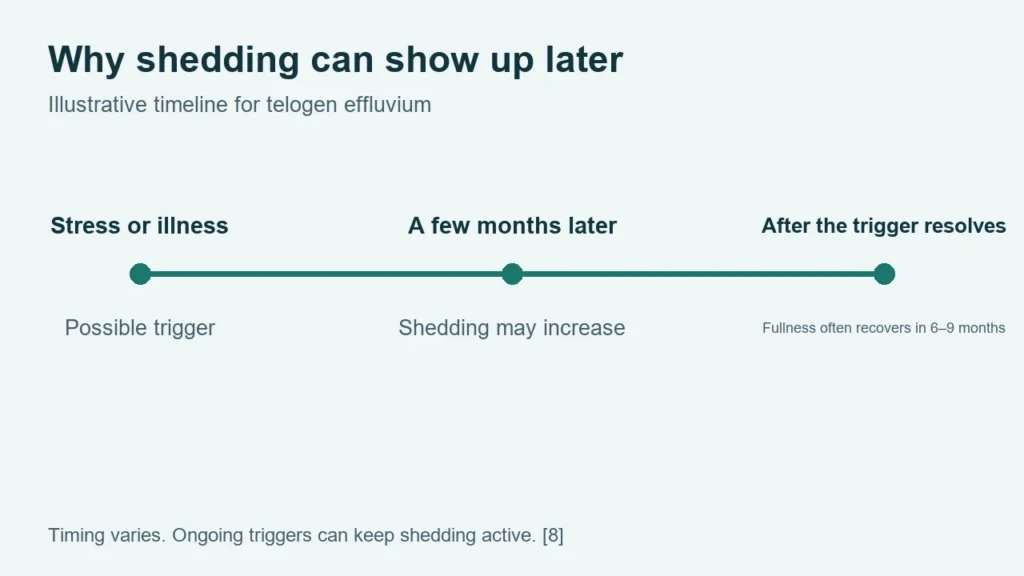
- 8. Support nutrition and recovery. Get adequate protein, iron, zinc, and vitamins C and D through a varied diet that can include eggs, nuts, spinach, and salmon. Significant stress, illness, or restrictive dieting can trigger telogen effluvium, in which more hairs shift into a resting phase and shed months later. Exercise or meditation can support stress management. Ask about testing if a deficiency is suspected. [8–10]
- 9. Get the diagnosis before choosing a growth product. Genetic pattern hair loss can gradually miniaturize follicles. If it’s confirmed, options such as topical minoxidil may help. Rosemary oil has limited evidence. In one 100-person study of rosemary oil and 2% minoxidil, both groups had higher hair counts at six months, with neither showing a significant gain at three months. Without a placebo group, the study could not establish the size of the effect over no treatment or prove a blood-flow mechanism. Oils can irritate the scalp. [9,11]
| What you see | What it may suggest | What to do |
|---|---|---|
| Short, uneven strands or split ends | Hair shaft breakage | Review heat, chemicals, brushing, and friction. |
| Thinning around a tightly styled hairline | Possible traction alopecia | Loosen the style and seek evaluation if thinning persists. |
| More full-length hairs after a major stressor | Possible telogen effluvium | Document timing and ask about other possible triggers. |
| A gradually widening part, receding temples, or crown thinning | Possible hereditary pattern hair loss | Discuss diagnosis and treatment options with a dermatologist. |
What does a simple weekly routine look like?
On wash days, cleanse the scalp, condition the lengths, and use a light leave-in or serum if needed. In the evening, release tight styles and detangle using the technique that suits your texture. A periodic deep conditioner is optional for dry lengths. Use a medicated scalp product only as directed. Track ongoing thinning with photos in similar lighting.
Common questions about PEPLIX HEALTH
The Peplix Health care model places medical decisions with independent, board-certified physicians. Monarch Brands LLC manages administrative services. A physician can help decide whether hair symptoms warrant testing, treatment, or an in-person scalp exam. Ask about the scope of appointments, cash-pay costs, and pharmacy fulfillment before starting a treatment plan.
Can a telehealth visit assess my hair loss?
A clinician can review photos, the pattern, and your timeline. Sudden or patchy loss, scalp pain, or signs of inflammation may require an in-person examination by a dermatologist.
How are prescriptions and doses chosen?
The physician considers the diagnosis, medical history, and treatment goals. A state-licensed pharmacy operating under Section 503A can prepare a patient-specific compounded prescription when clinically appropriate and lawful. Compounded medications do not have FDA approval. [12]
This article is for education. Discuss diagnosis or treatment decisions with a licensed healthcare professional.
For consultation information, see our vitamins and wellness guide or start an online assessment.
Sources
- American Academy of Dermatology — healthy hair tips
- American Academy of Dermatology — curly and coily hair care
- Review — hair conditioning chemistry
- Kaushik et al. — coconut-based hair oil and porosity
- American Academy of Dermatology — dandruff treatment
- American Academy of Dermatology — habits that damage hair
- American Academy of Dermatology — traction alopecia
- American Academy of Dermatology — hair shedding
- American Academy of Dermatology — hair loss diagnosis and treatment
- Almohanna et al. — vitamins, minerals, and hair loss
- Panahi et al. — rosemary oil and 2% minoxidil trial
- FDA — compounding and FDA approval
This article is for general education and is not medical advice. Talk with a licensed clinician before starting, stopping or changing any treatment. Compounded medications are not FDA-approved. See our safety information.
Keep reading

Wellness
Krill Oil vs Fish Oil for Omega-3s
Compare krill oil and fish oil for EPA and DHA, absorption, triglycerides, and side effects. Learn what to check on an omega-3 label.

Wellness
Sprinting Benefits and How to Start Sprint Interval Training
Learn how sprint intervals affect fitness and fat oxidation, how to start with controlled efforts, and how to fit sprinting into your week.

Wellness
CoQ10 Benefits, Dosage, and Safety
What does CoQ10 do? Explore the evidence for heart failure, fatigue, and statin symptoms, plus dosage, supplement forms, and interactions.