Dutasteride for Hair Loss: Benefits and Side Effects
Compare oral and topical dutasteride for hair loss. Review results, side effects, fertility concerns, and when to discuss treatment with a physician.

Oral dutasteride can improve hair density in some men with androgenetic alopecia. The FDA approves its use for benign prostatic hyperplasia, and prescribing it for hair loss is off-label in the United States. Topical dutasteride has less evidence. Discuss sexual side effects, fertility plans, and prostate screening before choosing a formulation.
How does dutasteride affect DHT and hair follicles?
Dutasteride blocks both type I and type II 5-alpha reductase, enzymes that convert testosterone into dihydrotestosterone, or DHT. In men with hereditary pattern hair loss, DHT causes susceptible follicles to produce shorter, finer hairs over time. Lowering DHT can slow that process and may improve density while follicles can still respond.
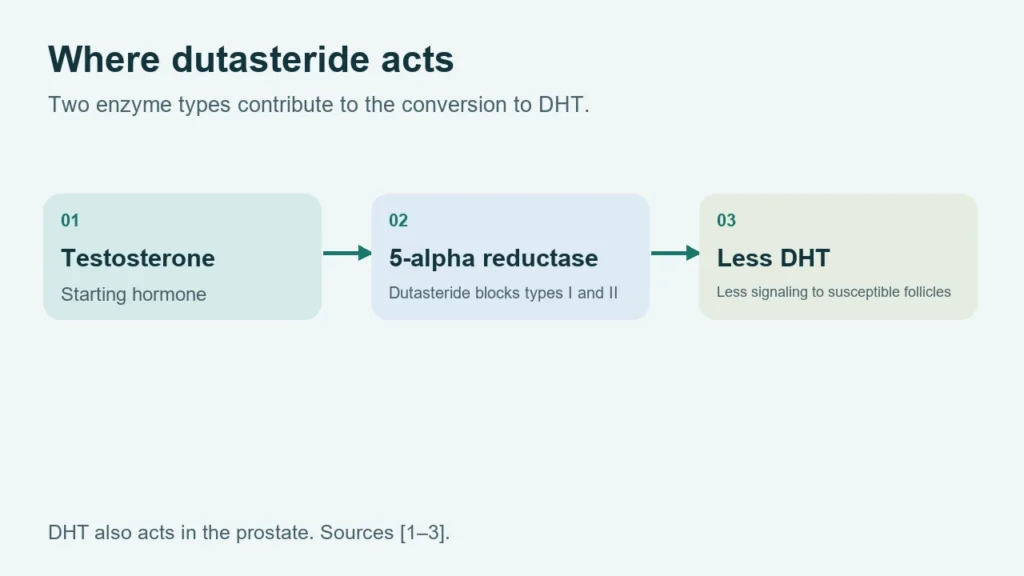
About 30–50% of men have some degree of pattern hair loss by age 50. Follicle sensitivity and genetics matter even when circulating androgens are normal. Dutasteride generally suppresses DHT more than finasteride, which mainly inhibits type II. Lowering DHT can also reduce prostate size and improve urinary symptoms in men with an enlarged prostate. The U.S. approved BPH product is an oral 0.5 mg capsule. [1–3]
How much regrowth did oral dutasteride produce in studies?
A 24-week randomized trial involving 917 men found that oral dutasteride at the study dose of 0.5 mg improved hair count and width more than finasteride 1 mg or placebo. An earlier study in identical twins also found better growth and slower progression. Individual results depend on the extent and cause of thinning.
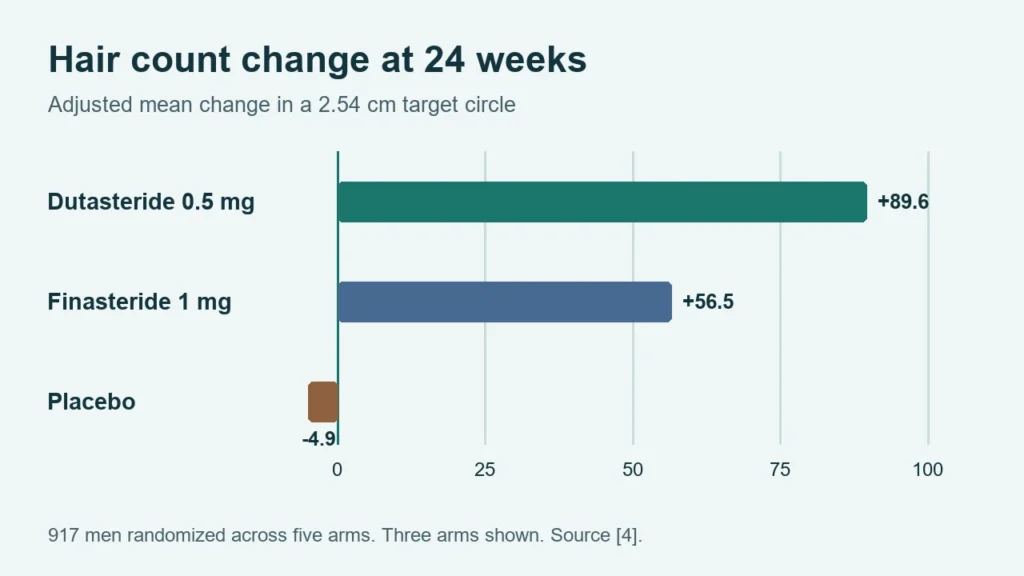
At week 24, adjusted mean change in a 2.54 cm target circle was +89.6 hairs with oral dutasteride, +56.5 with oral finasteride, and −4.9 with placebo. These are target-area averages, not entire-scalp results. The smaller 12-month trial enrolled 17 identical twin pairs and assigned one twin from each pair to dutasteride and the other to placebo. A 2020 systematic review also reported increased mean hair counts with oral treatment over about 24 weeks. Baseline and follow-up photos can make gradual changes easier to assess. [4–6]
Should you consider oral or topical dutasteride?
Oral dutasteride has the stronger clinical evidence for male pattern hair loss and affects DHT throughout the body. Topical studies suggest a benefit for some formulations, but there is limited direct evidence comparing topical with oral dutasteride. Product concentration, vehicle, scalp tolerability, and fertility plans all matter when weighing the choice.
| Form or approach | Evidence and U.S. status | Practical trade-off |
|---|---|---|
| Oral capsule | FDA-approved for BPH. Hair-loss prescribing is off-label. | Whole-body exposure and a long half-life. Hair-loss evidence includes several randomized trials. |
| Topical solution | No FDA-approved topical dutasteride product. One 24-week phase II trial found improved hair counts with a specific study formulation. | Systemic exposure may be lower with some formulas. Comparative safety and equivalence across products are unproven. |
| Combination treatment | A 15-patient pilot used a topical lotion containing dutasteride, finasteride, and minoxidil. Some changes were visible around 90 days. | Other treatments varied and there was no randomized control group. The pilot cannot isolate the contribution of dutasteride or establish that using both DHT blockers helps. |
A small study also examined topical dutasteride with microneedling. That design cannot show how much the topical solution would help on its own. Discuss better-established options and actual cash-pay costs for the consultation, formulation, and follow-up. Costs depend on the product and pharmacy. [7–9]
What side effects, fertility risks, and precautions matter?
Dutasteride can lower libido, make erections or ejaculation more difficult, and cause breast tenderness or enlargement. It can also affect semen measures and lower PSA, which matters for prostate screening. Tell your physician if you plan to conceive. Seek emergency care for trouble breathing, throat swelling, or a severe skin reaction.
- Fertility. In the prescribing-information study, average sperm count, semen volume, and motility decreased after 52 weeks. Recovery varied. Mean total sperm count remained below baseline at the 24-week follow-up, and two large individual decreases had only partly recovered. The effect on an individual’s fertility remains uncertain. [3,10]
- PSA and breast symptoms. Oral dutasteride lowers PSA by about half over three to six months in trials. Give your clinician a medication history and report a new breast lump, pain, or nipple discharge. The label warns about more high-grade prostate cancers in a prevention trial. Dutasteride is not approved for cancer prevention. [3]
- Serious reactions and handling. Face or throat swelling, difficulty breathing or swallowing, and severe peeling skin can signal a serious reaction. People who are pregnant or could become pregnant should avoid handling leaking capsules. Ask your pharmacist about avoiding exposure from any compounded topical product. [3,11]
Common questions about PEPLIX HEALTH
Independent, board-certified physicians evaluate the pattern of hair loss, your medical history, and your treatment preferences. Monarch Brands LLC manages Peplix Health’s administrative services. Ask how the physician will assess results, what follow-up costs include, and whether a licensed pharmacy can dispense an appropriate product in your state.
Who decides which dose or formulation I use?
Your physician selects the formulation and dose based on the diagnosis, benefit and risk, and your medical history. Bring a medication list, fertility goals, and any recent PSA results.
Where would a compounded prescription be filled?
When a compounded product addresses a patient-specific need and meets applicable laws, a state-licensed pharmacy operating under Section 503A can fill the prescription. Compounded drugs do not have FDA approval. Ask which pharmacy would dispense your medication and what standard options are available. [12]
This article is educational. Discuss diagnosis and treatment with a licensed healthcare professional.
For consultation information, see our vitamins and wellness guide or start an online assessment.
Sources
- Endotext — male pattern hair loss
- Rabasseda — dual 5-alpha reductase inhibition
- DailyMed — Avodart prescribing information
- Gubelin Harcha et al. — 24-week trial
- Stough — 12-month identical twin study
- Herz-Ruelas et al. — oral and intralesional systematic review
- Phase II trial — topical dutasteride
- Nada et al. — topical dutasteride with microneedling
- Rafi and Katz — topical combination pilot
- Amory et al. — semen parameters
- MedlinePlus — dutasteride adverse effects
- FDA — compounding and FDA approval
This article is for general education and is not medical advice. Talk with a licensed clinician before starting, stopping or changing any treatment. Compounded medications are not FDA-approved. See our safety information.
Keep reading

Wellness
Krill Oil vs Fish Oil for Omega-3s
Compare krill oil and fish oil for EPA and DHA, absorption, triglycerides, and side effects. Learn what to check on an omega-3 label.

Wellness
Sprinting Benefits and How to Start Sprint Interval Training
Learn how sprint intervals affect fitness and fat oxidation, how to start with controlled efforts, and how to fit sprinting into your week.

Wellness
CoQ10 Benefits, Dosage, and Safety
What does CoQ10 do? Explore the evidence for heart failure, fatigue, and statin symptoms, plus dosage, supplement forms, and interactions.