CoQ10 Benefits, Dosage, and Safety
What does CoQ10 do? Explore the evidence for heart failure, fatigue, and statin symptoms, plus dosage, supplement forms, and interactions.

Coenzyme Q10 helps mitochondria make adenosine triphosphate (ATP) and contributes to antioxidant defense. Supplements have shown some benefit alongside standard heart failure treatment, while results for fatigue, exercise performance, and statin muscle symptoms vary. If you take warfarin, insulin, or several heart medications, have a clinician or pharmacist review your medication list before adding CoQ10.
What does CoQ10 do in your cells?
Your body makes CoQ10, a fat-soluble compound that transfers electrons in the inner mitochondrial membrane. That transfer helps build the gradient cells use to make ATP. CoQ10 cycles between ubiquinone and ubiquinol, and the reduced form helps protect membrane lipids from oxidation. This mechanism alone cannot predict a benefit from taking more.
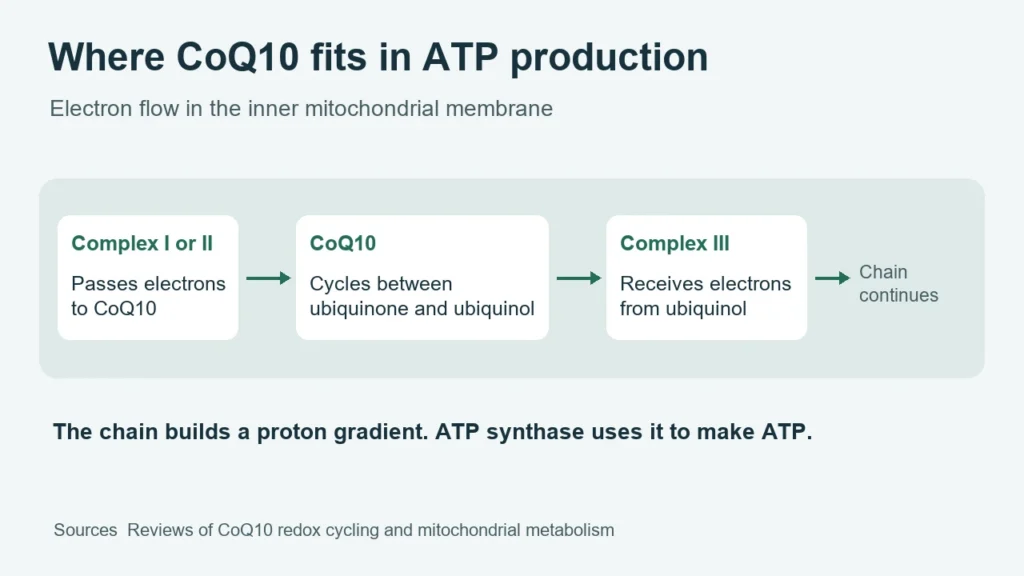
CoQ10 is present throughout the body, including in the heart, liver, kidneys, skeletal muscle, and brain. The heart beats roughly 100,000 times daily, with variation by heart rate. The adult brain accounts for about 2% of body mass and roughly 20% of resting oxygen consumption. These tissues depend on a steady ATP supply. [1–4, 17]
Normal metabolism generates reactive oxygen species that can help cells signal. In excess, they can damage lipids, proteins, and DNA. Ubiquinol helps limit lipid oxidation in membranes. Caffeine acts through a different pathway by blocking adenosine receptors and temporarily increasing alertness. CoQ10 has no established immediate stimulant effect. [2, 4, 5]
How strong is the evidence for CoQ10 in heart failure?
In Q-SYMBIO, 15% of adults who received CoQ10 alongside standard heart failure care experienced a major cardiovascular event over about two years, compared with 26% on placebo plus standard care. The trial found no significant early improvement on its short-term measures. A cardiology team can assess whether an add-on is appropriate.
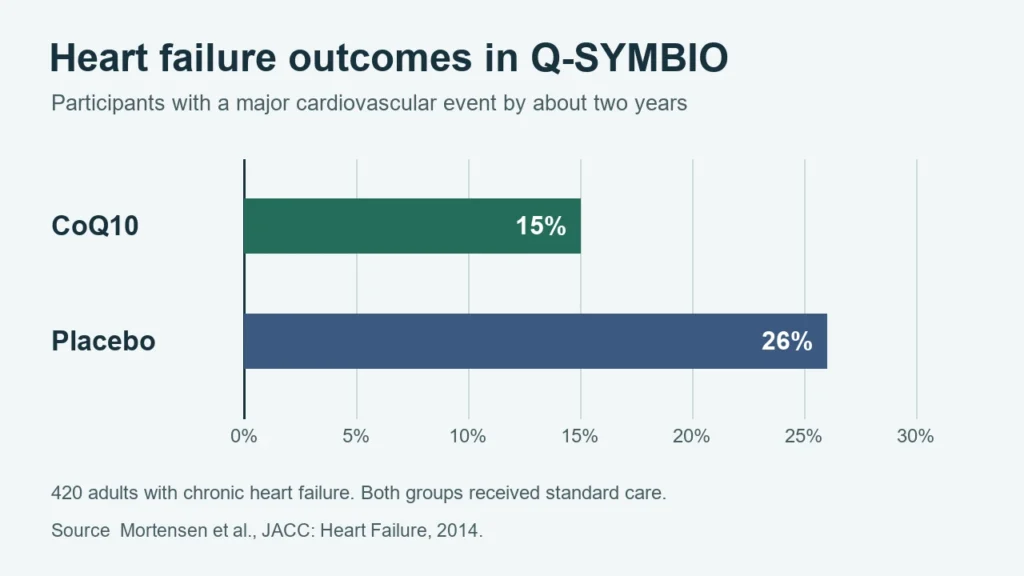
The trial randomized 420 adults with moderate to severe chronic heart failure. The CoQ10 group took 100 mg three times a day. At 16 weeks, there were no significant between-group differences on the measures of functional class, six-minute walking distance, or NT-proBNP, a marker of cardiac stress. The two-year composite included events such as hospitalization for worsening heart failure and cardiovascular death. [6]
A Cochrane review found that CoQ10 probably reduces heart failure hospitalization, with uncertainty about exercise capacity. The mortality estimate depended on one trial. These studies evaluated CoQ10 in diagnosed heart failure, usually as an add-on. Evidence does not establish that it prevents cardiovascular disease in healthy adults or that family history alone is a reason to take it. [1, 6, 7]
Can CoQ10 help with fatigue, workouts, or statin muscle aches?
Some randomized trials report lower fatigue scores with CoQ10, but study populations and results differ. Statins can lower circulating CoQ10 without establishing why a particular person has muscle pain. The 2026 U.S. cholesterol guideline advises against routine CoQ10 use to prevent or treat statin-attributed muscle symptoms. Have new symptoms reviewed before changing medication.
- Persistent fatigue. A 13-trial review found lower fatigue scores on average. That result does not establish a two-to-four-week response window or a reliable athletic or recovery benefit. Plasma CoQ10 is not a routine fatigue test, and symptoms alone do not identify low CoQ10. [1, 8, 9]
- Age, training, and calorie restriction. CoQ10 may decline with age in some tissues. A fixed production peak in your twenties, a universal drop in midlife, and depletion from hard training or eating less are not well established. If energy drops during a GLP-1 or hormone program, review food intake, sleep, training load, and other possible causes with your clinician. [8, 9, 14]
- Statin symptoms. Statins inhibit HMG-CoA reductase in the pathway that produces cholesterol and contributes to CoQ10 synthesis. If you notice pain, cramps, or weakness, tell your prescriber. Ask about timing, other potential causes, and alternatives before changing your statin. There is no dependable four-to-six-week benefit from CoQ10. [1, 10, 11]
Which CoQ10 form, dose, and timing should you discuss?
Many adult studies use 100–300 mg per day, but there is no universal dose for energy or wellness. Ubiquinone and ubiquinol are two forms of the same compound, and the product formulation also affects absorption. If your clinician recommends a supplement, discuss taking it with a meal and agree on what to monitor.
| Option | How it works | What to consider |
|---|---|---|
| Ubiquinone | Oxidized form. Accepts electrons in the respiratory chain. | Used in clinical studies. Carrier oil and how the product dissolves influence absorption. [2, 12] |
| Ubiquinol | Reduced form. Donates electrons and acts as an antioxidant. | Some formulations show higher blood levels in absorption studies. An absorption difference alone cannot establish better clinical outcomes. [2, 12] |
| With a meal or divided doses | CoQ10 is fat-soluble. A meal with some fat can help absorption. | Choose a schedule you can follow. Ask about splitting a higher daily dose if stomach upset occurs. No best time of day has been established. [9, 12, 13] |
Reported effects include nausea, stomach discomfort, and insomnia. Some trial-based safety assessments include doses up to 1,200 mg per day. That figure is a research observation. A clinician can advise what dose, if any, fits your goal, medical history, and other treatments. [1, 9, 13]
CoQ10 may make warfarin less effective and may interact with insulin or some cancer treatments. Consult your clinician before use if pregnant, breastfeeding, or taking a complex cardiac regimen. Review all sources of CoQ10, including combination products, when calculating your total daily intake. [1, 9, 13]
Common questions about PEPLIX HEALTH
Peplix Health is a cash-pay telehealth service managed by Monarch Brands LLC. Independent, board-certified physicians review symptoms, medications, supplements, and relevant labs. If a treatment is appropriate, the clinician individualizes dosing and follow-up. An eligible compounded prescription can be filled by a state-licensed pharmacy under applicable Section 503A and state requirements.
What should I bring to a Peplix Health visit for low energy?
Bring a medication and supplement list, recent labs, and a short timeline of symptoms. A clinician may consider sleep, thyroid function, iron status, and food intake. Magnesium supports ATP-dependent reactions, B vitamins support energy metabolism, and vitamins D and K have roles in bone health. Evidence does not establish that a CoQ10 blend improves results from testosterone or GLP-1 therapy. [8, 9, 14]
Can CoQ10 improve male fertility or testosterone?
Some studies in men with subfertility report improved sperm motility or concentration. Researchers have proposed antioxidant and cellular energy effects in sperm. Evidence has yet to establish higher pregnancy or live-birth rates or support CoQ10 as a testosterone treatment. Discuss your goals with a fertility specialist. [15, 16]
Can I take CoQ10 with coffee or pre-workout?
CoQ10 has no established immediate alertness effect. Caffeine can temporarily improve alertness through adenosine receptor blockade. If you use a pre-workout product, check its caffeine and other ingredients with your clinician, especially if you are taking cardiovascular medications. [1, 5]
Do I need a prescription or a compounding pharmacy for CoQ10?
CoQ10 is widely sold as a dietary supplement. If a clinician identifies a patient-specific need for a compounded prescription drug, eligible fulfillment through a state-licensed pharmacy follows applicable ingredient, quality, and prescription requirements. Compounded drugs do not undergo FDA premarket approval. [1, 18, 19]
For consultation information, see our vitamins and wellness guide or start an online assessment.
Sources
- NCCIH. Coenzyme Q10 clinical evidence and safety.
- Review of the ubiquinone–ubiquinol redox cycle.
- Shulman et al. Energetic basis of brain activity.
- Review of CoQ10 targets in mitochondria.
- Ribeiro and Sebastião. Caffeine and adenosine.
- Mortensen et al. Q-SYMBIO randomized heart failure trial.
- Cochrane. Coenzyme Q10 for heart failure.
- Tsai et al. Systematic review of CoQ10 and fatigue.
- StatPearls. Coenzyme Q10 clinical reference.
- Banach et al. Statins and circulating CoQ10.
- ACC/AHA and partner societies. 2026 dyslipidemia guideline.
- López-Lluch et al. CoQ10 formulation and bioavailability.
- Mayo Clinic. CoQ10 safety, side effects, and interactions.
- Joint advisory. Nutritional priorities during GLP-1 therapy.
- Lafuente et al. CoQ10 for male infertility meta-analysis.
- AUA and ASRM. Male infertility guideline, amended 2024.
- American Heart Association. Heart rate across a day.
- FDA. Compounding questions and answers.
- FDA. Section 503A requirements for prescription compounding.
This article is for general education and is not medical advice. Talk with a licensed clinician before starting, stopping or changing any treatment. Compounded medications are not FDA-approved. See our safety information.
Keep reading
Wellness
Krill Oil vs Fish Oil for Omega-3s
Compare krill oil and fish oil for EPA and DHA, absorption, triglycerides, and side effects. Learn what to check on an omega-3 label.

Wellness
Sprinting Benefits and How to Start Sprint Interval Training
Learn how sprint intervals affect fitness and fat oxidation, how to start with controlled efforts, and how to fit sprinting into your week.

Wellness
How to Build a Four-Minute Habit for Better Follow-Through
Use a four-minute check-in to review progress, adjust your next action, and build a repeatable habit. Includes prompts and a sample schedule.