MCT Oil vs. Seed Oils in Injectable Testosterone
Compare MCT, sesame, and cottonseed oil in injectable testosterone. Learn what carriers do and what to ask about irritation or allergies.

Testosterone cypionate, enanthate, and undecanoate can be formulated in oils that dissolve the ester and help it release gradually. Some MCT oils are less viscous than conventional vegetable oils, but evidence has not established that MCT-based testosterone absorbs faster or causes fewer reactions. Check the specific product and ingredients with your prescriber.
Why do some testosterone injections contain a carrier oil?
Common injectable testosterone esters dissolve poorly in water. A suitable pharmaceutical oil keeps the ester in solution and forms a small depot after injection. The ester gradually leaves that depot and is converted to testosterone. The ester, concentration, injection volume, and route all help determine how the finished drug behaves.
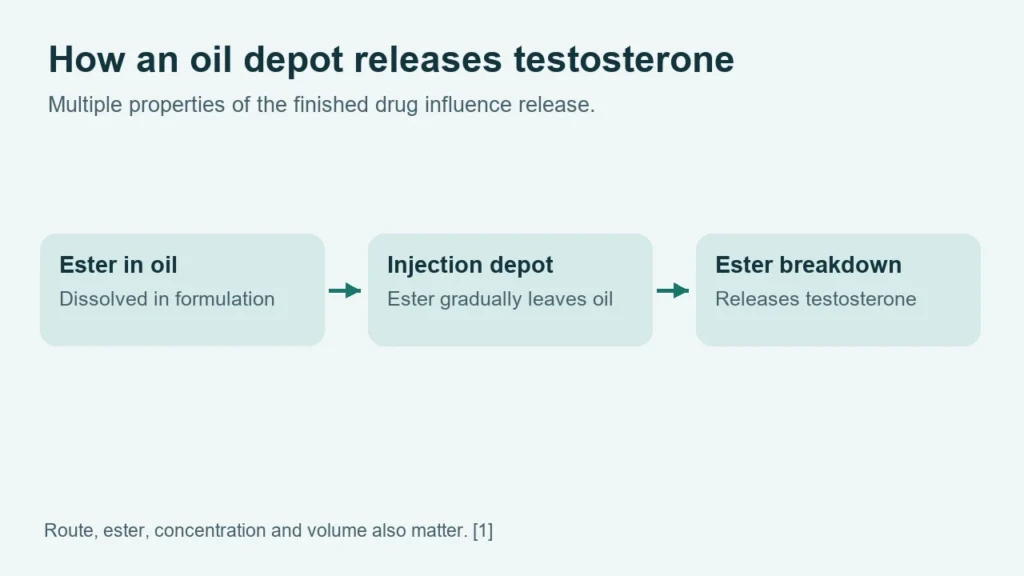
A carrier can affect viscosity, flow, and formulation stability. Excipients such as benzyl alcohol or benzyl benzoate can also change how a product feels or is tolerated. Injection-site pain, irritation, and allergy can have multiple causes. Review reactions and product ingredients with a licensed clinician or pharmacist. [1–4]
Which carrier oils do approved testosterone injections use?
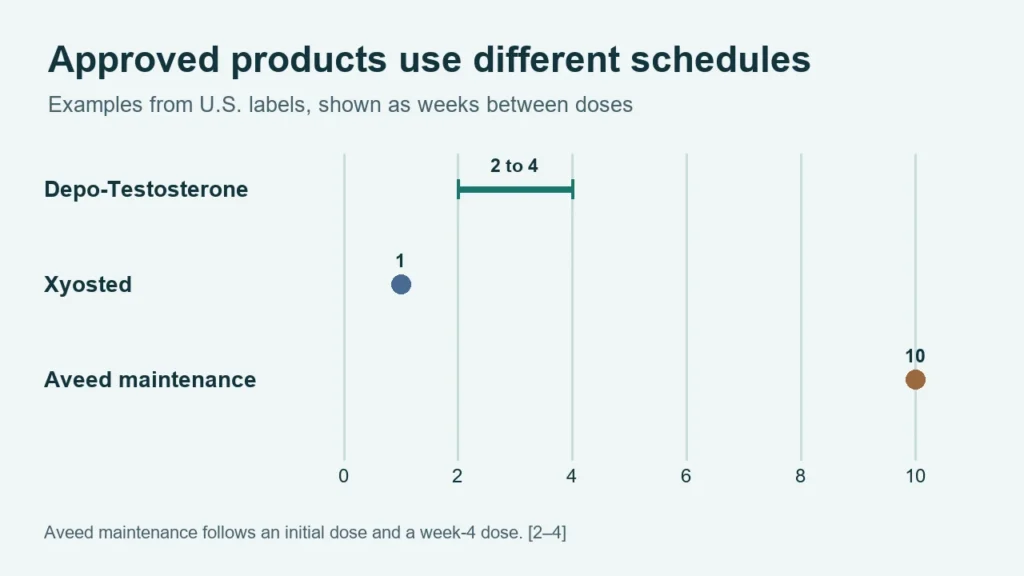
The answer depends on the exact product. U.S. examples include cottonseed oil in Depo-Testosterone cypionate, sesame oil in Xyosted enanthate, and castor oil in Aveed undecanoate. Their routes and schedules differ. A longer dosing interval reflects the full formulation and ester, so it cannot tell you which oil is better.
| Example product | Carrier and approved route | What the label illustrates |
|---|---|---|
| Depo-Testosterone, cypionate | Cottonseed oil, intramuscular | Its IM half-life is about eight days. The label describes a two- to four-week interval for replacement dosing. |
| Xyosted, enanthate | Sesame oil, subcutaneous | Labeled for weekly administration with its autoinjector. |
| Aveed, undecanoate | Castor oil, intramuscular | Labeled at initiation, four weeks later, then every ten weeks. Requires observation for 30 minutes after each injection because of serious reaction risks. |
Other commercial or compounded formulations can differ. Some compounded examples use MCT or other oils, such as olive, grapeseed, or safflower, depending on the prescriber and pharmacy. Check the package label or ask the dispensing pharmacist for the product’s actual inactive ingredients. [1–5]
Is MCT oil better tolerated than sesame or cottonseed oil?
MCT oil can be less viscous than some longer-chain oils, and its saturated composition makes it less prone to oxidation under some conditions. Those properties may matter to a formulator. Clinical evidence comparing injected testosterone products has not established that MCT consistently reduces pain, inflammation, or irritation, or delivers testosterone faster.
- Composition. Pharmaceutical medium-chain triglycerides are commonly rich in caprylic and capric fatty acids and can be made from fractionated coconut or palm kernel oil. The source oils can come from kernels. The useful distinction is fatty-acid composition. Sesame, cottonseed, grapeseed, safflower, and sunflower oils usually contain more long-chain fatty acids. [5,6]
- Viscosity and stability. Some longer-chain oils are more viscous. Oils with more polyunsaturated fatty acids may oxidize more readily, depending on formulation and storage. That chemical property does not establish that omega-6 in an approved injection causes inflammation. The finished product, packaging, expiration date, and storage instructions matter. [1,5,6]
- Absorption and comfort. Dietary MCTs can be metabolized quickly. That observation does not describe an injectable testosterone depot. Formulations differ in needle resistance, but pain and tolerability are individual and can also depend on site, route, excipients, and volume. Never use a culinary oil in an injection. [1–6]
When should you ask about switching carriers?
If you have a known ingredient allergy, recurring injection-site irritation, or a problem using your current device, ask your prescriber to review the full formula. Bring the product name, dose, and a description of the reaction. Changing products may also change the concentration, route, dosing interval, or follow-up labs.
Discuss whether another FDA-approved product meets your needs and whether an individual formulation change is medically appropriate. A prescriber can coordinate with the pharmacist and review testosterone response and tolerability after any change. Seek urgent care for trouble breathing, swelling of the face or throat, or other signs of a severe reaction. [2–4]
Common questions about PEPLIX HEALTH
At Peplix Health, independent licensed clinicians make decisions about testing, treatment, and follow-up. Monarch Brands LLC manages the practice’s administrative services. If a physician determines that a compounded medicine is appropriate for an individual patient, a state-licensed pharmacy operating under Section 503A may fill the prescription when applicable requirements are met.
Can I ask about the oil in my testosterone prescription?
Yes. Ask your prescribing physician and dispensing pharmacist to verify the carrier and other ingredients. A clinician needs to review your treatment history before changing the product or dose.
How do I know who prescribes and fills a medication?
Ask the independent, board-certified physician performing your evaluation about expected benefits, individualized dosing, and follow-up. Ask who will fill the prescription and whether an FDA-approved option is suitable. Compounded drugs do not undergo FDA premarket review for safety, effectiveness, or quality.
This article is for education. Discuss medical decisions with a licensed clinician.
For consultation information, see our low testosterone guide or start an online assessment.
Sources
- JCEM — pharmacology of testosterone ester formulations
- Pfizer — Depo-Testosterone prescribing information
- DailyMed — Xyosted prescribing information
- DailyMed — Aveed prescribing information
- Review — medium-chain triglyceride sources and metabolism
- Review — lipid oxidation and formulation stability
- FDA — compounding and FDA approval
This article is for general education and is not medical advice. Talk with a licensed clinician before starting, stopping or changing any treatment. Compounded medications are not FDA-approved. See our safety information.
Keep reading

Testosterone
What Is Enclomiphene and How Does It Compare With TRT?
Compare enclomiphene, TRT, and Clomid for low testosterone. Learn what trials found about sperm counts, side effects, and FDA approval.

Testosterone
Does Enclomiphene Build Muscle?
Does enclomiphene build muscle? Review the evidence on testosterone, lean mass, fertility, and what to discuss before treatment.

Testosterone
Does Vitamin D Raise Testosterone?
Does vitamin D raise testosterone? Review results from clinical trials, food sources, safe intake, and when to ask about testing.