Does Vitamin D Raise Testosterone?
Does vitamin D raise testosterone? Review results from clinical trials, food sources, safe intake, and when to ask about testing.

Vitamin D supports bones, muscles, and immune function. Some studies link low vitamin D with lower testosterone or poorer semen measures, but supplementation trials have produced mixed results. Correcting a deficiency is worthwhile for its established health benefits. Persistent symptoms of low testosterone call for a separate evaluation and appropriately timed blood tests.
What do vitamin D studies actually show about testosterone?
One small trial in overweight men found a rise in testosterone after vitamin D supplementation during a weight-loss program. A later 12-week placebo-controlled trial found no benefit. Reviews have reached different conclusions about small changes in total testosterone and have not established a reliable rise in free testosterone or improvement in symptoms.
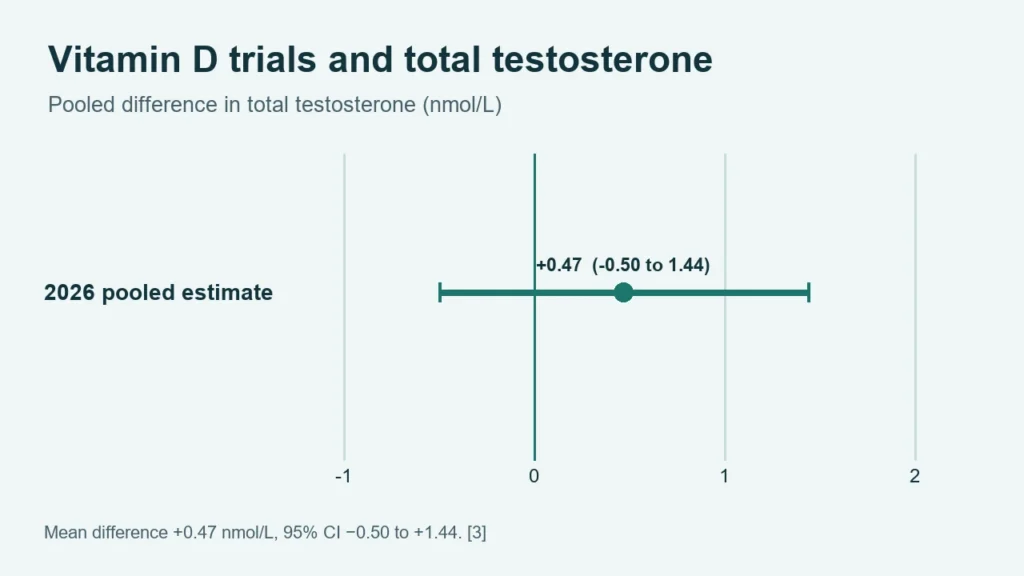
The early trial reported a change from about 10.7 to 13.4 nmol/L within the vitamin D group. Those men were part of a weight-loss trial and had low vitamin D at baseline. A 2023 review of eight studies found inconsistent results. Across trials, baseline status, age, BMI, length of follow-up, and study methods differed. The influence of genetics remains unclear. [1–4]
Observational research has associated higher vitamin D levels with better sperm count, concentration, or other semen measures in some populations. That association does not establish that supplements improve fertility or testosterone in healthy men. [4,5]
How could vitamin D affect male reproductive health?
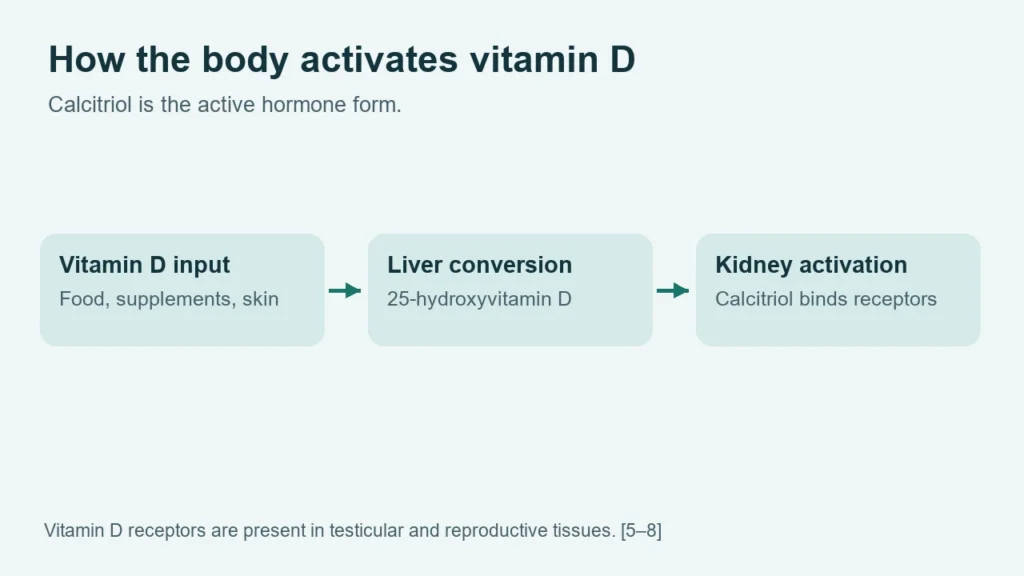
The body converts vitamin D into an active hormone called calcitriol. Receptors for it are present in the testes, epididymis, prostate, and sperm. Lab studies suggest vitamin D can influence testosterone production in the testes, but the size and clinical importance of that effect after taking a supplement remain uncertain.
- Leydig cells. These cells produce testosterone. Exposing testicular tissue to vitamin D in the lab increased testosterone release in one study. Human supplement trials measure a different question. [6]
- SHBG and free testosterone. SHBG binds circulating testosterone. Some observational studies link higher vitamin D with lower SHBG, which could affect the unbound fraction. Controlled evidence is mixed. [3,4]
- Wider hormone signaling. Research has explored vitamin D and the adrenal system, including the hypothalamic-pituitary-adrenal axis that helps regulate cortisol. This remains an area of research. Established roles include calcium regulation, bone health, and muscle and immune function. Evidence does not support taking high doses for heart or cognitive protection. [7,8]
How does vitamin D compare with supplements sold for testosterone?
Vitamin D and zinc help meet essential nutrient needs. Correcting a deficiency can address a specific health problem. Evidence for raising testosterone with D-aspartic acid, ashwagandha, or Tribulus is limited or inconsistent. If you’re feeling tired or have low libido, evaluation can help identify the cause before you spend money on supplements.
| Supplement | What the evidence shows | Practical meaning |
|---|---|---|
| Vitamin D | Trials show mixed testosterone results. Benefits for calcium and bone metabolism are established. | Discuss testing or replacement if deficiency is suspected. |
| Zinc | Essential to normal hormone and reproductive function. Deficiency can affect testosterone. | Evidence does not support supplementing to block aromatase or raise testosterone routinely. |
| D-aspartic acid | An early study reported a 42% testosterone rise in untrained men. Trials in resistance-trained men found no sustained benefit and some results showed decreases. | Early short-term results do not predict effects in regular lifters. |
| Ashwagandha | Small trials suggest possible stress, cortisol, anxiety, or sleep benefits. Testosterone findings are limited and inconsistent. | Ask about interactions and risks if considering it. |
| Tribulus terrestris | Studies in healthy men and athletes generally show no consistent testosterone, performance, or body composition benefit. | Marketing claims exceed the clinical evidence. |
Supplement evidence varies substantially by population and product. Adequate vitamin D supports muscle health, including in athletes, while extra supplementation is not a reliable path to better performance. [8–11]
How can you get enough vitamin D safely?
Food sources include salmon, mackerel, sardines, egg yolks, and fortified milk or juice. Skin can make vitamin D from UVB exposure, and production varies with season, latitude, and skin pigmentation. Supplements can help when intake or levels are low. Ask a clinician about testing or higher doses if you have risk factors.
- Use food first where practical. Include fatty fish and fortified foods you already like. Beef liver contains some vitamin D. Magnesium helps enzymes involved in vitamin D metabolism and is available in spinach, nuts, seeds, bananas, and avocado. [8]
- Know the intake benchmarks. The recommended daily intake is 600 IU for adults ages 19–70 and 800 IU for those older than 70. The adult upper limit is 4,000 IU a day from all sources unless a clinician supervises a specific treatment plan. Vitamin D3 often raises blood levels more than vitamin D2, although both can work. Vitamin K2 is not required to absorb vitamin D. [8]
- Avoid fixed sun and high-dose rules. Use sun protection. A set number of minutes outside cannot account for UV intensity and skin sensitivity. Clinicians consider vitamin D testing based on symptoms and risk factors. Persistent sexual symptoms or low energy merit their own assessment. [8,12]
Common questions about PEPLIX HEALTH
At Peplix Health, independent licensed clinicians make decisions about testing, treatment, and follow-up. Monarch Brands LLC manages the practice’s administrative services. If a physician determines that a compounded medicine is appropriate for an individual patient, a state-licensed pharmacy operating under Section 503A may fill the prescription when applicable requirements are met.
Can my physician review both vitamin D and testosterone?
Tell your evaluating physician about your symptoms and current supplements. They can decide whether there is a reason to order either test and explain the results in context.
How do I know who prescribes and fills a medication?
Ask the independent, board-certified physician performing your evaluation about expected benefits, individualized dosing, and follow-up. Ask who will fill the prescription and whether an FDA-approved option is suitable. Compounded drugs do not undergo FDA premarket review for safety, effectiveness, or quality.
This article is for education. Discuss medical decisions with a licensed clinician.
For consultation information, see our low testosterone guide or start an online assessment.
Sources
- Pilz et al. — vitamin D supplementation and testosterone
- Lerchbaum et al. — 12-week placebo-controlled trial
- Systematic review and meta-analysis — vitamin D and testosterone
- Literature review — vitamin D and male testosterone
- Vitamin D and male reproductive function review
- Human testicular tissue study
- Review — vitamin D and adrenal function
- NIH Office of Dietary Supplements — vitamin D
- Melville et al. — D-aspartic acid in resistance-trained men
- NIH Office of Dietary Supplements — ashwagandha
- Systematic review — botanicals and testosterone
- Endocrine Society — testosterone evaluation and treatment
- FDA — compounding and FDA approval
This article is for general education and is not medical advice. Talk with a licensed clinician before starting, stopping or changing any treatment. Compounded medications are not FDA-approved. See our safety information.
Keep reading

Testosterone
What Is Enclomiphene and How Does It Compare With TRT?
Compare enclomiphene, TRT, and Clomid for low testosterone. Learn what trials found about sperm counts, side effects, and FDA approval.

Testosterone
Does Enclomiphene Build Muscle?
Does enclomiphene build muscle? Review the evidence on testosterone, lean mass, fertility, and what to discuss before treatment.

Testosterone
MCT Oil vs. Seed Oils in Injectable Testosterone
Compare MCT, sesame, and cottonseed oil in injectable testosterone. Learn what carriers do and what to ask about irritation or allergies.