How to Build a Four-Minute Habit for Better Follow-Through
Use a four-minute check-in to review progress, adjust your next action, and build a repeatable habit. Includes prompts and a sample schedule.

Spend two minutes writing what happened and why. Use the next two minutes to decide what to keep, change, or try before your next check-in. This four-minute habit pairs goal tracking with a specific next action. Start with one check-in anchored to a moment you already have in your day.
What do you write in a four-minute check-in?
Pick a behavior you can attempt in the next few hours. Afterward, record what you did and the most likely reason it went that way. Set a realistic next action and choose a cue for the next check-in. The objective is a written adjustment you can test during your actual day.
- Minute 1. What did I do? Compare the action you planned with what you completed. At the first check-in of the day, you can start by reading yesterday’s summary.
- Minute 2. What made it easier or harder? Name one cause you can change, such as an overrun meeting, a missing reminder, or equipment you had ready.
- Minute 3. What will I keep or change? Build on the strategy that worked, or choose one small alternative to test.
- Minute 4. What will I do next? Write one specific, measurable, achievable, relevant, and time-bound action, then schedule the next check-in.
For example, if an afternoon meeting displaced your planned walk, move it to your first ten minutes after lunch tomorrow. An if-then plan can help. If the meeting runs long, take the walk when you close your laptop. The format adapts Cam Sepah’s Keystone Habit framework. [1]
Why combine a progress review with a cue and reward?
A progress review shows whether the plan fit the day. A repeatable cue makes starting easier, and a benefit you experience soon after can encourage another repetition. Research supports monitoring progress and repeating behaviors in a stable context. The four-minute format is one way to apply those principles during a busy week.
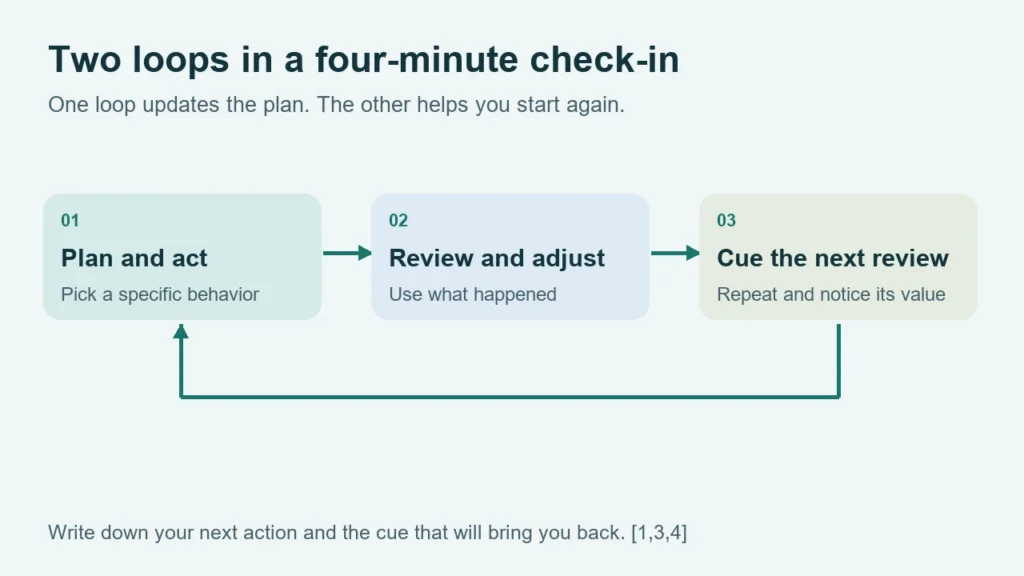
The goal loop is plan, act, review, and adjust. The habit loop is cue, repeat the action, and notice what makes it worth repeating. After finishing lunch, you might open a notebook, record the morning, and appreciate having one concrete next task. Rewards can also be part of the action, such as enjoying time outside or seeing a friend during an exercise session. [1,3,4]
One older study followed 200 New Year’s resolution makers. It reported that 77% kept their resolutions at one week and 19% at two years. That percentage describes the cohort. A later meta-analysis of 138 experiments involving 19,951 participants found that monitoring progress helped people reach goals on average, especially when participants recorded outcomes. The research did not test Sepah’s full timetable. [2,3]
What would the four-hour schedule look like?
In the full example, three four-minute reviews happen about four hours apart. An evening summary takes fifteen minutes, for twenty-seven minutes total on a standard day. At the end of the workweek, substitute an hour-long weekly review for that day’s evening summary. You can begin with a single daily review or move the times to fit your work.
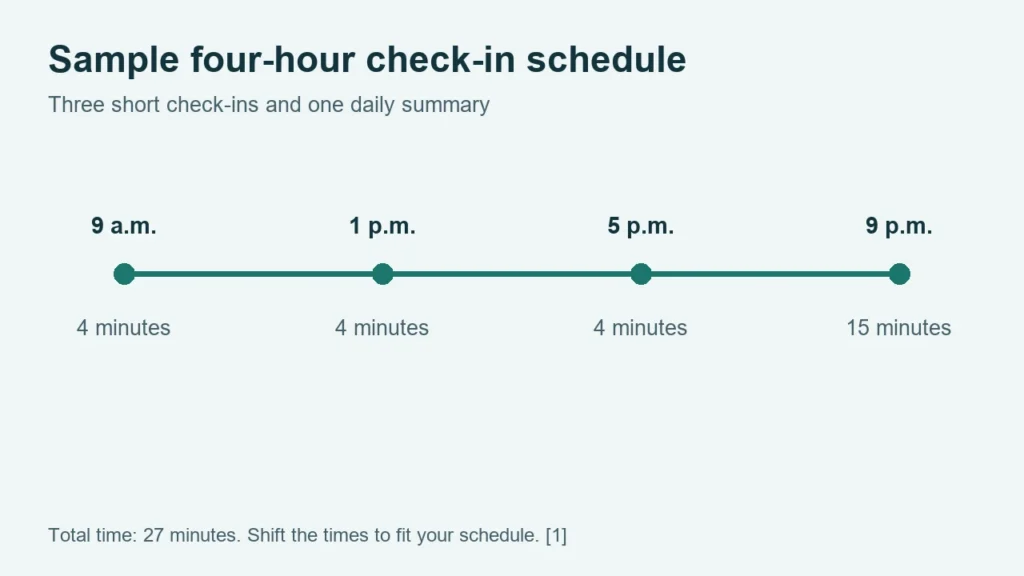
| Review | Example schedule | What to do |
|---|---|---|
| Quick check-in | 9 a.m., 1 p.m., and 5 p.m. | Spend two minutes looking back and two planning the next block. |
| Daily summary | 9 p.m., 15 minutes | Spend five minutes on the latest block and reading the day’s notes, five recording lessons, and five planning tomorrow. |
| Weekly summary | 60 minutes on your last workday | Read the daily summaries and choose what to carry forward or adjust. Replace that day’s 15-minute review. |
| Longer summaries | Monthly, quarterly or by trimester, annually, and optionally every four years | Use prior summaries and revisit longer plans. Break extended reviews into shorter sessions. |
The full five-day schedule includes 20 check-ins. The 15 short reviews take 60 minutes. Four daily summaries and one weekly summary take 120 minutes. Total time is three hours, averaging nine minutes per entry. The intervals are a scheduling convention. Choose your last workday and natural breaks. [1]
How could you run a four-day annual review?
Review the closing quarter and reread your quarterly notes on day one. Ask a friend, relative, or colleague for specific observations on day two. Draft lessons and next year’s priorities on day three. Refine your plan on day four. Spread the work across short sessions. If you already have a longer goal, such as completing a degree, work backward from annual and quarterly milestones to the reading or assignment you can act on today. [1]
How do you restart if you miss a check-in?
Resume at the next practical cue and use the next entry to notice what made you miss the last one. Choose a better reminder or a smaller action if your day keeps crowding it out. In one habit study, missing a single opportunity did not materially alter the formation process.
Use a notebook and reminder, or a task app with scheduled due times. In every entry, make the next review part of the plan. If you have been away for days, start with what you want to accomplish in the next four hours. You can add longer goals later. This can support routines for sleep, nutrition, exercise, mood management, and social connection. [1,4]
Common questions about PEPLIX HEALTH
Use the check-in to record patterns you want to discuss with an independent licensed clinician. Monarch Brands LLC manages Peplix Health’s administrative services. Medical decisions, including testing, prescriptions, and follow-up, remain with the evaluating physician. A journal can help you bring specific examples to a visit and track an agreed plan.
Is the four-minute habit a clinical treatment?
It is an educational planning and reflection exercise. For persistent symptoms or an established health condition, a board-certified clinician can assess what care and follow-up may be appropriate.
Can a journal help me prepare for a visit?
Bring a few examples that capture when your concern occurs and what you have tried. If a physician prescribes medication, the formulation and dose are individualized. A compounded prescription, when clinically and legally appropriate, can be filled by a state-licensed pharmacy operating under Section 503A. Compounded medications do not have FDA approval. [5]
This article is for education. Discuss diagnosis or treatment decisions with a licensed healthcare professional.
For consultation information, see our vitamins and wellness guide or start an online assessment.
This article is for general education and is not medical advice. Talk with a licensed clinician before starting, stopping or changing any treatment. Compounded medications are not FDA-approved. See our safety information.
Keep reading

Wellness
Krill Oil vs Fish Oil for Omega-3s
Compare krill oil and fish oil for EPA and DHA, absorption, triglycerides, and side effects. Learn what to check on an omega-3 label.

Wellness
Sprinting Benefits and How to Start Sprint Interval Training
Learn how sprint intervals affect fitness and fat oxidation, how to start with controlled efforts, and how to fit sprinting into your week.

Wellness
CoQ10 Benefits, Dosage, and Safety
What does CoQ10 do? Explore the evidence for heart failure, fatigue, and statin symptoms, plus dosage, supplement forms, and interactions.