How Therapy Can Improve Your Mental Health
Learn how therapy can help with stress, anxiety, grief, and relationships. Compare CBT, ACT, DBT, and REBT and find a licensed therapist.

Psychotherapy can help you manage stress, anxiety, or depression, cope with grief or a major life change, and work on patterns that affect relationships. Start by identifying what you want to change, then look for a licensed therapist with relevant experience. Ask how you will work together and assess progress.
What can you work on in therapy?
A therapist can help you understand patterns in your thoughts, emotions, and behavior. Together, you can practice skills for a specific problem, such as managing worry, coping with a job loss, or communicating during conflict. Therapy can also give you space to process grief and work through changes in daily life.
Progress depends on your needs, the approach, and how treatment fits your life. Goals might include responding differently during an argument, dealing with stress at work, or returning to an activity you value. Regular participation and practicing skills between appointments can support progress. Sleep, exercise, time with people you trust, and a simple gratitude practice can also support well-being. [1,2]
Why might people hesitate to start therapy?
Privacy, cost, uncertainty about what to say, and expectations about handling problems alone can all make the first appointment harder. In a 2019 U.S. survey, women reported receiving counseling or therapy more often than men. You can start with a brief consultation and decide what you feel comfortable sharing.
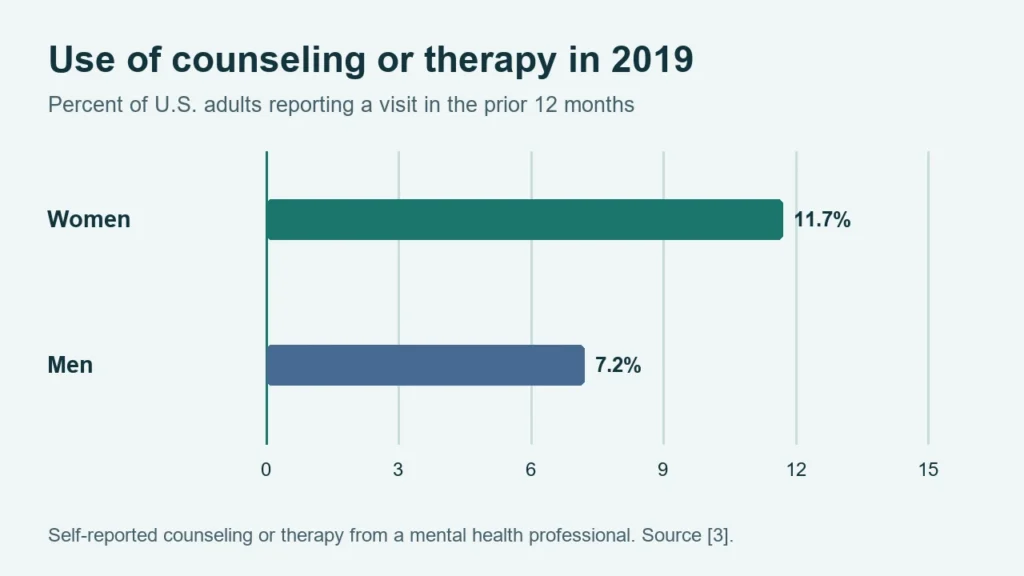
The CDC’s National Center for Health Statistics reported that 11.7% of women and 7.2% of men received counseling or therapy in the prior year. For any mental health treatment, including medication, the figures were 24.7% and 13.4%, respectively. An earlier study found more favorable average attitudes about professional psychological help among women. Surveys describe groups and cannot explain why any individual does or does not seek care. [3,4]
A 2019 Ipsos MORI survey commissioned by Movember polled 4,000 men in Australia, Canada, the United Kingdom, and the United States. In that survey, 58% perceived pressure from society to appear emotionally strong, and 38% overall had avoided talking about feelings for fear of appearing less masculine. The figure was 62% among men who felt substantial pressure to appear masculine. Respondents described pressures from society, peers, and themselves. Still, 77% saw talking as an effective way to handle problems and 76% believed talking openly could benefit mental health. [5]
How do CBT, ACT, DBT, and REBT compare?
Cognitive behavioral therapy is a well-studied approach that addresses unhelpful thinking and behavior patterns. Related approaches emphasize different skills, from accepting difficult emotions to managing intense feelings or testing rigid beliefs. A clinician can recommend a suitable option based on your symptoms, preferences, and goals and explain what sessions typically involve.
| Approach | What you practice | What you can ask the therapist |
|---|---|---|
| Cognitive behavioral therapy (CBT) | Notice how thoughts, feelings, and actions interact. Test unhelpful interpretations and practice new responses. | How would we use CBT for the symptoms or situations I want to address? |
| Acceptance and commitment therapy (ACT) | Make room for uncomfortable thoughts and feelings and act in ways that fit your values. ACT calls this psychological flexibility. | How would we turn my values into actions I can practice during the week? |
| Dialectical behavior therapy (DBT) | Combine acceptance and validation with behavior change. Skills often include regulating emotions, tolerating distress, and communicating effectively. | Do you offer a full DBT program or use selected DBT skills in sessions? |
| Rational emotive behavior therapy (REBT) | Examine rigid or unhelpful beliefs and replace them with more flexible, realistic ones. | How would we identify and challenge a belief that keeps me stuck? |
CBT has extensive research support and is often recommended for conditions such as anxiety and depression. Match the method to the concern with your clinician. ACT, DBT, and REBT share behavioral or cognitive roots, and each has a distinct treatment emphasis. [1,6–9]
How do you find a therapist who fits your needs?
Verify the therapist’s license and ask about experience with your concern, training in the proposed approach, and how progress is reviewed. A first appointment also helps you assess whether communication feels respectful and useful. Confirm scheduling, telehealth availability, fees, and payment terms before you commit to ongoing visits.
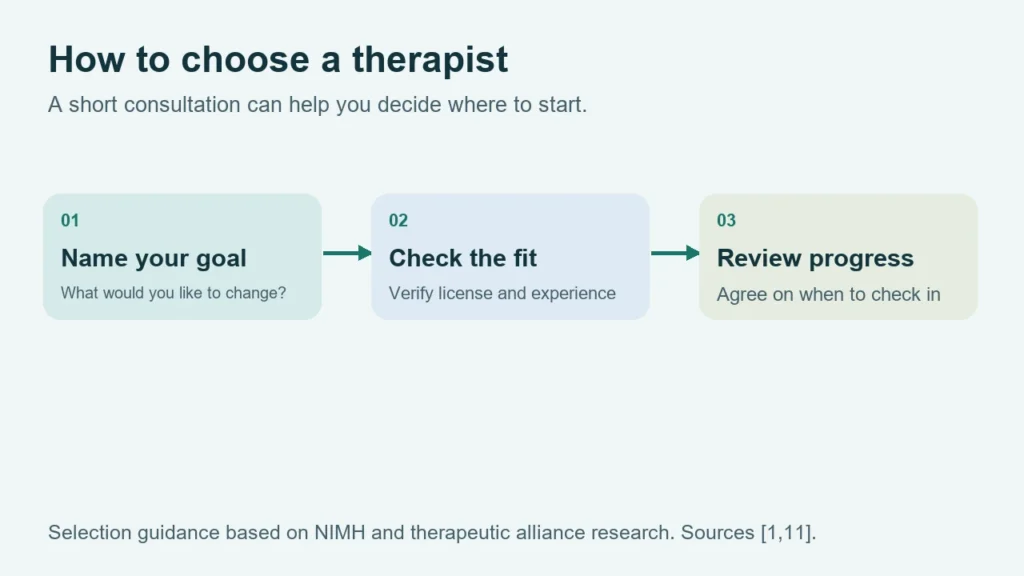
- Make a shortlist. A trusted friend, a primary care clinician, or a therapist’s office may be able to suggest someone. Look for a clinician whose specialty matches the issue, such as grief, anxiety, or relationship concerns.
- Check credentials and training. Confirm an active license with the relevant state board and ask where the clinician trained or completed supervision. For psychology programs, you can check APA accreditation where applicable. Accreditation varies by profession and program. [1,10]
- Ask about the plan. Find out what the therapist’s approach involves, what you might work on between visits, and when you will review whether treatment is helping. Ask how confidentiality works and how to contact the office. [1]
- Review how it feels to work together. Early sessions can involve difficult topics. Pay attention to whether you feel heard, understand the goals, and can discuss concerns openly. Research links the quality of the working relationship with therapy outcomes. [11]
Common questions about PEPLIX HEALTH
Independent, board-certified physicians can review health concerns and help identify when a referral to a licensed mental health professional would be appropriate. Monarch Brands LLC provides management services for Peplix Health. Ask whether your cash-pay visit addresses your concern and what separate arrangements you may need for ongoing psychotherapy.
Do I need a diagnosis to look for a therapist?
You can seek therapy for stress, grief, relationship difficulties, or a life transition. A therapist can assess what is happening and explain whether a structured course of treatment or another type of support fits your situation. [1]
When does Section 503A pharmacy fulfillment apply?
Counseling sessions do not involve pharmacy fulfillment. Any medication and dose depend on an independent prescribing clinician’s evaluation. If an individual clinical need warrants compounding and applicable requirements are met, a state-licensed pharmacy operating under Section 503A can prepare a patient-specific prescription. Compounded drugs lack FDA approval. [12]
For consultation information, see our vitamins and wellness guide or start an online assessment.
Sources
- NIMH – psychotherapy approaches and finding a therapist
- NIMH – caring for your mental health
- CDC NCHS – U.S. mental health treatment in 2019
- Mackenzie et al. – attitudes toward help-seeking
- Movember and Ipsos MORI – 2019 survey on opening up
- David et al. – evidence base for CBT
- U.S. Administration for Children and Families – ACT
- Cleveland Clinic – dialectical behavior therapy
- Association for Rational Emotive Behaviour Therapy – REBT
- APA – accredited psychology programs
- Flückiger et al. – therapeutic alliance meta-analysis
- FDA – Section 503A compounding requirements
This article is for general education and is not medical advice. Talk with a licensed clinician before starting, stopping or changing any treatment. Compounded medications are not FDA-approved. See our safety information.
Keep reading

Wellness
Krill Oil vs Fish Oil for Omega-3s
Compare krill oil and fish oil for EPA and DHA, absorption, triglycerides, and side effects. Learn what to check on an omega-3 label.

Wellness
Sprinting Benefits and How to Start Sprint Interval Training
Learn how sprint intervals affect fitness and fat oxidation, how to start with controlled efforts, and how to fit sprinting into your week.

Wellness
CoQ10 Benefits, Dosage, and Safety
What does CoQ10 do? Explore the evidence for heart failure, fatigue, and statin symptoms, plus dosage, supplement forms, and interactions.