Magnesium for Muscle Growth and Recovery
Does magnesium help build muscle or ease cramps? Compare malate and glycinate, learn when to take magnesium, and check how much you need.

Magnesium helps muscles use energy, contract, relax, and make proteins. Meeting your daily needs supports those functions. Evidence that supplements build muscle or speed recovery in people who already get enough is limited. If you lift regularly or eat less during GLP-1 treatment, start by reviewing your diet and current supplements.
Does magnesium help you build muscle or lift more?
Magnesium is needed for muscle protein synthesis and for enzymes that use ATP. Resistance training and dietary protein provide signals for muscle growth. The mineral’s role in these processes is well established, but trials have yet to show that taking extra magnesium consistently increases strength or muscle size in well-nourished lifters.
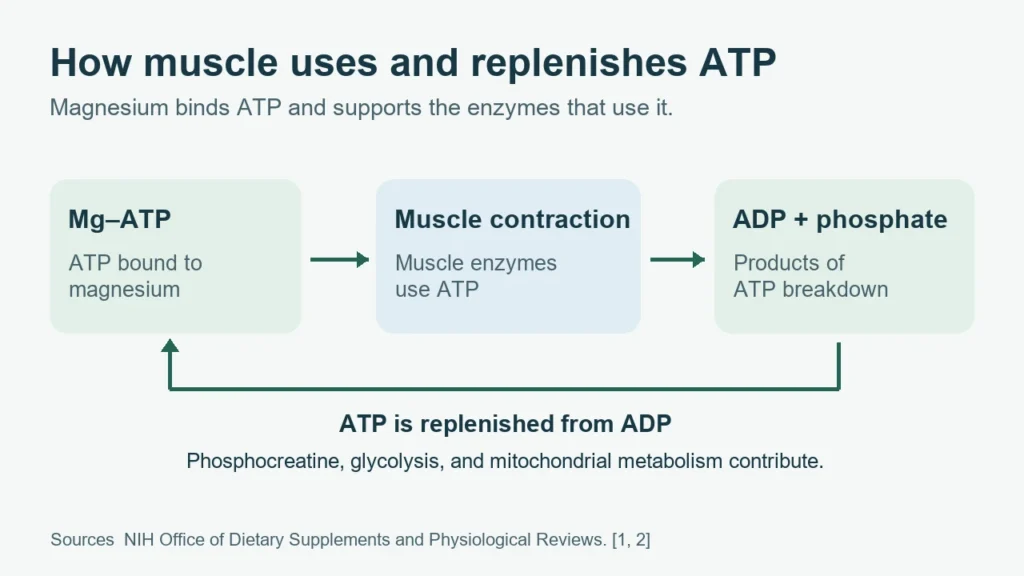
Magnesium is a cofactor in more than 300 enzyme systems. In a hard set, creatine kinase transfers phosphate from phosphocreatine to ADP, replenishing ATP. Glycolysis and mitochondrial metabolism also replenish ATP. Magnesium helps regulate calcium and nerve signals for contraction and relaxation. [1, 2]
Mechanical loading, leucine, and growth factors signal through routes including mTORC1. Magnesium helps stabilize the ribosomes that translate RNA into protein. Trials have yet to establish that extra magnesium increases mTORC1 activity in well-nourished lifters. [1, 3, 4]
Observational and small exercise studies linked magnesium to testosterone. One proposed mechanism involves sex hormone–binding globulin, but meaningful effects on free testosterone remain uncertain. A 14-trial review found no clear muscle-fitness benefit in athletes and active participants. [5–8]
Can magnesium help with soreness, sleep, or workout cramps?
Small studies suggest magnesium may reduce soreness after some workouts, but the evidence remains limited. Low magnesium can cause cramps or twitches, and correcting a confirmed deficiency addresses that cause. Exercise cramps can also follow fatigue or heavy exertion. Sleep research suggests possible benefits for some people, with little evidence directly connecting magnesium use to better training recovery.
A review of exercise studies reported some reductions in muscle soreness, but the small evidence base used different protocols and outcomes. The Cochrane review found no randomized trials for exercise-associated muscle cramps. Fatigue and neuromuscular factors can matter, while fluid and electrolyte losses may contribute in some situations. Cramps alone cannot identify which factor is involved. [9–11]
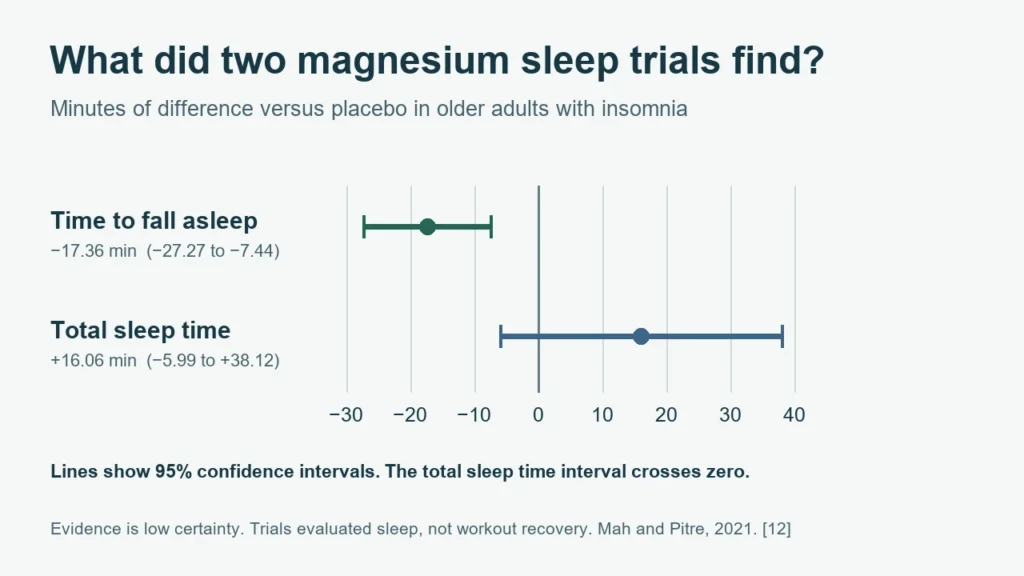
Magnesium’s role in excitatory NMDA signaling is established. Effects on inhibitory GABA signaling and stress-related arousal are possible mechanisms under study. In older adults with insomnia, two trials pooled in a review found shorter sleep onset, while the estimate for total sleep time was uncertain. Slow-wave sleep is associated with a major growth hormone pulse, and small sleep-loss studies reported changes in testosterone and muscle protein synthesis. Those sleep studies did not test whether magnesium improves hormonal recovery or muscle repair. [12–16]
Which magnesium form should you take for muscle recovery?
Malate, glycinate, citrate, chloride, and oxide can all supply magnesium. Citrate and chloride are generally better absorbed than oxide, while no strong comparative evidence establishes malate or glycinate as the best option for muscle recovery. Choose by the elemental dose, cost, and digestive tolerance, and use a schedule you can maintain.
| Form | What makes it different | What matters for training |
|---|---|---|
| Malate | Combines magnesium with malate, an intermediate in the citric acid cycle. | An option for routine intake. Malate’s metabolic role does not establish a supplement advantage for strength, energy, or recovery. [1, 17, 18] |
| Glycinate / bisglycinate | Binds magnesium to glycine. Often taken at night. | One short study found a small improvement in self-reported insomnia symptoms. Its effects on training recovery and exercise cramps are uncertain. [10, 19] |
| Citrate | An oral form that is generally better absorbed than oxide. Some products are saline laxatives. | Can loosen stools. Check whether the label describes a supplement or a laxative. [1, 18, 20] |
| Chloride | An oral option generally better absorbed than oxide. | An option for routine intake. It can still cause diarrhea. [1, 21] |
| Oxide | High elemental magnesium by weight, with relatively low absorption. Also used as a laxative. | One study estimated about 4% fractional absorption for the oxide product tested. That figure does not apply to every formulation. [1, 21] |
Should you take magnesium before or after a workout?
Breakfast, a pre-training meal, or dinner can work if the timing fits your routine and medications. No clear evidence establishes a pre-workout or post-workout window. If you use malate in the morning and glycinate at night, add up the elemental magnesium in both. Carbohydrate, protein, fluids, and electrolytes such as sodium and potassium can be part of a training nutrition plan tailored to your workload. [1, 22]
How much magnesium do you need if you lift weights or take a GLP-1?
Most adult women need 310 to 320 mg per day and adult men need 400 to 420 mg per day from all sources, depending on age. Exercise can increase sweat losses, and GLP-1 treatment can reduce food intake. No universal higher target is established for lifters or people taking GLP-1 medication.
- Start with what you eat. Beans, whole grains, nuts, seeds, and leafy greens supply magnesium. Heavy training increases ATP turnover, and exercise can change sweat and urinary magnesium losses. If appetite or calorie intake falls, review how much you get from food. [1, 2, 22, 23]
- Count elemental magnesium. Read the amount beside “Magnesium” in Supplement Facts and multiply by servings taken. Include multivitamins, standalone supplements, and magnesium-containing medicines. The adult upper limit is 350 mg per day from supplements and medicines. Magnesium in food falls outside that limit. [1]
- Review persistent symptoms with a licensed clinician. Fatigue, heavy legs, frequent cramps or twitches, and poor sleep can have several causes. Mention blood pressure or metabolic changes if they accompany your symptoms. Ask about diet, training load, medicines, kidney function, and whether lab testing would help. [1, 11]
Higher supplemental doses can cause diarrhea, nausea, or abdominal cramps. Kidney impairment increases the risk of magnesium accumulation. Oral magnesium can interfere with absorption of some antibiotics and osteoporosis medicines, so ask your prescriber or pharmacist about timing and dose. [1]
Common questions about PEPLIX HEALTH
Peplix Health is a cash-pay telehealth service managed by Monarch Brands LLC. An independent, board-certified physician can review your training, nutrition, symptoms, and medications. If treatment is appropriate, the physician individualizes dosing and follow-up. A state-licensed pharmacy can fill eligible patient-specific compounded prescriptions under Section 503A and applicable state requirements.
Can I take magnesium during testosterone or GLP-1 treatment?
A physician can review your food intake, renal function, medication list, and elemental magnesium dose. Adequate dietary magnesium supports normal muscle function. Evidence has not established that a particular form boosts testosterone treatment or prevents muscle loss during GLP-1 treatment. Discuss adequate protein and resistance training when weight loss is a goal. [1, 5–8, 22, 23]
Can Peplix Health help if I keep getting cramps after training?
Have your training log, recent medication changes, and supplement labels ready. A clinician can evaluate whether a problem with magnesium intake is plausible and consider other causes, including fatigue, fluid losses, or medications. A recurrent cramp alone cannot diagnose magnesium deficiency. [1, 10, 11]
Do magnesium supplements need a 503A pharmacy?
Standard retail magnesium is a dietary supplement. If an eligible prescription drug needs compounding, Section 503A requires a valid prescription for an identified patient and other federal and state conditions. Compounded drugs do not receive FDA premarket review for safety, effectiveness, or quality. [24, 25]
For consultation information, see our vitamins and wellness guide or start an online assessment.
Sources
- NIH Office of Dietary Supplements. Magnesium fact sheet.
- Glancy and Balaban. Energy metabolism in striated muscle.
- Roberts et al. Mechanisms of overload-induced skeletal muscle hypertrophy.
- Pontes et al. Magnesium, ribosome stabilization, and translation.
- Maggio et al. Magnesium and anabolic hormones in older men.
- Cinar et al. Magnesium supplementation, exercise, and testosterone.
- Maggio et al. Interplay between magnesium and testosterone.
- Wang et al. Meta-analysis of magnesium supplementation and muscle fitness.
- Systematic review of magnesium supplementation and muscle soreness.
- Garrison et al. Cochrane review of magnesium for skeletal muscle cramps.
- Miller et al. Review of exercise-associated muscle cramps.
- Mah and Pitre. Systematic review and meta-analysis of sleep in older adults.
- Pickering et al. Review of magnesium and stress pathways.
- Van Cauter and Copinschi. Growth hormone and sleep.
- Leproult and Van Cauter. Sleep restriction and testosterone.
- Lamon et al. Acute sleep deprivation and muscle protein synthesis.
- NCBI Bookshelf. Biochemistry of the citric acid cycle.
- Pardo et al. Systematic review of supplement bioavailability.
- Schuster et al. Trial of bisglycinate in adults reporting poor sleep.
- DailyMed. Magnesium citrate saline laxative label.
- Firoz and Graber. Bioavailability of commercial magnesium preparations.
- Joint advisory on nutritional priorities during GLP-1 therapy.
- Review of vitamin D and magnesium in athletes.
- FDA. Federal provisions for human drug compounding.
- FDA. Compounding questions and answers.
This article is for general education and is not medical advice. Talk with a licensed clinician before starting, stopping or changing any treatment. Compounded medications are not FDA-approved. See our safety information.
Keep reading

Wellness
Krill Oil vs Fish Oil for Omega-3s
Compare krill oil and fish oil for EPA and DHA, absorption, triglycerides, and side effects. Learn what to check on an omega-3 label.

Wellness
Sprinting Benefits and How to Start Sprint Interval Training
Learn how sprint intervals affect fitness and fat oxidation, how to start with controlled efforts, and how to fit sprinting into your week.

Wellness
CoQ10 Benefits, Dosage, and Safety
What does CoQ10 do? Explore the evidence for heart failure, fatigue, and statin symptoms, plus dosage, supplement forms, and interactions.