Finasteride for Hair Loss: What to Know Before You Start
Compare oral and topical finasteride for male pattern hair loss, understand the timeline, and learn which side effects to discuss with your physician.

Oral finasteride can slow male pattern hair loss and help some men regain density. The 1 mg tablet has FDA approval for this use. Topical finasteride has shown promise in a controlled trial, but compounded U.S. products do not have FDA approval. Discuss sexual side effects, mood, and prostate screening before starting.
How do you decide between oral and topical finasteride?
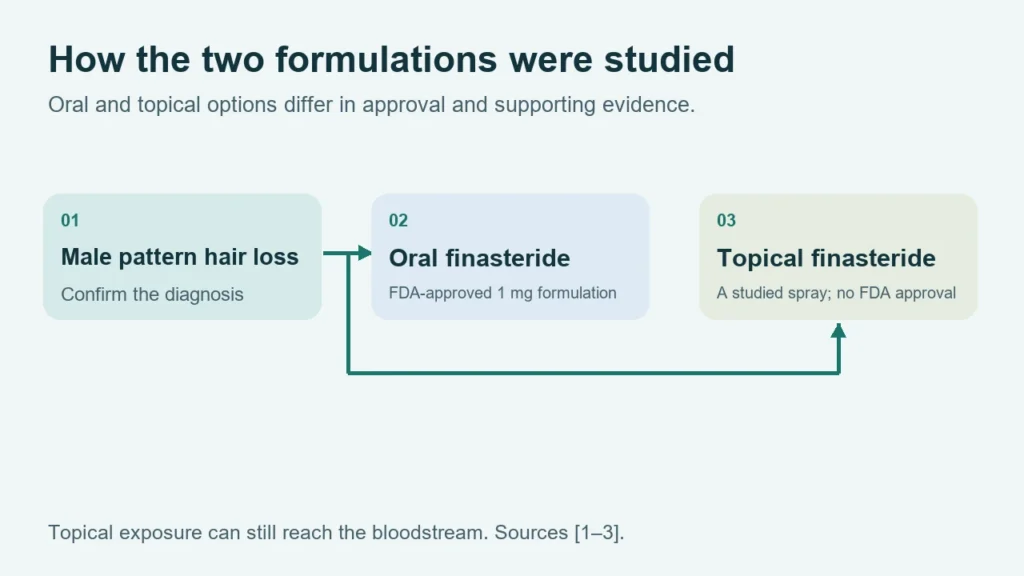
The oral tablet has the strongest long-term evidence for male pattern hair loss. A specific topical spray also improved hair counts over placebo in a 24-week trial. Its results were numerically similar to oral finasteride, but the trial did not establish that the two were equivalent. Topical use can still produce systemic exposure.
| Option | Clinical use and evidence | What to discuss |
|---|---|---|
| Oral finasteride 1 mg | FDA-approved for male pattern hair loss in men. Long-term studies found better preservation of hair and some regrowth. | Sexual and mood history, fertility plans, and prostate monitoring. |
| Topical finasteride | No FDA-approved topical finasteride in the United States. The phase 3 study tested a specific spray. | Formula, possible systemic effects, local irritation, and prevention of transfer. |
| Oral finasteride 5 mg | FDA-approved for symptomatic benign prostatic hyperplasia in men with an enlarged prostate. | A separate indication and dose. Tell the clinician interpreting PSA that you take it. |
At 24 weeks, adjusted target-area hair counts increased by 20.2 hairs with the studied topical spray, 6.7 with placebo, and 21.1 with the oral comparator. Blood DHT declined less with the spray than with oral treatment, though the spray was still absorbed. FDA has received adverse-event reports about compounded topical products. Such reports cannot establish how often a reaction occurs. [1–4]
What causes pattern thinning and how long does treatment take?
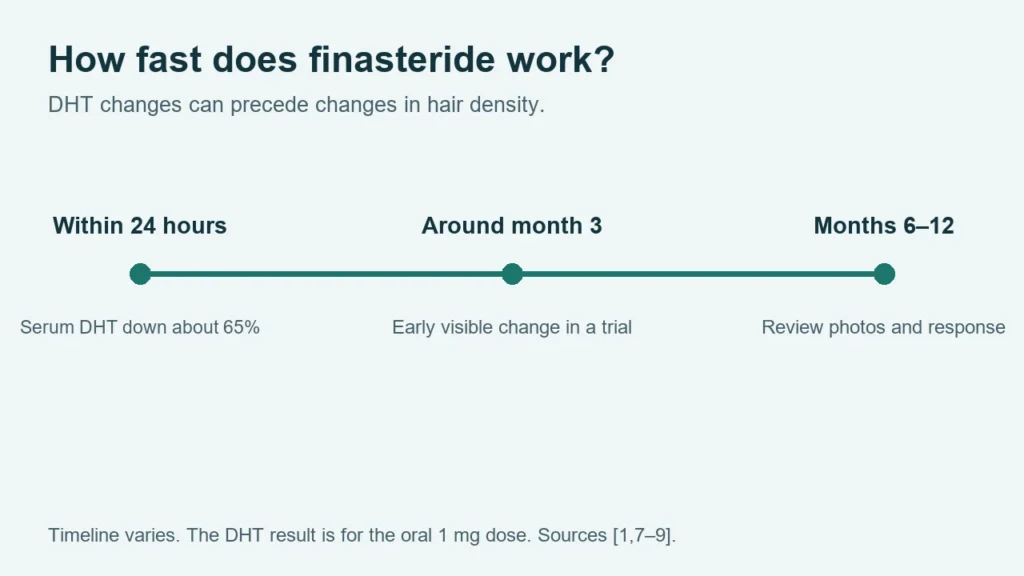
Finasteride inhibits type II 5-alpha reductase, reducing conversion of testosterone into dihydrotestosterone, or DHT. That can slow miniaturization in genetically susceptible follicles. A first dose can reduce circulating DHT quickly, but visible hair changes usually take months. Take baseline photos and agree on when to review progress with your clinician.
Male pattern hair loss affects up to about half of men by age 50 and often starts at the temples or crown. Normal circulating hormones can still have a strong effect on susceptible follicles. DHT also has roles in male sexual development and prostate growth. [1,5,6]
Labeling data show about a 65% fall in serum DHT within 24 hours of a 1 mg oral dose. A study of 414 Japanese men detected improvement by three months. Pivotal oral studies also found improved hair counts and slower progression. One five-year report found that about 90% of assessed men maintained or improved hair density on photographs. That figure includes men whose hair loss stabilized. Ask about a six- to twelve-month review and ongoing use to maintain results. [1,7–9]
Can finasteride be combined with minoxidil?
A clinician may recommend both when appropriate. Finasteride reduces DHT, while topical minoxidil affects the hair growth cycle through a different mechanism. Using both can help some men with confirmed pattern hair loss. The decision depends on treatment goals, tolerability, and how consistently each product can be used. [10]
Which side effects should you discuss?
Lower libido, erection difficulty, changes in ejaculation, testicular pain, and mood changes can occur. Tell your prescriber about current symptoms or a history of depression before starting. Finasteride can also lower PSA. If you have prostate screening, tell the clinician how long you have used it and at what dose.
- Sexual or mood symptoms. In first-year trials of oral 1 mg finasteride, 3.8% of men reported at least one treatment-related sexual effect compared with 2.1% on placebo. Persistent symptoms, depression, and suicidal thoughts have been reported after marketing. If you develop depression while taking the hair-loss tablets, stop and contact your prescriber promptly. Seek immediate help for thoughts of self-harm. [1,11,12]
- PSA screening. A high-grade prostate cancer finding in a prevention trial of 5 mg finasteride prompted a class warning. It does not quantify risk for the 1 mg hair-loss dose. A confirmed rise from the lowest PSA value while taking finasteride warrants clinical review even if your value is within a standard reference range. [1,13]
- Pregnancy exposure. Anyone who is pregnant or may become pregnant should avoid handling broken or crushed tablets or contacting a topical application site. Follow instructions provided by your pharmacist and discuss what to do after accidental exposure. [1,3]
Common questions about PEPLIX HEALTH
An independent, board-certified physician can assess the type of hair loss, review your health history, and discuss where finasteride fits. Monarch Brands LLC manages Peplix Health’s administrative services. Ask which appointment types are available, when the physician will review treatment, and what a cash-pay plan includes before you start.
Who chooses the formulation and dose?
The independent prescriber decides based on the diagnosis, expected benefits, medical history, risks, and preferences. Ask whether an approved product meets your individual needs.
Where is a compounded topical prescription filled?
A state-licensed pharmacy operating under Section 503A can prepare a valid patient-specific prescription when clinical needs and applicable legal requirements are met. Compounded topical finasteride has no FDA approval. Ask the pharmacy for instructions on use and transfer precautions. [14]
This article is educational. Discuss symptoms and treatment options with a licensed healthcare professional.
For consultation information, see our vitamins and wellness guide or start an online assessment.
Sources
- DailyMed — Propecia prescribing information
- Piraccini et al. — 24-week topical spray trial
- FDA — compounded topical finasteride risks
- DailyMed — Proscar prescribing information
- Endotext — male androgenetic alopecia
- StatPearls — dihydrotestosterone physiology
- Kawashima et al. — study in Japanese men
- Kaufman et al. — oral finasteride trial
- Shapiro and Kaufman — long-term outcomes
- Chen et al. — finasteride and minoxidil evidence
- MedlinePlus — finasteride adverse effects
- EMA — risk measures for suicidal thoughts
- FDA — 5-alpha reductase inhibitors and high-grade prostate cancer
- FDA — compounding and FDA approval
This article is for general education and is not medical advice. Talk with a licensed clinician before starting, stopping or changing any treatment. Compounded medications are not FDA-approved. See our safety information.
Keep reading

Wellness
Krill Oil vs Fish Oil for Omega-3s
Compare krill oil and fish oil for EPA and DHA, absorption, triglycerides, and side effects. Learn what to check on an omega-3 label.

Wellness
Sprinting Benefits and How to Start Sprint Interval Training
Learn how sprint intervals affect fitness and fat oxidation, how to start with controlled efforts, and how to fit sprinting into your week.

Wellness
CoQ10 Benefits, Dosage, and Safety
What does CoQ10 do? Explore the evidence for heart failure, fatigue, and statin symptoms, plus dosage, supplement forms, and interactions.