Vitamin B12 for Hair and Skin
Can low B12 contribute to hair shedding or skin changes? Learn who may need testing, how to read borderline results, and when treatment helps.

Vitamin B12 supports red blood cell formation and DNA synthesis. A deficiency can cause pale skin, a sore tongue, and sometimes darker patches. Hair shedding has many possible causes, and research linking it directly to low B12 is limited. Correct a confirmed deficiency and have persistent or patterned thinning evaluated on its own.
Can low vitamin B12 cause hair loss?
Low B12 may coexist with excess shedding, but hair loss alone is a poor indicator of deficiency. Correcting a documented deficiency supports overall health. Studies have yet to establish how often hair grows back after B12 treatment. Extra B12 has no proven regrowth benefit when your B12 status is adequate.
The American Academy of Dermatology estimates that people normally shed about 50–100 hairs a day. A noticeable change from your usual pattern can be more useful than trying to count strands. Diffuse shedding, a widening part, and isolated bald patches can point to different causes. Seek evaluation for sudden, patchy, or persistent hair loss. [3, 4, 5]
In androgenetic alopecia, inherited follicle sensitivity to androgens such as dihydrotestosterone (DHT) contributes to shrinking follicles, particularly in male pattern loss. Someone can have both pattern loss and a nutritional deficiency. In that case each needs its own evaluation. [3, 5, 6]
How does vitamin B12 support skin and hair follicles?
Vitamin B12 helps the body make healthy red blood cells and synthesize DNA in dividing cells. It also helps convert homocysteine to methionine. These functions support normal tissue maintenance. In deficiency, megaloblastic anemia can cause pallor, and some people develop a smooth, sore tongue or darker skin patches.
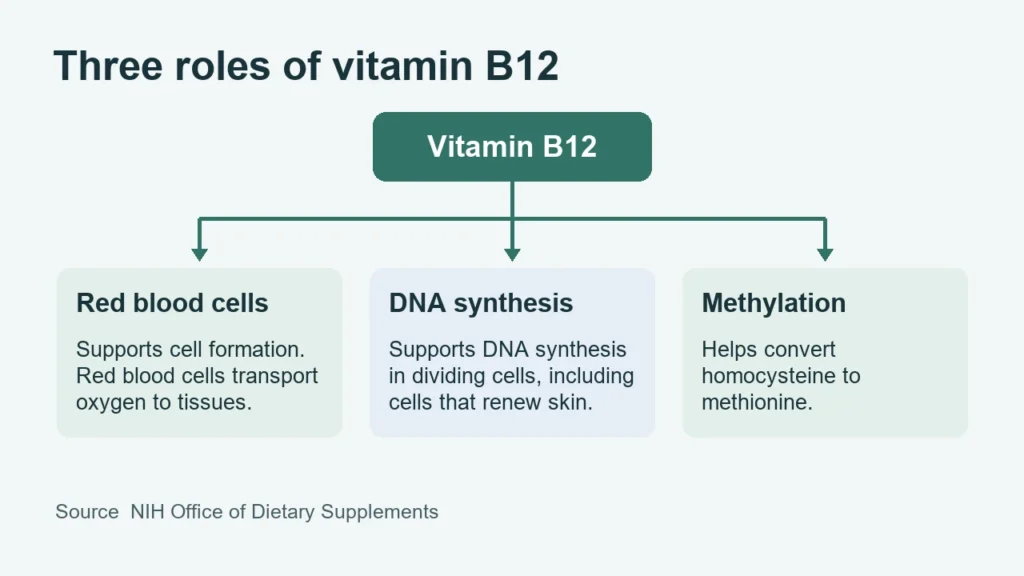
In megaloblastic anemia, impaired DNA synthesis leads to unusually large, immature blood-cell precursors and can reduce red blood cell production. Anemia can lower the blood’s oxygen-carrying capacity. Follicles and the skin both contain rapidly renewing cells, but these mechanisms alone cannot explain an individual’s shedding, slow regrowth, brittle strands, dry skin, or slow wound healing. [1, 3]
Pale or yellow-tinged skin, a smooth red tongue (glossitis), and darker patches, including on the hands or face, have been reported with deficiency. Cracks at the corners of the mouth have other causes as well. Some people also experience fatigue, difficulty concentrating, tingling, or balance problems. Neurologic symptoms can occur without anemia and warrant prompt evaluation. [1, 2, 7]
B12-dependent methionine synthase helps process homocysteine and supports production of a methyl donor used throughout the body. Elevated homocysteine is nonspecific. Evidence supports treating B12 deficiency, with no established cosmetic benefit for acne, eczema, wrinkles, sun-related aging, or post-inflammatory marks from supplementing B12. [1, 2, 7]
Who should ask about B12 testing, and what do labs show?
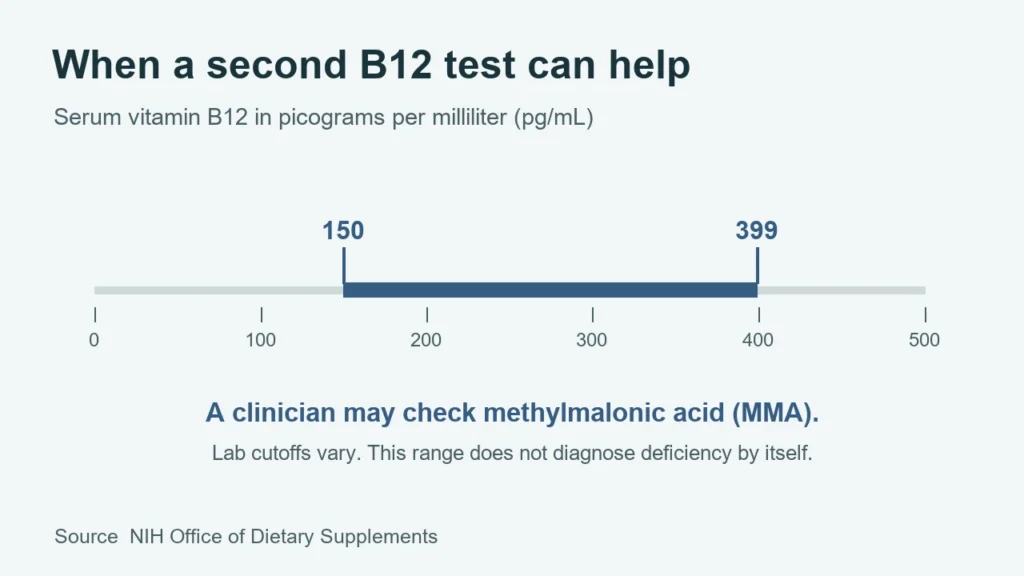
B12 testing can be useful when symptoms occur alongside a risk factor such as low intake of animal or fortified foods, bariatric surgery, or long-term metformin use. Clinicians often start with serum B12. Methylmalonic acid can help clarify a borderline result, especially when symptoms and the initial result point in different directions.
- Review diet, medications, and absorption. Vegan diets and some vegetarian diets may supply little B12 without fortified foods or supplements. Absorption can also be affected by age-related stomach changes, bariatric surgery, and long-term use of metformin or acid suppressants such as proton pump inhibitors. [1, 2]
- Mention appetite changes. If a GLP-1 medication has substantially reduced how much you eat over time, review overall nutrient and protein intake with your care team. Low intake can warrant a nutrition assessment. [8]
- Interpret tests in context. Total serum B12 or active B12 can be used initially. A complete blood count can help assess anemia. A clinician may order MMA or, in some situations, homocysteine. Kidney impairment can raise MMA, and folate status can influence homocysteine. Share any B12 supplements you already take. [1, 2]
Which treatment fits B12 deficiency, and when might symptoms improve?
The right form of B12 and the route depend on the cause and severity of deficiency. Methylcobalamin and cyanocobalamin can both supply B12. Clinicians use oral replacement in some situations and injections in others. General symptoms may improve over weeks to months, while research provides no predictable timetable for hair regrowth.
| Option | When it may fit | What to know |
|---|---|---|
| Food or a daily supplement | Maintaining adequate intake, particularly if your diet has few B12 sources. | Animal foods and fortified products can supply B12. A multivitamin may be a practical source. Its dose may be insufficient for treating deficiency. [1, 2] |
| Oral B12 replacement | Clinician-directed treatment, often when low dietary intake contributes. | Discuss dose, duration, and follow-up. NIH reports no evidence of different absorption rates among supplemental forms of B12. [1, 2] |
| Intramuscular B12 | Some causes of poor absorption or cases requiring prompt, reliable treatment. | Some irreversible causes require continuing replacement. A clinician determines the route and follow-up. [2] |
Methylcobalamin is a biologically active form. Cyanocobalamin is converted to active forms in the body. Evidence does not establish that one produces better hair or skin outcomes. For dietary prevention, a reliable ongoing intake matters more than an occasional high-dose shot. For deficiency, use the regimen prescribed for the cause. [1, 2]
NICE advises that overall deficiency symptoms may start to improve within two weeks and can take up to three months to begin improving. Full resolution can take longer. A sore tongue or deficiency-related pigmentation may improve after repletion. The hair growth phase can last years, and changes in density are slow to assess. There is no validated two-to-three-month shedding or four-to-six-month thickening estimate specific to B12. [2, 3, 7, 9]
Common questions about PEPLIX HEALTH
Peplix Health is a cash-pay telehealth service managed by Monarch Brands LLC. Independent, board-certified physicians review symptoms, medications, and relevant lab results. They can recommend testing and tailor a treatment plan when appropriate. If a qualifying compounded prescription is needed, a state-licensed pharmacy can dispense it under applicable Section 503A and state requirements.
What else should I ask about if my B12 is adequate?
Depending on your history, a clinician may look at iron and ferritin, thyroid function, recent illness or stress, rapid weight loss, and overall protein intake. Vitamin D, zinc, or folate may be relevant in selected cases. A scalp exam helps assess pattern loss or another hair disorder. Avoid taking multiple supplements on the assumption that every nutrient will help. [3–6, 9]
Is hair loss associated with low B12 reversible?
It depends on what is driving the shedding. Temporary diffuse shedding, called telogen effluvium, can improve once its trigger resolves. A B12 result alone does not establish the trigger. If pattern hair loss is also present, your clinician can discuss treatments that address follicle miniaturization or support growth. [3–6, 9]
Can B12 shots or supplements cause breakouts?
Acne-like eruptions have been reported after B12 use. One proposed mechanism involves changes in skin bacteria that increase production of inflammatory compounds. Reports cannot tell us how common the reaction is. Tell your clinician if breakouts begin after treatment, so you can review your options while addressing the deficiency. [7, 10, 11]
Does B12 replacement require a compounding pharmacy?
Many cases can use standard products. If a clinician identifies a patient-specific need for a compounded preparation, a licensed pharmacist can fill an eligible prescription subject to ingredient and quality requirements. Compounded drugs do not receive FDA premarket review for safety, effectiveness, or quality. [1, 2, 12, 13]
For consultation information, see our vitamins and wellness guide or start an online assessment.
Sources
- NIH Office of Dietary Supplements. Vitamin B12 fact sheet for health professionals.
- NICE. Vitamin B12 deficiency in over 16s, guideline NG239.
- Almohanna et al. Review of vitamins and minerals in hair loss.
- American Academy of Dermatology. Hair shedding and hair loss.
- American Academy of Dermatology. Hair loss diagnosis and treatment.
- DermNet. Male pattern hair loss and follicle miniaturization.
- Brescoll and Daveluy. Review of vitamin B12 in dermatology.
- ACLM, ASN, OMA, and TOS. Joint advisory on nutrition during GLP-1 therapy.
- DermNet. Telogen effluvium and the hair growth cycle.
- Owen et al. Vitamin B12-induced acneiform eruption.
- Kang et al. Vitamin B12 and skin microbiota in acne.
- FDA. Compounding questions and answers.
- FDA. FD&C Act provisions that apply to human drug compounding.
This article is for general education and is not medical advice. Talk with a licensed clinician before starting, stopping or changing any treatment. Compounded medications are not FDA-approved. See our safety information.
Keep reading

Wellness
Krill Oil vs Fish Oil for Omega-3s
Compare krill oil and fish oil for EPA and DHA, absorption, triglycerides, and side effects. Learn what to check on an omega-3 label.

Wellness
Sprinting Benefits and How to Start Sprint Interval Training
Learn how sprint intervals affect fitness and fat oxidation, how to start with controlled efforts, and how to fit sprinting into your week.

Wellness
CoQ10 Benefits, Dosage, and Safety
What does CoQ10 do? Explore the evidence for heart failure, fatigue, and statin symptoms, plus dosage, supplement forms, and interactions.