Does Scalp Microneedling Help With Hair Loss?
Learn how scalp microneedling works, what studies say about combining it with minoxidil, and what to ask about dutasteride or PRP.
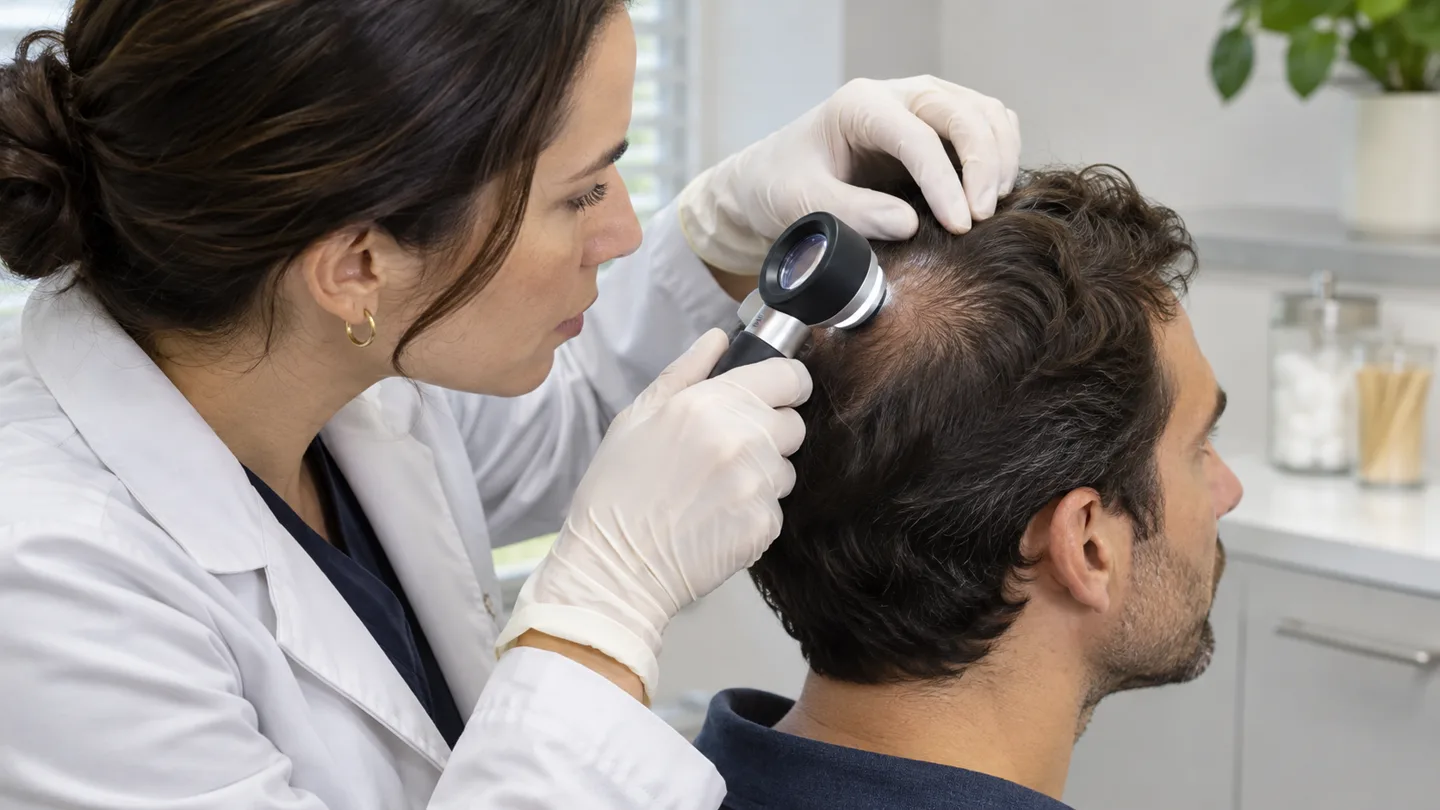
Scalp microneedling may improve hair counts in people with pattern hair loss when added to topical minoxidil. Studies have used different devices and depths, and the best protocol remains uncertain. A clinician can confirm the cause of thinning, discuss whether the scalp is suitable for the procedure, and review medication and follow-up options.
How does scalp microneedling work?
A microneedling pen, roller, or stamp makes tiny punctures in the scalp. The controlled injury starts a wound-healing response and creates temporary channels in the skin. These changes may affect follicle signaling and topical drug penetration. The exact contribution of each mechanism to hair regrowth in humans remains uncertain.
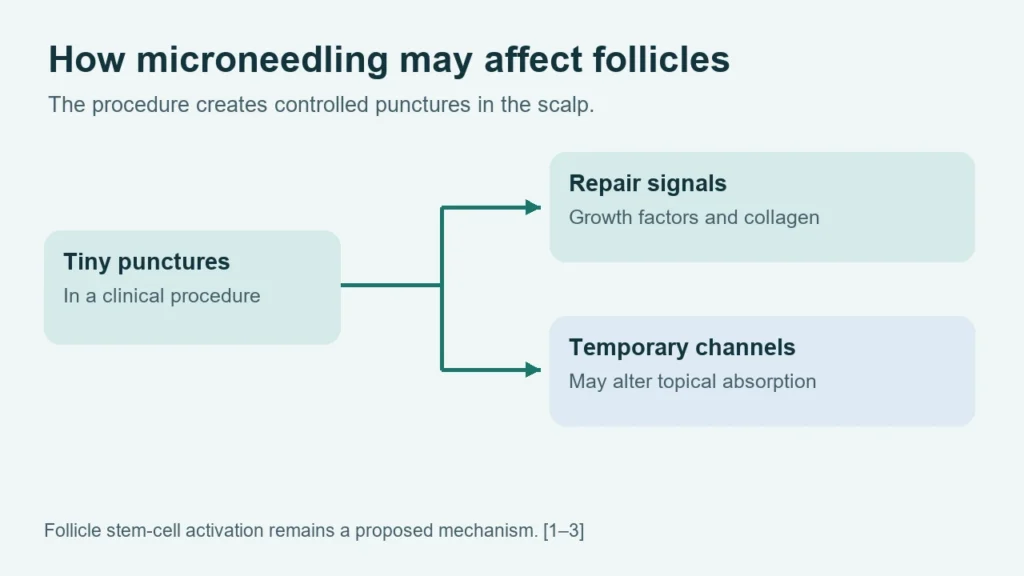
Controlled injury can stimulate collagen formation and growth factors, including vascular endothelial growth factor (VEGF), which helps regulate blood vessel formation. Researchers also propose that signaling can activate stem cells in the follicle’s bulge region. Better local circulation and delivery of oxygen or nutrients are plausible contributors, although the clinical studies did not measure how much each mechanism matters. [1–3]
In hereditary pattern hair loss, dihydrotestosterone (DHT) binds to androgen receptors in genetically susceptible follicles. Follicles gradually miniaturize and produce shorter, finer hairs. Microneedling acts through wound signaling rather than blocking DHT. Long-standing thinning can be harder to treat, and evaluation is useful before assuming a receding hairline or bald patch has a particular cause. [2,4]
What does research say about microneedling plus minoxidil?
In one small 12-week study, 82% of participants using microneedling with minoxidil reported greater than 50% improvement, compared with 4.5% using minoxidil alone. The result is promising, but it reflects self-ratings in a specific trial. Later studies generally favor the combination while leaving uncertainty about the ideal technique and treatment schedule.
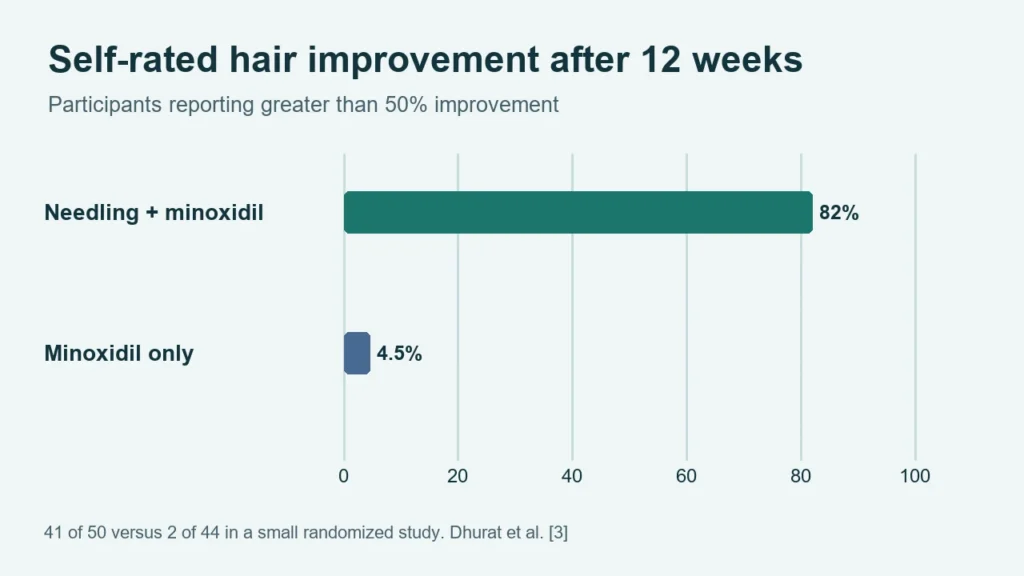
The 2013 trial randomized 100 men and analyzed 94 completers. Mean hair count rose by 91.4 in the combination group and 22.2 in the minoxidil-only group in the study target area. Both groups used topical 5% minoxidil. A later analysis of 12 randomized trials with 631 participants also favored combination treatment for hair count, with substantial variation across trials. Results depend on the diagnosis, severity, treatment consistency, and individual response. [3,5]
How do microneedling, dutasteride, minoxidil, and PRP differ?
Minoxidil supports the hair growth phase. Dutasteride reduces DHT, which drives miniaturization in susceptible follicles. Microneedling triggers wound repair and may increase topical penetration. Platelet-rich plasma delivers platelets from your own blood. The strongest combination data here pair microneedling with minoxidil. Studies of three-way combinations and PRP are smaller and less conclusive.
| Treatment | How it acts | What the evidence says |
|---|---|---|
| Microneedling | Controlled injury and possible enhancement of topical penetration. | Evidence is strongest as an adjunct to minoxidil in pattern hair loss. |
| Minoxidil | Vasodilator that can shorten telogen and support entry into or maintenance of the growth phase. | Topical products are FDA-approved for labeled use in pattern hair loss. Benefits take time. |
| Dutasteride | Blocks type I and II 5-alpha reductase and reduces production of DHT. | Approved in the U.S. for benign prostatic hyperplasia. Hair-loss treatment is off-label. |
| PRP | Uses platelet-rich plasma from your blood, usually injected into the scalp. | Small studies examine PRP alone and with needling. The best approach remains uncertain. |
Microneedling may increase absorption of topical products through temporary channels. Evidence does not establish that adding topical dutasteride to needling and minoxidil is superior or that needling improves dutasteride absorption by an amount that benefits patients. Likewise, PRP and microneedling combinations may help some patients, but better studies are needed. [2,5–8]
What should you ask before booking scalp microneedling?
Ask who will perform the procedure, what training and infection-control practices they follow, how they manage discomfort, and when to restart scalp medication. Studies have used different depths and schedules, so their protocols are best read as research details. It can take several months to judge whether your hair is responding.
- Depth and setting. Trials have tested roughly 0.5–1.5 mm for scalp hair loss. A small study using 0.6 mm showed benefits with minoxidil and some outcomes trended better than with 1.2 mm. An older study used 1.5 mm. Depths studied for wrinkles or acne scars are not a guide for scalp use. Professional devices can reach deeper and may cause discomfort, irritation, or pinpoint bleeding. [1,3,9]
- Discomfort and aftercare. A trained clinician may use a topical anesthetic if appropriate. One trial waited 24 hours before restarting minoxidil. That study schedule does not establish a universal restart time for minoxidil, dutasteride, or other products. Patient-specific aftercare matters because injured skin can absorb more topical medicine. [3,9,10]
- Timing and safety. An early reassessment at about three to six months may help track progress. Visible minoxidil results commonly take six to twelve months. FDA has not cleared a microneedling device for hair loss or authorized these devices for delivery of medications or PRP. An active scalp infection, bleeding risk, or unexplained patchy loss calls for medical review. [10,11]
Common questions about PEPLIX HEALTH
At Peplix Health, independent licensed clinicians make decisions about testing, treatment, and follow-up. Monarch Brands LLC manages the practice’s administrative services. If a physician determines that a compounded medicine is appropriate for an individual patient, a state-licensed pharmacy operating under Section 503A may fill the prescription when applicable requirements are met.
Can an online visit determine if I’m a candidate?
A telehealth review may help assess your history and treatment options. A dermatologist may need to inspect your scalp in person, especially if the loss is patchy, painful, sudden, or accompanied by inflammation.
How do I know who prescribes and fills a medication?
Ask the independent, board-certified physician performing your evaluation about expected benefits, individualized dosing, and follow-up. Ask who will fill the prescription and whether an FDA-approved option is suitable. Compounded drugs do not undergo FDA premarket review for safety, effectiveness, or quality.
This article is for education. Discuss medical decisions with a licensed clinician.
For consultation information, see our vitamins and wellness guide or start an online assessment.
Sources
- Review — clinical microneedling mechanisms and technique
- Clinical review — microneedling for androgenetic alopecia
- Dhurat et al. — 12-week randomized pilot trial
- Review — androgenetic alopecia and miniaturization
- Systematic review — microneedling with minoxidil
- Review — minoxidil and hair disorders
- Comparative trial — dutasteride in male pattern hair loss
- Review — platelet-rich plasma therapies
- Faghihi et al. — comparison of microneedling depths
- FDA — microneedling devices, uses, and risks
- American Academy of Dermatology — hair loss diagnosis and treatment
- FDA — compounding and FDA approval
This article is for general education and is not medical advice. Talk with a licensed clinician before starting, stopping or changing any treatment. Compounded medications are not FDA-approved. See our safety information.
Keep reading

Wellness
Krill Oil vs Fish Oil for Omega-3s
Compare krill oil and fish oil for EPA and DHA, absorption, triglycerides, and side effects. Learn what to check on an omega-3 label.

Wellness
Sprinting Benefits and How to Start Sprint Interval Training
Learn how sprint intervals affect fitness and fat oxidation, how to start with controlled efforts, and how to fit sprinting into your week.

Wellness
CoQ10 Benefits, Dosage, and Safety
What does CoQ10 do? Explore the evidence for heart failure, fatigue, and statin symptoms, plus dosage, supplement forms, and interactions.