Testosterone Levels by Age and When to Test
Learn how testosterone changes with age, how to read total and free testosterone results, and when repeat morning testing or treatment may help.

Testosterone generally rises during puberty, reaches adult levels in late adolescence, and tends to decline with age. A result needs context: symptoms, the laboratory’s reference range, time of collection, and repeat testing. In men, clinicians diagnose testosterone deficiency when compatible symptoms or signs occur alongside consistently low levels on properly collected tests.
How do testosterone levels change with age?
Testosterone supports male reproductive development before birth and rises briefly again in early infancy. Childhood levels are usually low before increasing at puberty. In adulthood, average levels tend to fall over time. Health, medications, and body composition help explain why people of the same age can have very different levels.
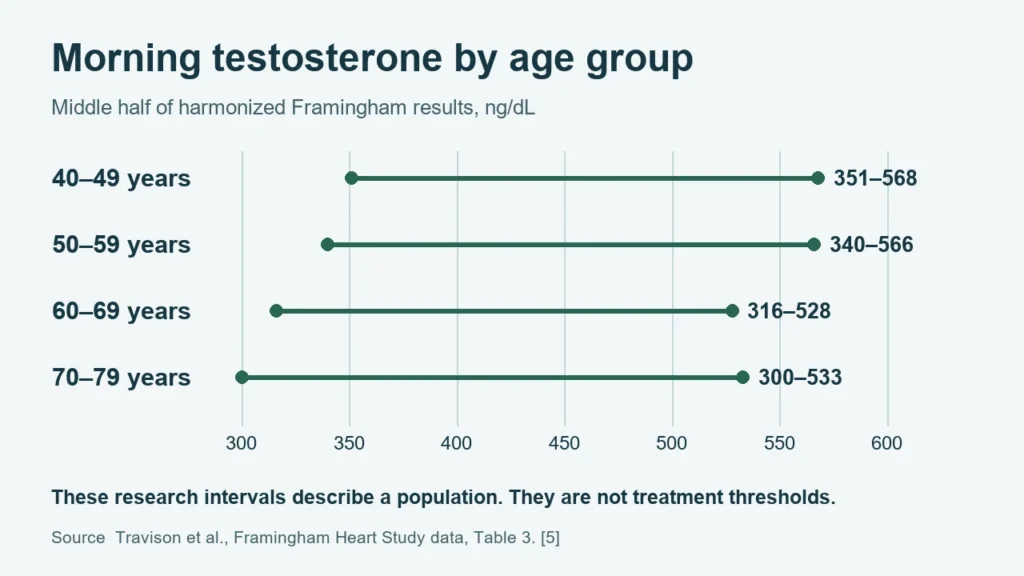
During puberty, testosterone contributes to voice deepening, body hair, muscle and bone growth, and sexual maturation. Adult concentrations are usually reached in late adolescence or early adulthood. A longitudinal study that enrolled men aged 40–70 estimated that total testosterone fell by about 1.6% per year on average, while free and bioavailable fractions declined faster. That cohort average cannot predict your level at a specific age. [1–3]
The chart shows the middle half of morning results by decade in the Framingham cohort. A separate U.S. survey found that the middle third ranged from 409–558 ng/dL at ages 20–24 and 350–473 ng/dL at ages 40–44. In healthy, nonobese men aged 19–39, harmonized measurements gave a 264–916 ng/dL reference interval and a median of 531 ng/dL. The interval covers the central 95% of that reference group. [4, 5]
What does a normal testosterone result actually mean?
Total testosterone includes the hormone bound to proteins and the small fraction circulating unbound. The American Urological Association uses a total testosterone below 300 ng/dL as a reasonable diagnostic cutoff in men. Your clinician considers symptoms and repeat results together, especially if total testosterone is borderline or binding protein levels are unusual.
| Result or measure | What it tells you | How to use it |
|---|---|---|
| Total testosterone | Bound and unbound testosterone. Often reported in ng/dL in the U.S. and nmol/L elsewhere. | Use the laboratory’s assay-specific interval. The AUA’s 300 ng/dL cutoff is a diagnostic aid, distinct from a population range. [1, 6] |
| Free testosterone | Unbound hormone. Roughly 2% circulates free, with variation. | If indicated, use equilibrium dialysis or a validated calculation using total testosterone, SHBG, and albumin. Methods have different ranges. [1] |
| SHBG and albumin | Proteins that bind circulating testosterone. Higher SHBG can leave less free testosterone at the same total level. | Obesity, diabetes, aging, some medications, and thyroid or liver conditions can change SHBG. [1] |
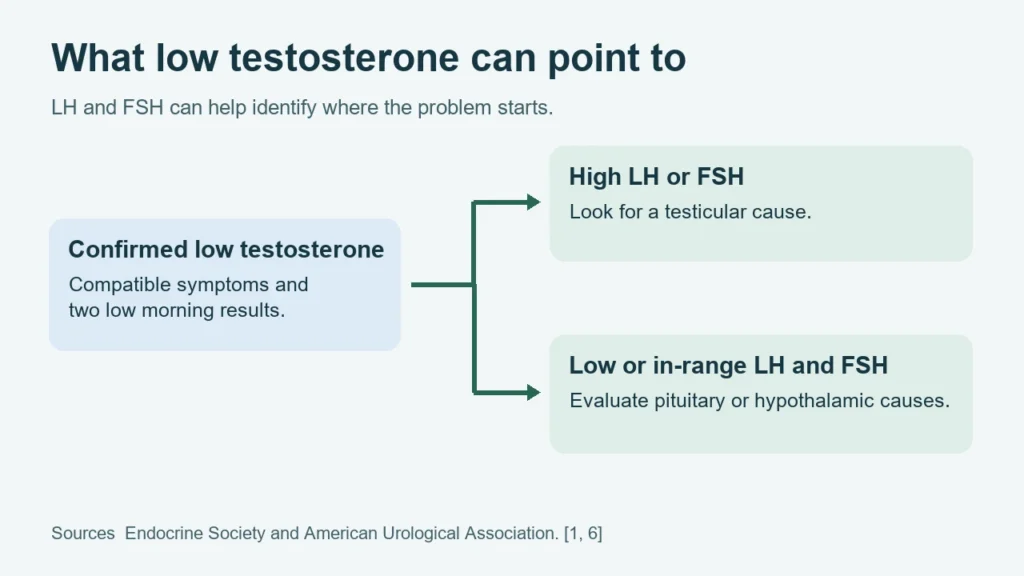
| LH and FSH | Pituitary signals involved in testosterone production and fertility. | After confirming low testosterone, they help distinguish a testicular problem from a problem involving the pituitary or hypothalamus. Low or low-normal LH can prompt a prolactin check. [1, 6] |
A symptomatic person whose total testosterone is near the lower limit may need free testosterone testing or assessment of other causes. There is no universally accepted “optimal range” by decade or a single free testosterone cutoff that applies across assays. [1, 6]
When should you get tested for low testosterone?
Consider testing if you notice a persistent drop in sexual desire, fewer morning erections, erectile difficulty, infertility, or other compatible changes. A clinician typically starts with two separate early-morning total testosterone measurements, preferably fasting under Endocrine Society guidance. One afternoon result cannot reliably estimate what your level would have been in the morning.
- Notice changes in context. In your 20s and 30s, fewer spontaneous erections, low libido, or a fertility concern may prompt evaluation. In midlife, mention loss of strength, mood changes, or fatigue alongside sexual symptoms. In later life, discuss low-trauma fractures, muscle loss, or unexplained anemia. Weight gain, poor concentration, and low energy have many possible causes. [1, 6]
- Repeat an initial low or borderline result. Use the same lab and similar early-morning conditions where possible, ideally while well. Ask about timing if you work nights. A validated assay matters. LC-MS/MS can be especially useful at lower concentrations. A repeat draw is more informative than applying a fixed correction to an afternoon result. [1, 6]
- Order further tests based on the findings. LH and FSH help identify the cause. Free testosterone, SHBG, albumin, prolactin, estradiol, or other labs are useful in selected situations. Estradiol testing may be relevant with gynecomastia or breast symptoms. Routine screening of all asymptomatic adults is discouraged. [1, 6]
What can lower testosterone besides age?
Obesity, type 2 diabetes, acute illness, chronic heavy drinking, and certain medications can affect testosterone or the way it is measured. Sleep loss can temporarily lower results. A clinician also checks for testicular or pituitary disease and considers thyroid conditions, depression, and sleep apnea when fatigue or reduced libido are the main concerns.
In men with obesity, lower SHBG can reduce measured total testosterone, and more severe obesity can suppress reproductive hormone signaling. Fat tissue also contains aromatase, which converts testosterone into estradiol. Weight loss can raise testosterone for some men with obesity, but the change varies. Type 2 diabetes remains a risk factor and does not by itself diagnose deficiency. [1, 7]
In one small study, a week of sleep restricted to five hours per night reduced daytime testosterone by about 10–15% in healthy young men. Treat sleep apnea for its own health benefits. CPAP studies have not shown a consistent testosterone increase. Chronic opioids and glucocorticoids can suppress the hormonal axis, and SSRIs can affect sexual function. Review medication or alcohol changes with your clinician. [1, 8–10]
Adequate sleep, resistance training, adequate nutrition, and support for chronic stress can improve health and function. They do not reliably produce a specific testosterone increase. Correct a documented nutrient deficiency when indicated. Vitamin D, zinc, magnesium, and ashwagandha have no established role as substitutes for testosterone deficiency evaluation or treatment. [1, 6, 7]
When is testosterone therapy appropriate, including for women?
In men, testosterone replacement therapy may be appropriate after consistently low results, compatible symptoms, and evaluation of the cause. Fertility plans and safety monitoring shape the decision. In women, a serum testosterone result alone cannot diagnose low desire. Evidence supports carefully monitored treatment principally for postmenopausal women with diagnosed hypoactive sexual desire disorder.
What options do men with confirmed hypogonadism have?
Prescription formulations include injections, daily skin gels, oral testosterone undecanoate capsules, and pellets implanted under the skin. Dosing and monitoring differ by product. Testosterone can suppress sperm production. Discuss fertility before treatment, and ask about testosterone, hematocrit, blood pressure, and appropriate prostate monitoring. Elevated hematocrit and untreated severe sleep apnea are among the reasons to defer treatment under Endocrine Society guidance. FDA added or strengthened blood pressure warnings after reviewing ambulatory monitoring studies. [1, 6, 11]
How should women interpret a testosterone result?
The ovaries and adrenal glands contribute to androgen production, and tissues also convert androgen precursors into testosterone. One Mayo Clinic Laboratories adult female total testosterone reference interval is 8–60 ng/dL using its method. Menopause, removal of both ovaries, combined hormonal contraception, adrenal disease, and undernutrition can affect androgen levels or interpretation. There is no blood cutoff for diagnosing hypoactive sexual desire disorder. [12–14]
If a specialist recommends testosterone for diagnosed postmenopausal hypoactive sexual desire disorder, international guidance favors a monitored transdermal approach that avoids exceeding physiologic premenopausal concentrations. Evidence does not support routine use for fatigue, cognition, bone health, or muscle gain. Excess exposure can cause androgenic effects, such as acne, facial hair, voice changes, or clitoral enlargement. [12, 17]
Common questions about PEPLIX HEALTH
Peplix Health is a cash-pay telehealth service managed by Monarch Brands LLC. Independent, board-certified physicians review symptoms, labs, medical history, and fertility goals. If treatment is appropriate, the physician individualizes dosing and monitoring. A state-licensed pharmacy may fill an eligible patient-specific compounded prescription subject to Section 503A and applicable state requirements.
Can I use an at-home testosterone result?
Share the result and collection details. A clinician can determine whether it needs confirmation with separate early-morning serum tests using a reliable laboratory method. One result by itself does not establish testosterone deficiency. [1, 6]
Is a result below 300 ng/dL enough to start TRT?
Usually, you need compatible symptoms or signs, a repeat low morning result, and evaluation of the cause and treatment risks. Tell your physician if you are trying to conceive now or want to preserve fertility. [1, 6]
How does a 503A pharmacy fit into treatment?
An eligible compounded prescription must meet federal and state requirements, including a valid prescription for an identified patient. Compounded medications do not undergo FDA premarket review for safety, effectiveness, or quality. Discuss whether an FDA-approved formulation meets your needs. [15, 16]
For consultation information, see our low testosterone guide or start an online assessment.
Sources
- Endocrine Society. Testosterone therapy in men with hypogonadism.
- Mason et al. Androgens in pediatrics.
- Feldman et al. Massachusetts Male Aging Study.
- American Urological Association. Morning testosterone distribution at ages 20–44.
- Travison et al. Harmonized total testosterone reference ranges.
- American Urological Association. Diagnostic algorithm for testosterone deficiency.
- Meta-analysis. Testosterone changes after weight loss in men with obesity.
- Leproult and Van Cauter. Testosterone and short-term sleep restriction.
- Meta-analysis. CPAP and testosterone in men with sleep apnea.
- Endocrine Society. Exogenous opioids and the human endocrine system.
- FDA. Class-wide labeling changes for testosterone products.
- Global Consensus Position Statement. Use of testosterone therapy for women.
- Mayo Clinic Laboratories. Testosterone, total and bioavailable, serum.
- Zimmerman et al. Combined oral contraception and testosterone.
- FDA. Federal provisions for human drug compounding.
- FDA. Compounding questions and answers.
- ISSWSH. Clinical practice guideline for systemic testosterone in women with HSDD.
This article is for general education and is not medical advice. Talk with a licensed clinician before starting, stopping or changing any treatment. Compounded medications are not FDA-approved. See our safety information.
Keep reading

Testosterone
What Is Enclomiphene and How Does It Compare With TRT?
Compare enclomiphene, TRT, and Clomid for low testosterone. Learn what trials found about sperm counts, side effects, and FDA approval.

Testosterone
Does Enclomiphene Build Muscle?
Does enclomiphene build muscle? Review the evidence on testosterone, lean mass, fertility, and what to discuss before treatment.

Testosterone
MCT Oil vs. Seed Oils in Injectable Testosterone
Compare MCT, sesame, and cottonseed oil in injectable testosterone. Learn what carriers do and what to ask about irritation or allergies.