Tesamorelin Timing, Results, and Safety
Does tesamorelin require fasting? Learn what Egrifta labels say, when trials measured visceral fat, and how clinicians monitor IGF-1 and glucose.

Egrifta SV and WR are once-daily tesamorelin injections with different preparation instructions. Their U.S. labels do not specify fasting or a preferred time of day. FDA approval covers excess abdominal fat in adults with HIV-associated lipodystrophy. Clinicians monitor IGF-1 and blood glucose and assess whether the treatment is providing a meaningful benefit.
When should you take tesamorelin and does food matter?
The U.S. labels for Egrifta SV and WR call for one injection daily. They give no required gap after meals and no preference for bedtime or morning. Choose a consistent time with your prescriber. If sleep changes after you start, discuss symptoms and any schedule change before adjusting your routine.
Blood glucose and nutrition influence normal growth hormone (GH) secretion. In human physiology studies, oral glucose can temporarily blunt the GH response to certain stimuli, while fasting can raise GH and lower insulin-like growth factor 1 (IGF-1). These findings do not establish that a one- or two-hour wait after eating improves tesamorelin outcomes. [1–4]
There is no established advantage for morning over bedtime dosing, or vice versa, for visceral fat reduction. Tell your prescriber if you notice lighter sleep, vivid dreams, or another new symptom. The evidence does not establish these as predictable effects or show that changing the dose time resolves them. [1–4]
How does tesamorelin work and how does it compare with sermorelin?
Tesamorelin and sermorelin both mimic the hypothalamic signal that prompts the pituitary gland to release growth hormone. Tesamorelin has randomized trial evidence for reducing visceral fat in a defined HIV population. The evidence available does not establish that it is superior to sermorelin for general body composition or that the two can be substituted.
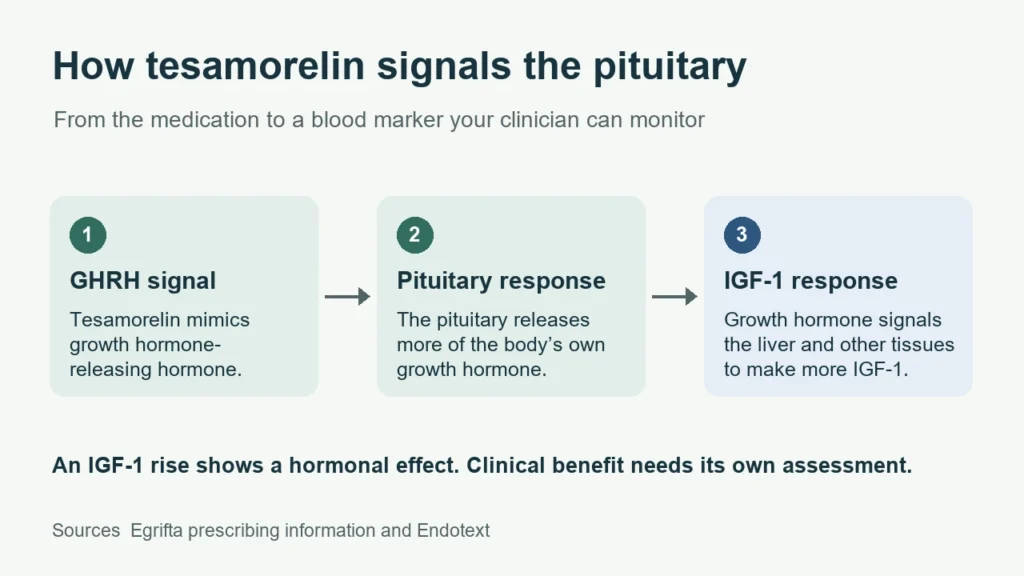
Tesamorelin is a synthetic analog of growth hormone-releasing hormone (GHRH). It acts on the pituitary, stimulating release of the body’s own GH. GH then signals the liver and other tissues to make IGF-1. The drug stimulates endogenous release. Recombinant human growth hormone supplies the hormone directly. [1, 3, 5]
| Tesamorelin | Sermorelin | |
|---|---|---|
| Shared pathway | Mimics GHRH and stimulates pituitary GH release. [1, 5] | Stimulates pituitary GH release through the same basic pathway. [6] |
| U.S. evidence and status | Egrifta is FDA approved to reduce excess abdominal fat in adults with HIV-associated lipodystrophy. [1, 2, 7] | Historical Geref products had pediatric or diagnostic uses and were discontinued. FDA found the withdrawals unrelated to safety or effectiveness. [6] |
| What you can compare | Randomized human trials measured visceral abdominal fat and IGF-1 in the HIV population. [7, 8] | No direct comparison establishes relative clinical potency, duration of effect, or visceral fat benefit in comparable patients. [5–8] |
What results did tesamorelin trials measure and when?
Randomized trials in adults with HIV and excess abdominal fat measured changes in visceral fat at 26 weeks. Some participants continued treatment or switched to placebo for another 26 weeks. Deep abdominal fat tended to return after switching to placebo. The trials provide no reliable timetable for sleep, energy, or exercise recovery.
Visceral adipose tissue (VAT) is deep abdominal fat around internal organs and is associated with metabolic risk. In a 26-week randomized trial of 412 adults with HIV and excess abdominal fat, CT-measured VAT fell 15.2% with tesamorelin and rose 5.0% with placebo. IGF-1 increased by 81.0% and decreased by 5.0%, respectively. Both comparisons had p < 0.001. These are group averages. [7]
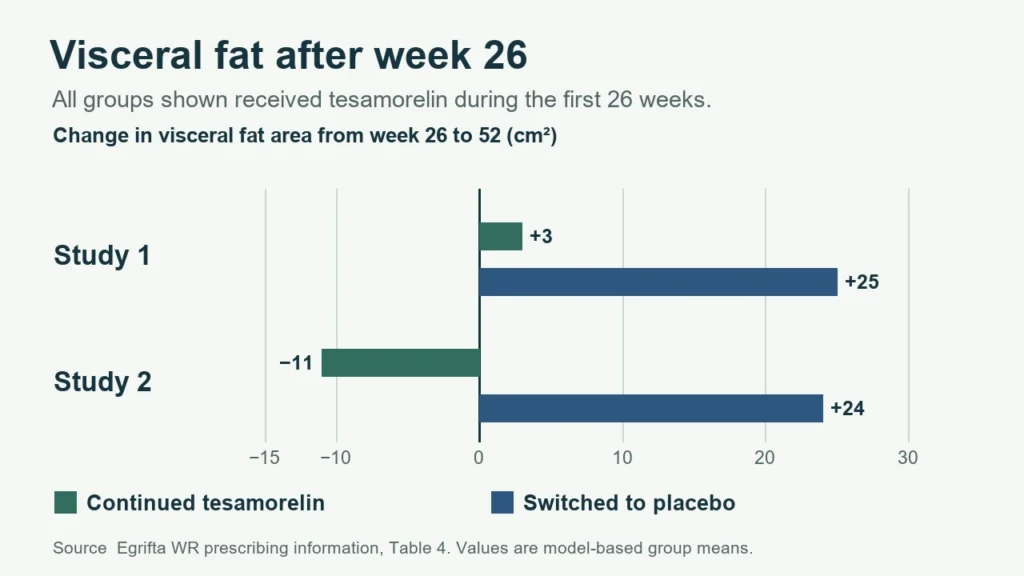
The extension studies measured change from week 26 to week 52 in people who had already received tesamorelin. As the chart shows, visceral fat increased after switching to placebo in both studies. A separate analysis found that participants whose visceral fat decreased also tended to have improvements in the liver enzymes ALT and AST. That association does not establish an approved liver treatment. [1, 8, 9]
Tesamorelin is used for a specific fat distribution problem. The label describes a weight-neutral effect and excludes general weight management. Evidence is insufficient to predict muscle preservation, workout recovery, earlier sleep or energy improvements, or added benefit during a calorie deficit. [1, 2, 7, 8]
What should you know about IGF-1 and glucose monitoring?
IGF-1 helps clinicians track how the body responds to tesamorelin and recognize sustained elevations. A higher result cannot establish how much visceral fat changed. Your clinician interprets IGF-1 alongside glucose, side effects, and treatment response. There is no universal IGF-1 target or guaranteed rise for someone starting with a low level.
Prolonged elevations in IGF-1 have uncertain effects. The label advises monitoring and says clinicians should consider stopping therapy if IGF-1 stays elevated, for example above 3 standard deviation scores, especially with limited clinical benefit. High-normal baseline results do not guarantee a ceiling. Sustained energy restriction can lower IGF-1, so interpretation depends on the clinical and nutritional context. [1–4]
Tesamorelin can raise glucose and may contribute to glucose intolerance or diabetes. Check glucose status before and during treatment. In the trials summarized in the WR label, 5% of tesamorelin recipients versus 1% taking placebo reached an HbA1c of at least 6.5% by week 26. The label recommends periodic monitoring for new or worsening retinopathy in patients with diabetes. Long-term cardiovascular safety remains unknown. [1, 2]
Tell your prescriber about any history of cancer, pituitary disease, cranial irradiation or head trauma. The label lists pregnancy, active malignancy, disruption of the hypothalamic-pituitary axis, and known hypersensitivity as contraindications. Report new swelling, joint pain, or persistent side effects promptly. [1, 2]
What can you do if a tesamorelin injection stings?
Injection-site discomfort, redness, or irritation can occur with tesamorelin. Rotate sites on the abdomen and follow the instructions for your exact formulation. Egrifta SV is used immediately after mixing, and WR has different storage requirements. Ask your clinician or pharmacist to review your technique if stinging keeps happening or becomes worse.
| Formulation | Labeled schedule | Preparation and handling |
|---|---|---|
| Egrifta SV | Under the skin, once daily. | Mix the single-dose vial and use the solution immediately. Discard leftovers. [2] |
| Egrifta WR | Under the skin, once daily. | One mixed vial provides seven daily doses. Store the mixed vial at the labeled room temperature and discard unused solution seven days after mixing. [1] |
- Follow the correct product instructions. The SV and WR formulations have different doses and mixing instructions and should not be interchanged. [1, 2]
- Use a different abdominal spot each day. Avoid the navel, scars, and bruises. Ask a pharmacist or clinician to check your technique before changing the angle, depth, or speed on your own. [1, 2, 10]
- Report persistent or worsening redness, swelling, or pain. Get emergency care for trouble breathing, facial or throat swelling, or fainting. [1, 2, 10]
Check the instructions before letting a prepared dose sit or trying a warming method. Egrifta SV’s immediate-use directions take priority. [2]
Common questions about PEPLIX HEALTH
Peplix Health is a cash-pay telehealth service managed by Monarch Brands LLC. An independent, board-certified physician evaluates your medical history, goals, and relevant labs. When treatment is appropriate, the physician individualizes the prescription and follow-up. A state-licensed pharmacy can dispense an eligible compounded preparation when applicable Section 503A and state requirements are met.
Does Peplix Health recommend tesamorelin for a calorie deficit?
The approved use is excess abdominal fat in adults with HIV-associated lipodystrophy. Evidence has not established tesamorelin as a way to improve general weight loss or preserve muscle during a calorie deficit. A physician can evaluate options for your diagnosis and goals. [1, 2, 7, 8]
Is compounded tesamorelin the same as FDA-approved Egrifta?
Compounded medicines do not receive FDA premarket review for safety, effectiveness, or quality. An eligible Section 503A preparation requires a valid prescription for an identified patient, compliant ingredients and applicable quality standards. Restrictions apply to making copies of commercially available products. Discuss the medical need and pharmacy with your care team. [11, 12]
How should I prepare for a Peplix Health visit?
Bring your diagnosis, medication list, recent labs, and questions about the outcome you want to improve. If you already have a prescription, bring the product name and instructions so the physician can identify the formulation.
For consultation information, see our longevity guide or start an online assessment.
Medical information notice
This article is educational. A licensed clinician can assess the benefits, risks, and alternatives for your situation.
Sources
- DailyMed. Egrifta WR prescribing information and instructions for use.
- DailyMed. Egrifta SV prescribing information and instructions for use.
- Endotext. Normal physiology of growth hormone in adults.
- Endotext. Regulation of GH secretion by glucose, sleep and nutrition.
- FDA. Egrifta clinical pharmacology and biopharmaceutics review (2010).
- FDA. Federal Register determination concerning discontinued Geref products.
- Falutz et al. Randomized 26-week tesamorelin trial in adults with HIV.
- Falutz et al. Pooled phase 3 trial and extension analysis.
- Fourman et al. Visceral fat changes and liver enzymes in adults with HIV.
- MedlinePlus. Tesamorelin injection patient information.
- FDA. Compounding and FDA oversight questions and answers.
- FDA. FD&C Act provisions for patient-specific compounding.
This article is for general education and is not medical advice. Talk with a licensed clinician before starting, stopping or changing any treatment. Compounded medications are not FDA-approved. See our safety information.
Keep reading

Peptides & Longevity
BPC-157 and Growth Hormone in Tendon Recovery
Learn what BPC-157 studies found in rat tendon cells, what IGF-1 can tell you, and why tesamorelin has no proven role in tendon recovery.

Peptides & Longevity
Growth Hormone Secretagogues and the Evidence Behind Them
Compare tesamorelin, sermorelin, CJC-1295, ipamorelin and MK-677. Learn what studies found about GH, IGF-1, safety and FDA status.

Peptides & Longevity
What the FDA Peptide Compounding Review Means for Patients
See what the July 2026 FDA advisory votes and HHS draft mean for BPC-157, TB-500, Semax, and other peptides considered for 503A compounding.