BPC-157 and Growth Hormone in Tendon Recovery
Learn what BPC-157 studies found in rat tendon cells, what IGF-1 can tell you, and why tesamorelin has no proven role in tendon recovery.

Rat tendon-cell experiments suggest BPC-157 can affect cell movement and growth hormone receptor expression. Human studies have yet to show that it speeds tendon healing, that low growth hormone explains mixed responses, or that adding tesamorelin improves recovery. An insulin-like growth factor 1 test can inform an evaluation for suspected growth hormone deficiency.
Why do people report different results with BPC-157?
People with different injuries, recovery timelines and rehabilitation plans may report different changes in pain or function. Those reports cannot establish how much improvement came from BPC-157. Human evidence for tendon healing is limited, and no validated test identifies who will respond to BPC-157 or explains why someone felt no change.
After an operation, around a shoulder injury or during tendon rehab, symptoms can fluctuate as activity changes and tissue heals. People may be comparing different diagnoses, treatments and time points. Differences in preparation or quality introduce additional uncertainty. Current evidence does not show which factor explains any individual experience, including growth hormone levels. [3, 4, 14]
A 2026 systematic review found three small human studies with 30 participants total. The only musculoskeletal study in that review was an uncontrolled, retrospective knee-pain series. The other two examined interstitial cystitis and short-term intravenous safety. An improvement in reported knee pain cannot establish tendon repair, faster postsurgical healing or reliable safety. [3, 4]
What did BPC-157 do in rat tendon cells?
Two studies found different effects in rat tendon experiments. One linked BPC-157 exposure with cell migration and better survival during oxidative stress. Another found increased growth hormone receptor expression. After researchers added growth hormone, they observed JAK2 signaling and more cell proliferation. Both experiments measured cell behavior under laboratory conditions.
In 2011, researchers used rat Achilles tendon tissue and cultured fibroblasts, cells that help maintain connective tissue. BPC-157 exposure increased cell outgrowth from tissue samples and migration in culture. The cells also survived oxidative stress better. The researchers observed signaling changes involving focal adhesion kinase (FAK) and paxillin, proteins involved in how cells attach and move. The migration and survival experiments did not require added growth hormone. BPC-157 alone did not directly increase proliferation in the assay used. [1]
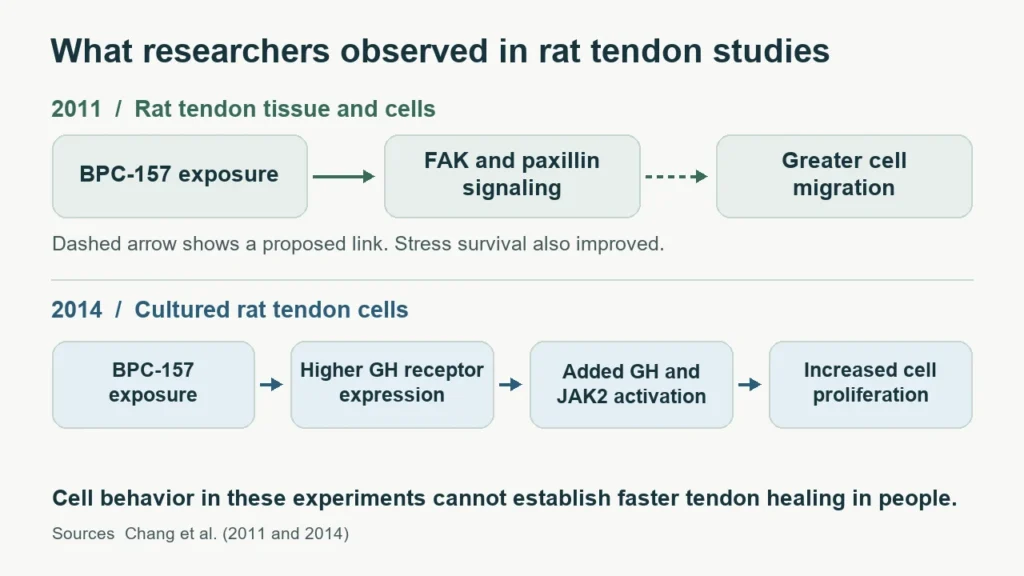
In 2014, rat Achilles tendon fibroblasts exposed to BPC-157 showed more growth hormone receptor messenger RNA and protein, with changes depending on concentration and exposure time. After growth hormone (GH) was added, the researchers observed time-dependent activation of Janus kinase 2 (JAK2) and increased proliferation. They assessed proliferation with a cell assay and expression of PCNA, a marker associated with proliferation. [2]
These results give researchers a way to investigate how the cells respond to GH. Whether those changes translate into stronger tendons, faster return to activity or better surgical recovery in people remains unknown. The experiments did not test human GH or IGF-1 levels as predictors of response. [1–4]
Can an IGF-1 test explain why BPC-157 felt ineffective?
IGF-1 can help a clinician evaluate suspected growth hormone deficiency, but it has no validated use for predicting a BPC-157 response. Growth hormone secretion generally declines with age and occurs in pulses. Physicians interpret IGF-1 in context, using age-adjusted ranges and, when indicated, a stimulation test to evaluate pituitary reserve.
Much of the IGF-1 in the blood is made by the liver in response to GH. A random GH level is hard to interpret because it can be low between normal pulses. Endotext describes about a 15% decline in GH secretion per decade after the third decade of life on average. Individual levels vary, and age-related changes alone do not establish a pituitary disorder. [5, 6]
1. Start with the clinical reason for testing. Tell your physician about pituitary disease or surgery, radiation, significant head trauma or other pituitary hormone deficiencies. These factors can make a GH deficiency evaluation appropriate. [6]
2. Review what could affect the result. An age-adjusted IGF-1 below range deserves interpretation. Liver disease, poorly controlled diabetes and oral estrogen use can influence it. A normal IGF-1 result also does not rule out deficiency when there is a strong clinical reason to investigate. [6]
3. Confirm the diagnosis when needed. A clinician may refer you to endocrinology for a validated GH stimulation test. Confirmed adult GH deficiency may be treated with prescription growth hormone replacement, with dose and follow-up individualized to the diagnosis and clinical response. [6, 23]
Can sleep or alcohol affect growth hormone release?
A major GH pulse often occurs after sleep onset, particularly during deep sleep. Sleep deprivation can disrupt that pattern, and human experiments found that alcohol can suppress nighttime GH release. Addressing sleep and alcohol use is relevant to general health. Human evidence does not establish either change as a way to make BPC-157 more effective. [5, 7, 8]
Does adding tesamorelin have a proven recovery benefit?
Tesamorelin stimulates pituitary growth hormone release and raises IGF-1. Its FDA-approved use is reducing excess abdominal fat in adults with HIV-associated lipodystrophy. The human trial measured changes in visceral fat and blood markers. Controlled studies have yet to show that adding tesamorelin or another GH-stimulating drug to BPC-157 improves tendon recovery.
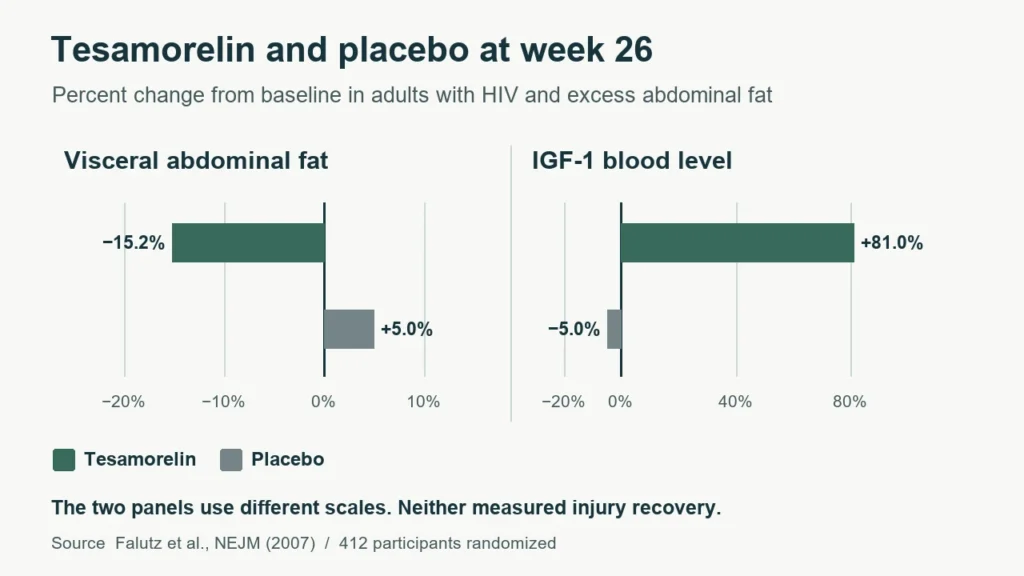
Tesamorelin is an analog of growth hormone-releasing hormone (GHRH). In the 2007 randomized study, 412 adults with HIV and excess abdominal fat received tesamorelin or placebo for 26 weeks. Visceral abdominal fat fell 15.2% with tesamorelin and rose 5.0% with placebo. Blood IGF-1 rose 81.0% and fell 5.0%, respectively. Both comparisons had p < 0.001. [9, 10]
| Therapy | Where the evidence applies | What remains unproven |
|---|---|---|
| Tesamorelin (Egrifta) | Human trials and FDA approval for excess abdominal fat in adults with HIV-associated lipodystrophy. [9, 10] | Tendon healing or faster recovery with BPC-157. |
| Sermorelin | GHRH analog with historical FDA-approved Geref products that were discontinued. [11] | Benefit for injury recovery or when combined with BPC-157. |
| CJC-1295 and ipamorelin | Stimulate GH release through different pathways. Neither has FDA approval. [4, 12, 13] | Clinical benefit for tendon recovery or a combination with BPC-157. |
| Prescription GH replacement | A supervised option for confirmed adult GH deficiency. [6] | A role as an add-on to BPC-157 for injury recovery. |
Egrifta’s prescribing information calls for glucose assessment before and during treatment and IGF-1 monitoring during therapy. A biomarker response in the approved population does not validate a recovery regimen. Clinician anecdotes cannot establish safety or effectiveness of combining these medicines. [3, 4, 10]
What should you discuss before deciding on next steps?
Start by asking what is slowing recovery and whether the injury diagnosis or rehabilitation plan needs review. BPC-157 has no FDA-approved use, and a draft HHS compounding policy is a separate regulatory development. If you compete in tested sport, anti-doping rules matter even when a substance is discussed in a clinical setting.
Describe when pain started, what loads or movements worsen it, and what has changed with rehabilitation. A clinician can assess whether you need an examination, physical therapy or a referral. For example, a guideline for midportion Achilles tendinopathy supports individualized tendon-loading exercise after assessment. Acute injuries and postoperative recovery may require a different plan. [20]
FDA highlights the potential for immune reactions by some routes, peptide impurities and difficulty confirming ingredient identity for BPC-157. The July 2026 advisory review concerned ulcerative colitis. HHS’s October 30 Federal Register notice identifies its six-peptide enforcement discretion policy as a draft. The public record reviewed on November 20, 2026, did not establish FDA approval or final 503A listing for BPC-157. [14–17]
Athlete advisory. WADA’s 2026 list prohibits BPC-157 under S0 and TB-500 under S2 at all times. GH and several GH-stimulating drugs are prohibited, including tesamorelin, sermorelin, CJC-1295 and ipamorelin. USADA also flags BPC-157 and TB-500. If you are subject to testing, check with your anti-doping organization before starting a treatment and ask about therapeutic use exemption rules where relevant. [18, 19]
Common questions about PEPLIX HEALTH
Peplix Health is a cash-pay telehealth service managed by Monarch Brands LLC. An independent, board-certified physician reviews symptoms, history and appropriate labs. When clinically indicated, the physician individualizes the prescription, dose and follow-up. A state-licensed pharmacy can fill patient-specific compounded prescriptions when the preparation meets applicable Section 503A and state requirements.
Should I get an IGF-1 test if BPC-157 did not help?
BPC-157 response is not an indication for IGF-1 testing. A physician can decide whether symptoms, pituitary history or other findings warrant an endocrine evaluation. [3, 6]
Is BPC-157 with tesamorelin a proven tendon treatment?
Controlled human evidence has yet to show that this combination improves tendon healing. Tesamorelin’s approved use concerns excess abdominal fat in adults with HIV-associated lipodystrophy. [3, 4, 10]
Does a Section 503A prescription mean FDA approved the product?
Section 503A governs eligibility and requirements for certain compounding. FDA does not review compounded medicines for safety, effectiveness or quality before marketing. The licensed dispensing pharmacy verifies applicable ingredient, quality and prescription requirements. [21, 22]
What should I bring to a Peplix Health visit?
Bring your diagnosis or surgery details, relevant labs, medication and supplement list, and a short record of what has helped or worsened symptoms. Mention competitive sport and testing requirements if they apply.
For consultation information, see our longevity guide or start an online assessment.
Medical information notice
This article is educational. Discuss diagnosis, recovery plans and medication decisions with a licensed healthcare professional.
Sources
- Chang et al. Rat tendon fibroblast outgrowth, migration and stress survival (2011).
- Chang et al. GH receptor expression in rat tendon fibroblasts (2014).
- Acta Orthopaedica Belgica. Systematic review of human BPC-157 evidence (2026).
- Journal of the American Academy of Orthopaedic Surgeons. Investigational peptides review (2026).
- Endotext. Growth hormone and aging.
- Endocrine Society. Evaluation and treatment of adult GH deficiency.
- Van Cauter and Copinschi. Growth hormone and sleep.
- Prinz et al. Alcohol and nighttime GH secretion.
- Falutz et al. Randomized tesamorelin trial in adults with HIV (2007).
- DailyMed. Egrifta WR U.S. prescribing information.
- FDA. Federal Register determination concerning discontinued Geref products.
- FDA. CJC-1295 bulk substance briefing.
- FDA. Ipamorelin bulk substance briefing.
- FDA. Bulk substances that may present significant safety risks.
- FDA. July 2026 advisory committee agenda and materials.
- Federal Register. HHS draft enforcement discretion policy notice.
- 21 CFR 216.23. Codified Section 503A Bulks List.
- WADA. 2026 Prohibited List.
- USADA. Athlete advisory on prohibited peptides.
- JOSPT. Midportion Achilles tendinopathy guideline (2024).
- FDA. Compounding and FDA questions and answers.
- FDA. Bulk ingredients and the Section 503A framework.
- AACE. Clinical guideline for adult GH deficiency.
This article is for general education and is not medical advice. Talk with a licensed clinician before starting, stopping or changing any treatment. Compounded medications are not FDA-approved. See our safety information.
Keep reading

Peptides & Longevity
Growth Hormone Secretagogues and the Evidence Behind Them
Compare tesamorelin, sermorelin, CJC-1295, ipamorelin and MK-677. Learn what studies found about GH, IGF-1, safety and FDA status.
Peptides & Longevity
What the FDA Peptide Compounding Review Means for Patients
See what the July 2026 FDA advisory votes and HHS draft mean for BPC-157, TB-500, Semax, and other peptides considered for 503A compounding.
Peptides & Longevity
BPC-157 Research and Safety in Humans
What do BPC-157 human studies show? Review the knee and bladder pilots, tissue studies, safety gaps, and current FDA compounding status.