BPC-157 Research and Safety in Humans
What do BPC-157 human studies show? Review the knee and bladder pilots, tissue studies, safety gaps, and current FDA compounding status.

BPC-157 has been studied in animals, human tissue outside the body, and a few small patient studies. These findings have yet to establish that BPC-157 heals injuries, improves gut symptoms, or is safe for routine use. It has no FDA-approved indication. The strength of the evidence depends on what researchers measured and where.
Why are people asking about BPC-157?
People ask about BPC-157 when pain, a nagging injury, or slow recovery interrupts daily life. Animal and laboratory findings help explain interest in tendons, ligaments, joints, and the gut. The question for patients is whether a particular use improves symptoms or function safely in people with the same condition.
Someone with lingering pain may be trying to return to training, keep up with a physical job, or follow a postoperative plan. Others come with concerns about gastrointestinal symptoms or inflammation. These situations have different causes, outcomes, and treatment options. A report about one kind of knee pain cannot answer whether a tendon heals faster or whether a gastrointestinal condition improves. [1–4]
The literature describes BPC-157 as a stable gastric pentadecapeptide, meaning it contains 15 amino acids. Researchers have examined wound repair, inflammatory signaling, and vascular responses. Those lines of investigation are far more developed in laboratory and animal studies than in clinical research. [1, 2, 7]
What do the BPC-157 human studies actually show?
One orthopedic review found 544 records and included 36 studies, only one of which was clinical. A later review identified three small human studies with 30 participants altogether. Reports of knee or bladder symptom relief are preliminary, and a two-person intravenous pilot cannot establish safety or guide routine use.
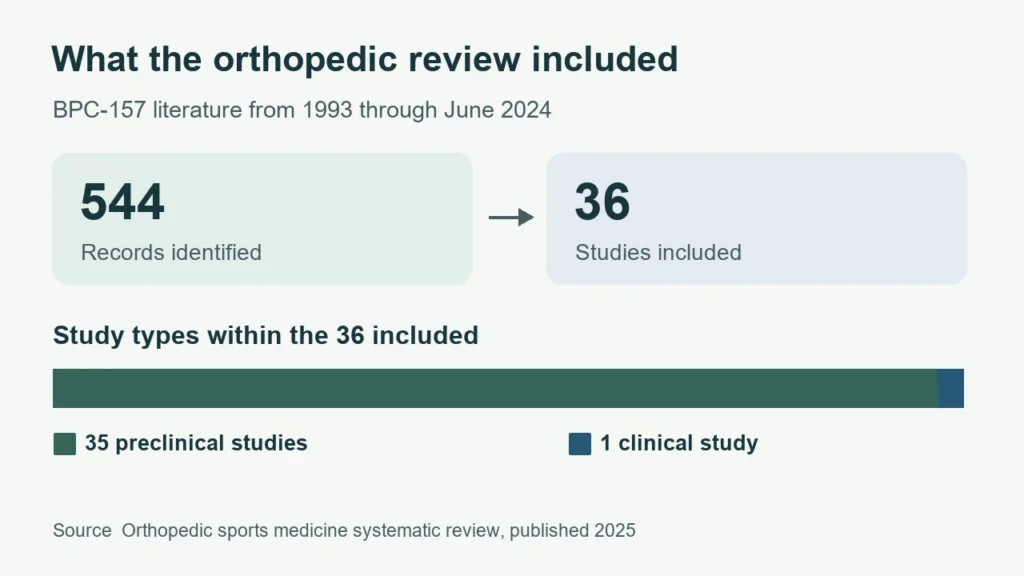
The 2025 orthopedic review searched through June 2024 and found records going back to 1993. The 2025 narrative review described early work in knee pain, bladder symptoms, and intravenous safety and pharmacokinetics. A 2026 systematic review that searched through June 1 rated the overall certainty of evidence very low. These reviews used different scopes and search dates. [1–3]
| Study | What researchers reported | What the design can tell us |
|---|---|---|
| Knee pain 2021 · 16 contacted | 14 reported relief after joint injections. That included 11 of 12 who received BPC-157 alone and 3 of 4 who also received thymosin beta-4. [4] | Retrospective, unblinded and uncontrolled. Pain reports cannot establish tissue repair or isolate a treatment effect. |
| Interstitial cystitis 2024 · 12 women | Participants reported improved bladder symptoms after treatment around inflamed areas during cystoscopy. [5] | Small pilot without a comparison group. It cannot establish efficacy or predict results for other bladder conditions. |
| Intravenous safety 2025 · 2 adults | The investigators reported no adverse effects in the two participants during short-term observation. [6] | Very small safety pilot. It cannot rule out uncommon or delayed harm, or establish safety for other routes. |
Thymosin beta-4 in the knee report is the name used by the investigators. TB-500 is separately identified on the anti-doping list. [4, 17]
What did artery studies find about nitric oxide?
In isolated rat aorta, BPC-157 affected endothelial nitric oxide signaling and vessel tone. A 2026 human artery experiment also found concentration-dependent relaxation, with a greater response when the vessel lining was intact. These experiments measured tissue outside the body and cannot show improved circulation or healing in patients.
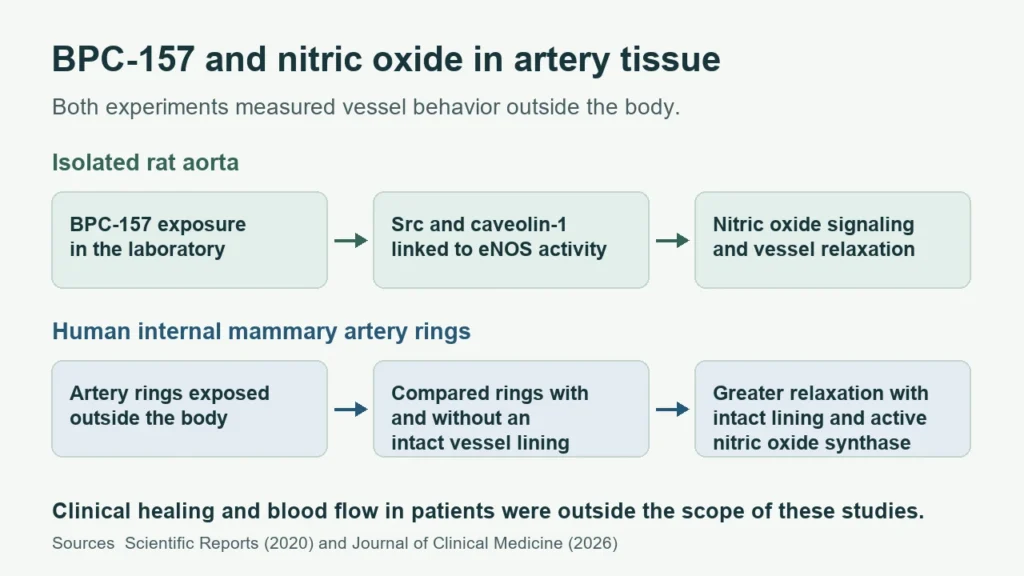
Endothelial cells line blood vessels. In the rat study, BPC-157 increased nitric oxide generation and affected a pathway involving Src, caveolin-1 and endothelial nitric oxide synthase (eNOS). Changes in these signals were associated with relaxation in an isolated aorta. Blocking nitric oxide signaling reduced that response. [8]
The human experiment used internal mammary artery tissue from 12 coronary bypass patients. It found greater relaxation in rings with intact endothelium. An inhibitor of nitric oxide synthase reduced relaxation, and some response remained. The tissue itself responded in the lab. The study did not administer BPC-157 to those patients or measure their recovery. [9]
What have researchers found in tendon and gut models?
BPC-157 has shown signals in animal and laboratory models of musculoskeletal and gastrointestinal injury. Rat studies report changes in growth hormone receptor expression, tissue repair, and blood supply. These are reasons for further investigation. They do not show that people recover faster after an injury, procedure, or gastrointestinal illness.
What did the connective tissue studies measure?
Reviews describe animal studies involving muscle, tendon, ligament, and bone injuries. Proposed mechanisms include effects on signals for blood vessel formation and on inflammatory cytokines. Cultured rat tendon fibroblasts expressed more growth hormone receptor messenger RNA and protein after exposure. Adding growth hormone increased proliferation and activated JAK2, a downstream signaling protein. [1, 7, 10]
In a rat model of injury at the point where muscle meets tendon, BPC-157-treated animals had better outcomes on gross inspection, microscopy, mechanical testing and functional measures than controls. Those measurements apply to the animal model. Controlled human studies are needed to test whether recovery improves after tendon or ligament injury, joint problems, or surgery. [1, 3, 11]
Do the gut studies show a benefit in patients?
Laboratory and animal research covers gastrointestinal injury, protection of cells and tissue, healing at sites where intestinal segments are surgically joined, and fistulas, which are abnormal connections between organs or tissues. Rat models of colitis and interrupted blood supply reported changes in collateral blood flow and injury to the colon lining. These findings have yet to establish a clinical benefit for gut symptoms or inflammatory bowel disease. [7, 12–14]
What do FDA status and safety mean for a patient?
BPC-157 has no FDA-approved use. FDA has raised concerns about ingredient identity, impurities, and possible immune reactions. An HHS draft describes proposed federal enforcement discretion for certain peptide preparations, including BPC-157. That development cannot establish clinical benefit or settle whether a specific pharmacy can dispense a product in your state.
The October 30, 2026 Federal Register notice describes the HHS policy as a draft. As of November 20, BPC-157 did not appear on the codified Section 503A Bulks List. A draft or an advisory vote does not establish FDA approval. Ingredient eligibility, a valid prescription for the individual, pharmacy quality controls and state requirements are separate checks in an eligible compounding workflow. [14–16, 19–21]
Athlete advisory. WADA prohibits BPC-157 under S0 and TB-500 under S2 at all times, in and out of competition. USADA also flags both. If you are subject to testing, avoid products containing either substance and ask your anti-doping organization about the rules before taking a new product. [17, 18]
What does useful follow-up look like in clinical care?
Useful follow-up starts with a diagnosis and a clear baseline for pain, symptoms, or activity. A clinician can record what changes, what other care is underway, and which side effects appear over time. Consistent tracking can guide an individual care decision and generate research questions. Controlled studies are needed to test cause and effect.
Bring your timeline of symptoms, the activities you want to resume, and any recent evaluation, procedure notes or test results. Discuss whether you need an exam or referral and which established options fit your situation. The same measures at follow-up help you compare progress against your starting point.
- Record the diagnosis, relevant health history, baseline symptoms, functional goals, and other treatments.
- If a clinician prescribes treatment, document the exact product, route, prescribed dose, and duration. Agree on when and how to follow up.
- Repeat the same symptom or function measures. Record both patient-reported outcomes and clinical observations, including limited benefit, tolerability, and adverse events.
- When outcomes are collected for research, use consistent definitions, record missing follow-ups, and protect patient privacy. Aggregate findings can help frame a controlled study.
Common questions about PEPLIX HEALTH
Peplix Health is a cash-pay telehealth service managed by Monarch Brands LLC. An independent, board-certified physician evaluates your symptoms, history, and goals. When treatment is clinically appropriate, the physician individualizes the prescription, dose, and follow-up. A state-licensed pharmacy can dispense a patient-specific compounded prescription when applicable Section 503A and state requirements are met.
Does BPC-157 have proven benefits for injuries or gut symptoms?
Human evidence remains very limited. The early knee and bladder reports measured symptoms in small, uncontrolled groups. Lab and animal studies cannot establish that BPC-157 improves tendon healing, post-procedure recovery, or gut symptoms in patients. [1–5, 12–14]
Does a Section 503A prescription mean FDA approved the drug?
Section 503A sets conditions for eligible compounding. FDA does not review compounded drugs for safety, effectiveness or quality before marketing. A licensed dispensing pharmacy must confirm that the applicable requirements are met. [19–21]
Can I use a Peplix Health visit to discuss injuries or peptide claims?
You can bring the exact claim, relevant diagnosis or procedure details, and the list of medicines and supplements you use. A physician can discuss the evidence, established options, and whether an in-person exam or referral is appropriate.
For consultation information, see our longevity guide or start an online assessment.
Medical information notice
This article is educational. A licensed clinician can help you assess treatment risks, benefits, and alternatives for your situation.
Sources
- Orthopedic sports medicine systematic review (2025).
- Regeneration or Risk? Narrative review of musculoskeletal research (2025).
- Systematic review of BPC-157 human evidence (2026).
- Lee and Padgett. Retrospective knee pain report (2021).
- Lee et al. Interstitial cystitis pilot (2024).
- Lee and Burgess. Two-person intravenous safety pilot (2025).
- Pharmaceuticals. Review of experimental BPC-157 findings (2025).
- Scientific Reports. Rat aorta and endothelial nitric oxide signaling (2020).
- Journal of Clinical Medicine. Human internal mammary artery experiments (2026).
- Molecules. Growth hormone receptor expression in rat tendon fibroblasts (2014).
- Biomedicines. Rat myotendinous-junction injury study (2021).
- Gastroenterology Research and Practice. Gastric cytoprotection review (2020).
- World Journal of Gastroenterology. Rat colitis and ischemia-reperfusion (2017).
- FDA. BPC-157 evaluation for the July 2026 advisory committee meeting.
- Federal Register. HHS notice of draft peptide compounding policy (October 2026).
- HHS. Peptide enforcement discretion policy text and covered ingredients.
- WADA. 2026 Prohibited List.
- USADA. Athlete advisory on prohibited peptides.
- FDA. Compounding and FDA oversight questions and answers.
- FDA. Section 503A bulk ingredient eligibility.
- 21 CFR 216.23. Codified Section 503A Bulks List.
This article is for general education and is not medical advice. Talk with a licensed clinician before starting, stopping or changing any treatment. Compounded medications are not FDA-approved. See our safety information.
Keep reading

Peptides & Longevity
BPC-157 and Growth Hormone in Tendon Recovery
Learn what BPC-157 studies found in rat tendon cells, what IGF-1 can tell you, and why tesamorelin has no proven role in tendon recovery.

Peptides & Longevity
Growth Hormone Secretagogues and the Evidence Behind Them
Compare tesamorelin, sermorelin, CJC-1295, ipamorelin and MK-677. Learn what studies found about GH, IGF-1, safety and FDA status.

Peptides & Longevity
What the FDA Peptide Compounding Review Means for Patients
See what the July 2026 FDA advisory votes and HHS draft mean for BPC-157, TB-500, Semax, and other peptides considered for 503A compounding.