Sermorelin and Growth Hormone Peptides
Learn how sermorelin differs from HGH, what IGF-1 tests can tell you, and which timing and storage questions to ask a clinician or pharmacist.

Sermorelin is a short-acting peptide that stimulates the pituitary gland to release growth hormone. It differs from growth hormone replacement, which supplies the hormone directly. Adult wellness benefits and long-term schedules remain unproven. A clinician can evaluate symptoms and IGF-1 results, while a pharmacist can confirm formulation-specific storage and injection instructions.
How does sermorelin differ from HGH?
Sermorelin mimics part of growth hormone-releasing hormone and relies on a responsive pituitary to release growth hormone. Somatropin supplies recombinant human growth hormone directly. These different mechanisms do not establish that sermorelin is safer or better tolerated. Suspected adult growth hormone deficiency usually calls for specialist testing before treatment is selected.
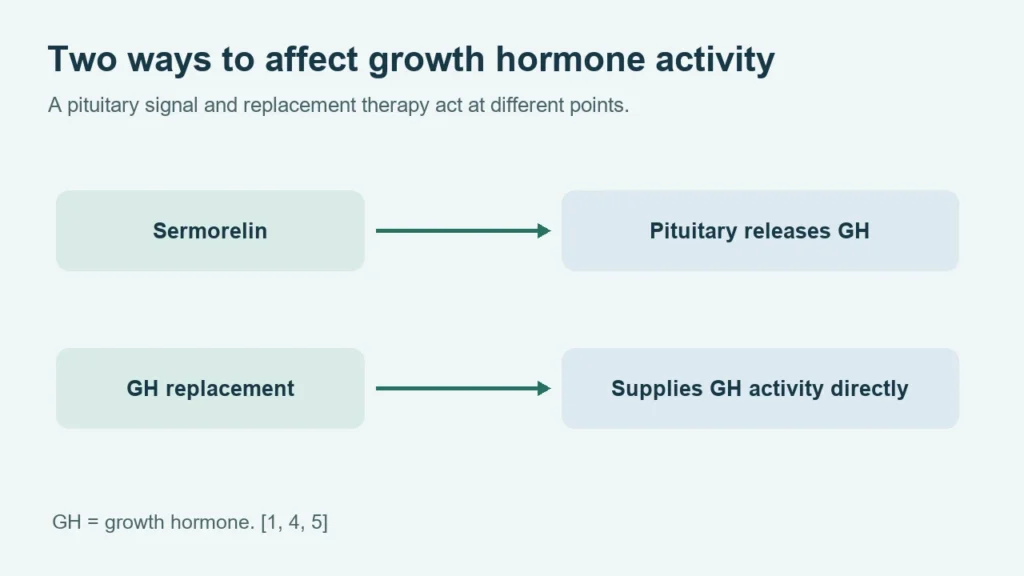
| Option | How it works | Clinical context |
|---|---|---|
| Sermorelin | Prompts the pituitary to release growth hormone, which can stimulate IGF-1 production. | Historically approved Geref products were discontinued. Adult sleep, recovery, and wellness uses lack FDA approval. [1–3] |
| Growth hormone replacement | Supplies growth hormone activity directly. | FDA-approved products are available for confirmed adult growth hormone deficiency. Some long-acting products have a labeled weekly schedule. [4, 5] |
External growth hormone can affect feedback signaling. Whether or how that affects an individual depends on the diagnosis and treatment. A pituitary response to sermorelin is itself a measurable hormonal effect. It does not establish better sleep, sustained energy, recovery, or body composition. [1–4]
What can IGF-1 and treatment timing tell you?
IGF-1 reflects part of the growth hormone axis and is interpreted against an age-adjusted reference range. It cannot show by itself whether symptoms come from a growth hormone disorder or whether treatment will help. Sermorelin’s short blood half-life also does not establish an effective weekly schedule or a timeline for benefits.
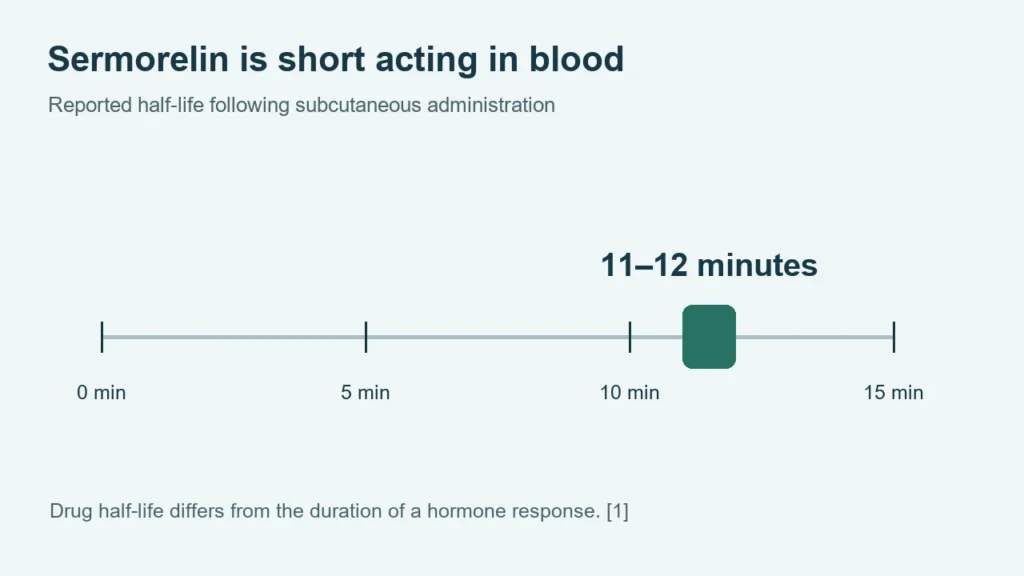
A pharmacology review reports an approximately 11–12 minute half-life after subcutaneous administration. This describes how fast the drug concentration falls and differs from the duration of a downstream growth hormone response. A small study in older men found changes in GH and IGF-1. Evidence does not establish a sequence of sleep changes in weeks, energy gains within a month or two, and later body-composition changes. It also does not establish an effective cycling schedule or long-term safety for wellness use. [1, 4, 6]
- Read IGF-1 in context. A low result can have several explanations, and a normal result may not rule out growth hormone deficiency. Severe nutritional restriction can affect the GH–IGF-1 relationship, while modest calorie restriction has no consistent effect on total IGF-1. It is not established that sermorelin preserves muscle or speeds fat loss in a deficit. [4, 7]
- Ask about meals and sleep. Whey can increase post-meal insulin, but that observation does not establish a 30-minute waiting period. Evidence also does not establish that fasting for one to two hours, morning dosing, or bedtime dosing improves adult clinical outcomes. If sleep worsens, review timing and whether to continue with your prescriber. [1, 7, 8]
How should you handle storage or injection discomfort?
If a clinician prescribes a compounded injectable, use the storage, preparation, and beyond-use instructions from the dispensing pharmacy. Refrigeration by itself does not establish that syringes filled at home stay sterile and stable for a week. Ask your pharmacist to demonstrate the correct syringe marking and explain what to do if injections sting.
- Confirm preparation. Have the pharmacy verify the concentration and prescribed volume. Ask whether the product is dispensed in a vial or a validated prefilled syringe. Prepare a dose close to administration unless the pharmacy provides explicit instructions for that product and container. [9, 10]
- Review discomfort. Mild irritation can occur. Verify the prescribed injection site and storage directions with the pharmacist before altering technique or warming medication. Persistent or worsening irritation needs clinical advice. [1, 9]
Common questions about PEPLIX HEALTH
Peplix Health offers cash-pay telehealth through a model managed by Monarch Brands LLC. Independent, board-certified physicians assess symptoms, health history, and whether specialist evaluation is needed. If an eligible patient-specific compounded prescription is medically appropriate, a state-licensed pharmacy can dispense it under Section 503A and applicable state rules.
What should I bring to a consultation?
Bring any prior IGF-1 results with the lab’s reference range, medications, symptoms, and any history of a pituitary condition or head radiation. [4]
How does Section 503A pharmacy fulfillment work?
Section 503A generally requires a valid prescription for an identified patient. FDA does not review compounded drugs for safety, effectiveness, or quality before marketing. Ask which pharmacy would dispense your prescription and how it confirms the preparation and storage directions. [10, 11]
For consultation information, see our longevity guide or start an online assessment.
Sources
- Review. Growth hormone secretagogues and pharmacology.
- FDA. Geref withdrawal determination.
- FDA. Advisory committee briefing on growth hormone secretagogues.
- Endocrine Society. Evaluation and treatment of adult GH deficiency.
- FDA. Sogroya prescribing information.
- Corpas and colleagues. GHRH (1–29) in older men.
- Review. Growth hormone, IGF-1, and insulin in health and disease.
- Human study. Insulin response after whey and glucose.
- CDC. Preventing unsafe injection practices.
- FDA. Compounding questions and answers.
- U.S. Code. Pharmacy compounding under Section 503A.
This article is for general education and is not medical advice. Talk with a licensed clinician before starting, stopping or changing any treatment. Compounded medications are not FDA-approved. See our safety information.
Keep reading

Peptides & Longevity
BPC-157 and Growth Hormone in Tendon Recovery
Learn what BPC-157 studies found in rat tendon cells, what IGF-1 can tell you, and why tesamorelin has no proven role in tendon recovery.

Peptides & Longevity
Growth Hormone Secretagogues and the Evidence Behind Them
Compare tesamorelin, sermorelin, CJC-1295, ipamorelin and MK-677. Learn what studies found about GH, IGF-1, safety and FDA status.
Peptides & Longevity
What the FDA Peptide Compounding Review Means for Patients
See what the July 2026 FDA advisory votes and HHS draft mean for BPC-157, TB-500, Semax, and other peptides considered for 503A compounding.