Sermorelin for Muscle Gain and Fat Loss
Can sermorelin build muscle or reduce belly fat? Learn what the studies measured, what IGF-1 can tell you, and when to seek evaluation.

Sermorelin can stimulate growth hormone release, but limited human evidence does not establish that it builds muscle, reduces belly fat, or speeds recovery in otherwise healthy adults. Changes in growth hormone or IGF-1 are laboratory findings. A clinician can look for causes of persistent fatigue or declining strength before considering hormone treatment.
How do sermorelin, growth hormone, and IGF-1 interact?
Sermorelin signals the pituitary to release growth hormone. Growth hormone acts on several tissues and stimulates IGF-1 production in the liver and elsewhere. These pathways help regulate growth, tissue maintenance, protein metabolism, and fat use. A measurable rise in a hormone still leaves open whether muscle, strength, or recovery would improve.
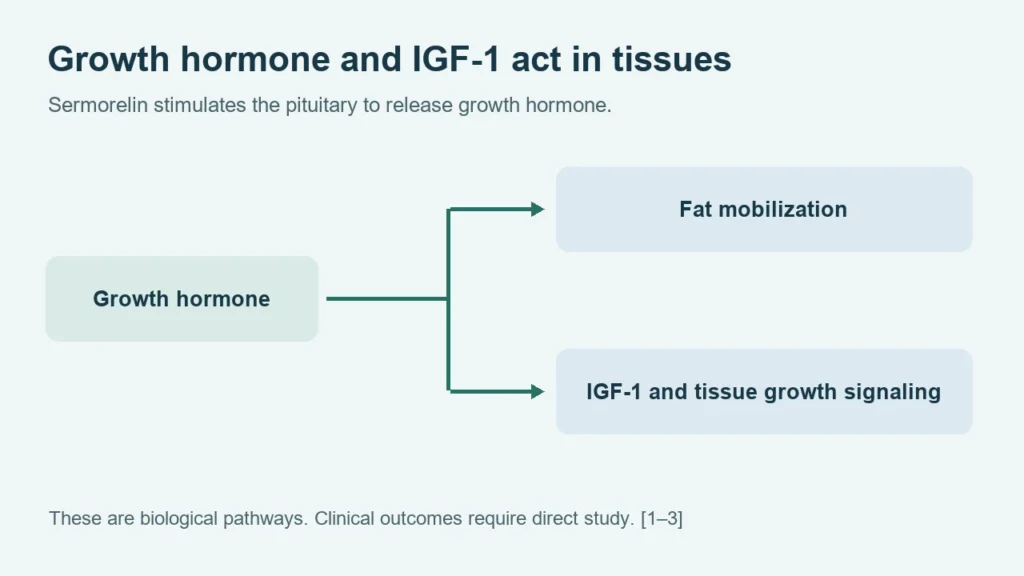
Growth hormone supports fat mobilization. IGF-1 participates in tissue growth and repair signaling, and its blood concentration depends on factors including nutrition and liver function. Growth hormone and IGF-1 patterns may change with age. Declining exercise performance or a change in waist size does not establish growth hormone or testosterone deficiency. A clinician considers medical history, symptoms, and relevant testing. [1–3]
Do the studies show gains in muscle or losses in fat?
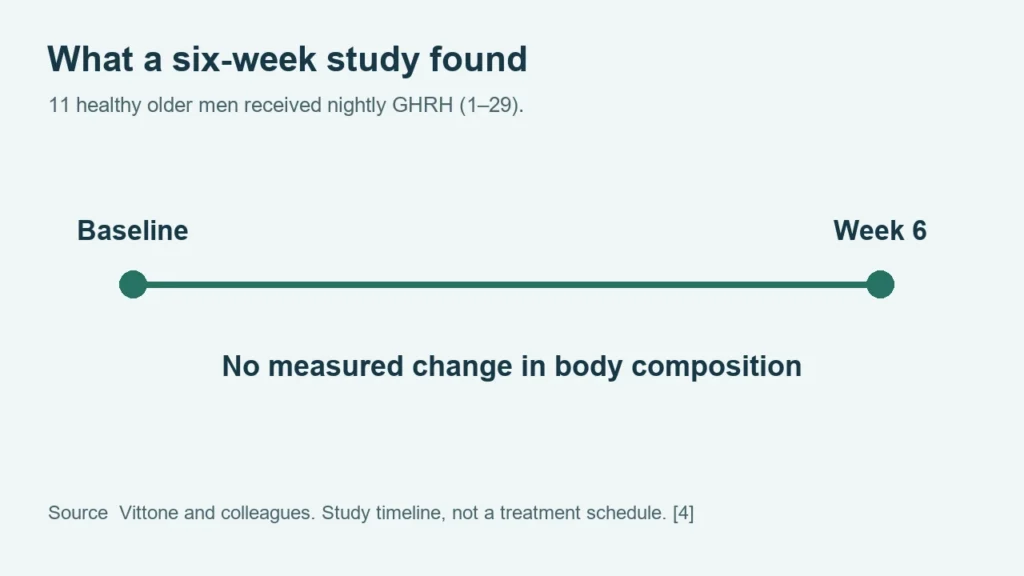
A six-week study of nightly growth hormone-releasing hormone in 11 older men found no measurable change in body composition. Studies of recombinant growth hormone in adults with confirmed deficiency address a different clinical situation. Their results cannot establish that sermorelin will improve strength, endurance, recovery, or waist measurements in healthy adults.
| Study or evidence type | What it assessed | What it can tell you |
|---|---|---|
| Vittone and colleagues | Nightly GHRH (1–29) for six weeks in 11 healthy older men. | Nighttime GH rose without an IGF-1 or DXA change. Two of six strength measures and one endurance test improved. [4] |
| Corpas and colleagues | GHRH (1–29) and the GH–IGF-1 response in older men. | Shows changes in blood markers under study conditions. Does not establish muscle gain. [5] |
| Recombinant GH studies | Growth hormone treatment in adults with confirmed deficiency, or acute protein turnover experiments. | Can inform replacement therapy and physiology. Does not establish benefits from sermorelin in healthy adults. [1, 6, 7] |
The Vittone study enrolled men ages 64 to 76 who had low baseline IGF-1. The small before-and-after study cannot predict results for middle-aged adults or a fat-loss timeline. [4]
Human studies cited for cognition, skin, and sexual function typically involved different populations, growth hormone replacement, or associations with IGF-1. Those findings do not establish that sermorelin improves focus, sleep, collagen, sexual function, or all-day energy. Sleep and growth hormone secretion are linked. That relationship does not demonstrate that raising IGF-1 improves deep sleep. [8–11]
What should you track if body composition is your goal?
Track a few measures you can repeat, such as strength on the same exercises, waist circumference, and changes in recovery or fatigue. Review nutrition, sleep, and training alongside those measures. If symptoms persist or you have a pituitary history, bring that information to a clinician who can determine whether endocrine testing is appropriate.
- Use outcomes that matter to you. Strength training performance and waist measurements answer different questions. A lab result alone cannot show which tissues changed or whether you recovered faster.
- Check safety before discussing injections. Tell your clinician about pregnancy, cancer or cancer history, pituitary conditions, and other serious medical conditions. There is no established daily or three- to six-month sermorelin regimen for adult body recomposition. If an eligible injectable is prescribed, confirm concentration, units, storage, and injection training with the pharmacy. Report persistent irritation or headaches. [1, 2, 12]
Common questions about PEPLIX HEALTH
Peplix Health offers cash-pay telehealth through a model managed by Monarch Brands LLC. Independent, board-certified physicians evaluate symptoms, health history, and available test results. When a patient-specific compounded prescription is medically appropriate and eligible, a state-licensed pharmacy can fill it under Section 503A and applicable state rules.
Does a low IGF-1 level mean I need sermorelin?
No. A clinician interprets IGF-1 using the age-adjusted range and the clinical context. A diagnosis of adult growth hormone deficiency often requires stimulation testing. [1]
What should I ask about 503A pharmacy fulfillment?
Ask why compounding is needed, which pharmacy would dispense the prescription, and what follow-up is planned. Section 503A generally requires a valid prescription for an identified patient. FDA does not review compounded drugs for safety, effectiveness, or quality before marketing. [12, 13]
For consultation information, see our longevity guide or start an online assessment.
Sources
- Endocrine Society. Adult growth hormone deficiency guideline.
- Review. Growth hormone secretagogues and pharmacology.
- Review. Growth hormone, IGF-1, and insulin.
- Vittone and colleagues. Nightly GHRH in healthy older men.
- Corpas and colleagues. GHRH and hormone response in older men.
- Recombinant human GH in adults with deficiency.
- Acute GH and muscle protein synthesis.
- Sleep and the GH–IGF-1 axis.
- GH replacement and cognition after traumatic brain injury.
- Skin characteristics after GH replacement in severe GH deficiency.
- Observational study of IGF-1 and sexual function.
- FDA. Compounding questions and answers.
- U.S. Code. Pharmacy compounding under Section 503A.
This article is for general education and is not medical advice. Talk with a licensed clinician before starting, stopping or changing any treatment. Compounded medications are not FDA-approved. See our safety information.
Keep reading

Peptides & Longevity
BPC-157 and Growth Hormone in Tendon Recovery
Learn what BPC-157 studies found in rat tendon cells, what IGF-1 can tell you, and why tesamorelin has no proven role in tendon recovery.

Peptides & Longevity
Growth Hormone Secretagogues and the Evidence Behind Them
Compare tesamorelin, sermorelin, CJC-1295, ipamorelin and MK-677. Learn what studies found about GH, IGF-1, safety and FDA status.

Peptides & Longevity
What the FDA Peptide Compounding Review Means for Patients
See what the July 2026 FDA advisory votes and HHS draft mean for BPC-157, TB-500, Semax, and other peptides considered for 503A compounding.