Oral vs Injectable Testosterone
Compare oral and injectable testosterone for low T, including dosing routines, lab timing, blood counts, and fertility considerations.

Oral and injectable testosterone can both raise blood testosterone when prescribed for confirmed deficiency. They differ in formulation, meal timing, how hormone levels change between doses, and how follow-up labs are scheduled. Both can suppress sperm production and increase hematocrit. The choice depends on your diagnosis, preferences, fertility plans, and monitoring needs.
How do oral and injectable testosterone differ?
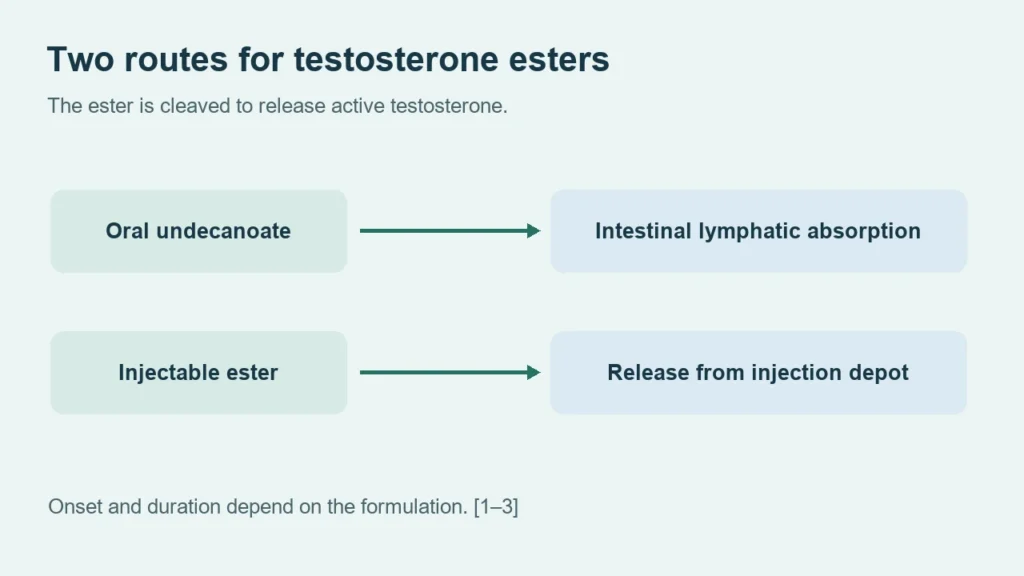
FDA-approved oral testosterone capsules contain testosterone undecanoate and have product-specific food instructions. Some compounded tablets use unesterified testosterone. Oil-based injections commonly use cypionate, enanthate, or undecanoate, which release testosterone over a product-specific interval. A daily capsule avoids injections, while injections avoid having to coordinate each dose with meals.
| Feature | Oral testosterone | Injectable testosterone |
|---|---|---|
| Form | Approved capsules use a testosterone ester. Unesterified tablets are a separate formulation. | Common esters include cypionate, enanthate, and undecanoate. |
| Routine | Approved capsules are taken with food as directed. Excipients vary by product. | Intervals depend on the product. Injection-site discomfort or bruising can occur. |
| Hormone exposure | Oral levels vary with formulation, food, and timing. | Some injections can produce higher peaks and lower troughs, depending on the dose and interval. |
Does oral testosterone raise levels as much as injections?
Both routes can raise serum testosterone, but a company report on oral testosterone plus enclomiphene cannot establish equivalence to injections. Blood draws at different times can produce different estimates of treatment response. Clinicians interpret results using product-specific instructions, dose timing, symptoms, and side effects before considering an adjustment to therapy.
Unesterified testosterone is already active. Esters must be cleaved to release testosterone. Modern oral undecanoate formulations favor intestinal lymphatic absorption and differ from older 17-alpha-alkylated oral androgens associated with liver toxicity. Tolerability varies by product. Evidence does not establish that all oil-containing oral capsules cause digestive symptoms or that unesterified tablets are consistently easier to tolerate. [1–5]
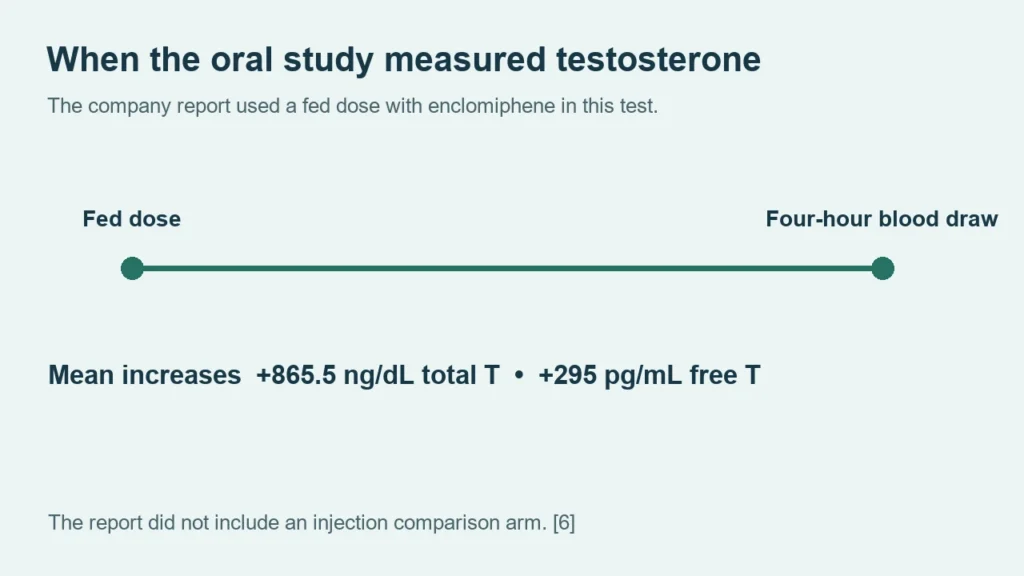
A company white paper reported a mean total testosterone increase of 865.5 ng/dL (307.6%) and free testosterone increase of 295 pg/mL (470.1%) in the group measured four hours after a fed dose of oral testosterone plus enclomiphene. The report averaged individual percentage changes. Mean follow-up values were 1,327.6 ng/dL total and 383 pg/mL free testosterone at that time point, with no head-to-head injection arm. They do not establish comparable effectiveness, better tolerability, or fertility outcomes. [6]
Natural testosterone generally peaks earlier in the day, especially in younger men. Oral doses create a formulation-dependent rise and fall, but research does not establish that they reproduce the natural daily rhythm. Some depot injections last longer and take more time to adjust after a dose change. Supraphysiologic peaks can occur with some regimens. The magnitude varies with the product, dose, interval, and person. [2–5, 7]
What should guide your choice of testosterone treatment?
Consider how each route would fit your day and whether you can follow its monitoring plan. Short-acting injections have been associated with higher rates of elevated hematocrit in some studies. Both routes require follow-up. If you want children now or in the future, ask about fertility before choosing any exogenous testosterone.
- Discuss fertility before starting. Exogenous testosterone can lower LH and FSH and suppress sperm production. Small reports on oral unesterified formulations do not establish that they protect sperm counts. [1, 8, 9]
- Plan the safety checks. A clinician reviews hematocrit, blood pressure, symptom changes, and adverse effects. High hematocrit can require a dose change or pause and evaluation for contributing causes. Blood donation is not a routine substitute for that review. [1, 4, 5, 9]
- Match labs to the product. Ask when to schedule a blood draw after a capsule or injection. For example, Jatenzo labeling specifies a draw six hours after the morning dose. Injection sampling depends on the product and interval. [1, 4, 5]
Common questions about PEPLIX HEALTH
Peplix Health offers cash-pay telehealth through a model managed by Monarch Brands LLC. Independent, board-certified physicians review symptoms, repeat labs, and personal priorities before recommending a formulation or adjusting a prescription. Eligible patient-specific compounded prescriptions may be filled by a state-licensed pharmacy under Section 503A and applicable state requirements.
Does fatigue alone mean I need testosterone?
No. Fatigue, low libido, and reduced drive have several possible causes. Diagnosis generally requires compatible symptoms and repeated low early-morning testosterone results, along with evaluation of the cause. [4, 5]
How does Section 503A pharmacy fulfillment work?
Ask which licensed pharmacy would dispense your medicine and why the specific formulation is needed. Section 503A generally requires a valid prescription for an identified patient. Compounded products do not undergo FDA premarket review for safety, effectiveness, or quality. [10, 11]
For consultation information, see our low testosterone guide or start an online assessment.
Sources
- FDA. Jatenzo prescribing information.
- Yin and colleagues. Oral testosterone undecanoate pharmacokinetics.
- Shoskes and colleagues. Testosterone formulation pharmacology.
- American Urological Association. Testosterone deficiency guideline.
- Endocrine Society. Testosterone therapy for hypogonadism.
- Maximus. Oral testosterone and enclomiphene company report.
- Brambilla and colleagues. Diurnal variation in testosterone.
- AUA and ASRM. Male infertility guideline.
- Ohlander and colleagues. Erythrocytosis following testosterone therapy.
- FDA. Compounding questions and answers.
- U.S. Code. Pharmacy compounding under Section 503A.
This article is for general education and is not medical advice. Talk with a licensed clinician before starting, stopping or changing any treatment. Compounded medications are not FDA-approved. See our safety information.
Keep reading

Testosterone
What Is Enclomiphene and How Does It Compare With TRT?
Compare enclomiphene, TRT, and Clomid for low testosterone. Learn what trials found about sperm counts, side effects, and FDA approval.

Testosterone
Does Enclomiphene Build Muscle?
Does enclomiphene build muscle? Review the evidence on testosterone, lean mass, fertility, and what to discuss before treatment.

Testosterone
MCT Oil vs. Seed Oils in Injectable Testosterone
Compare MCT, sesame, and cottonseed oil in injectable testosterone. Learn what carriers do and what to ask about irritation or allergies.