Oral Testosterone for Men
Compare oral testosterone with injections and gels. Learn when to take it with food, when to get blood work, and what it can mean for fertility.

Oral testosterone is a prescription option for confirmed testosterone deficiency. FDA-approved capsules contain testosterone undecanoate and have product-specific instructions for food, dosing, and blood tests. Oral treatment can suppress sperm production, so discuss fertility before starting. Your clinician can help compare capsules, injections, and gels based on your health and daily routine.
How is oral testosterone different from injections and gels?
FDA-approved oral testosterone capsules contain testosterone undecanoate, an ester that releases testosterone after absorption. Their formulation helps the medicine enter intestinal lymph before reaching the bloodstream, reducing initial liver metabolism. Injections and gels deliver testosterone through other routes. Each route has its own practical trade-offs, monitoring needs, and potential side effects.
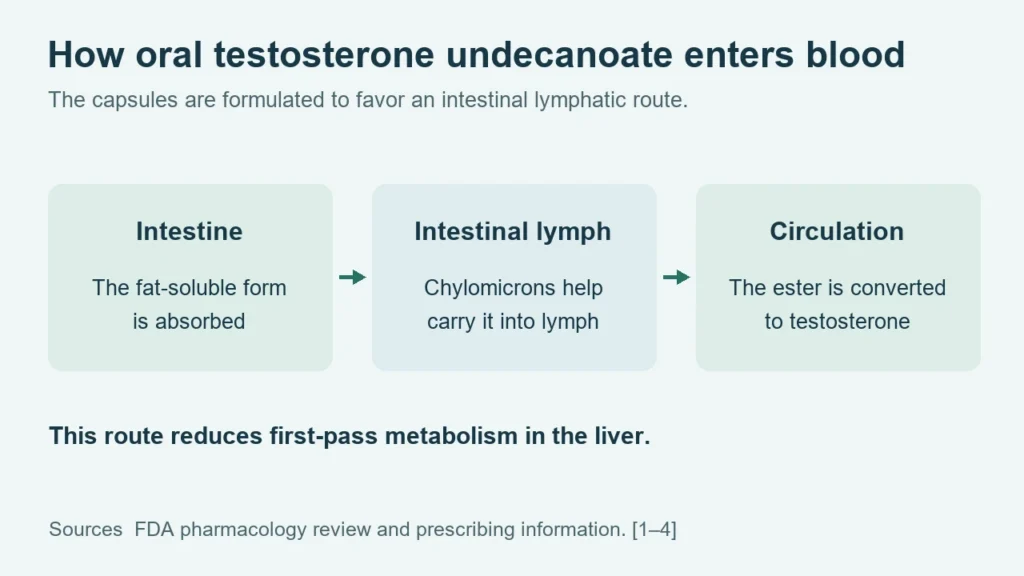
Testosterone undecanoate formulations encourage absorption of the fat-soluble ester through intestinal lymph, in part via chylomicrons, particles that transport dietary fats. This reduces first-pass metabolism through the liver. Modern testosterone undecanoate differs from older 17-alpha-alkylated androgens such as methyltestosterone, which have established liver risks. The oral route still has important safety considerations, including higher blood pressure, elevated hematocrit, and reduced sperm production. [1–5]
| Route | What using it involves | What to discuss with your prescriber |
|---|---|---|
| Oral testosterone undecanoate | Capsules taken with food according to the product directions. | Meal routine, blood pressure, laboratory timing, and adherence to the prescribed schedule. [2–4] |
| Injection | A shot at the interval prescribed for the specific product. | Needle preference, injection-site reactions, and timing of follow-up levels. [5, 6] |
| Topical gel | Regular application to an approved skin site. | How to prevent skin-to-skin transfer to a partner or child and when to draw follow-up labs. [5, 6] |
Do you need to take oral testosterone with a fatty meal?
Jatenzo, Tlando, and Kyzatrex are labeled to be taken with food. The effect of a meal varies by product, and a single fat target or 30-minute wait does not apply across formulations. Follow the instructions for your prescription and tell your clinician if your routine makes meal timing difficult.
In a Jatenzo food-effect study, a breakfast with 15 g of fat produced about 25% lower testosterone exposure than one with 30 g. This measured overall exposure, so it cannot be restated as a specific change in peak testosterone. The finding applies to Jatenzo under study conditions. Tlando and Kyzatrex have their own food-effect data and labeling. [2–4]
- Choose a meal you can repeat. Options such as eggs, salmon, sardines, yogurt, nuts, nut butter, or avocado can fit a meal plan. Fat content varies with product and portion. Ask your pharmacist what the directions mean for the product you use. [2–4]
- Check before substituting oil for food. Medium-chain triglycerides are handled differently from long-chain fats. A spoonful of MCT or olive oil is not a validated substitute for the meal specified in the prescription instructions. [1–4]
- Keep your prescribed schedule. The labeled regimens generally use morning and evening dosing with food, though Kyzatrex has an adjusted morning-only regimen at one dose level. A breakfast-only or breakfast-and-lunch split is not interchangeable with these regimens. Ask your prescriber before redistributing doses. [2–4]
When should blood be drawn after oral testosterone?
Use the blood-draw window for your exact product. Labeling calls for about six hours after the morning dose for Jatenzo, three to five hours for Kyzatrex, and eight to nine hours for Tlando. Tell the lab and your prescriber when you took the dose so they can interpret the result correctly.
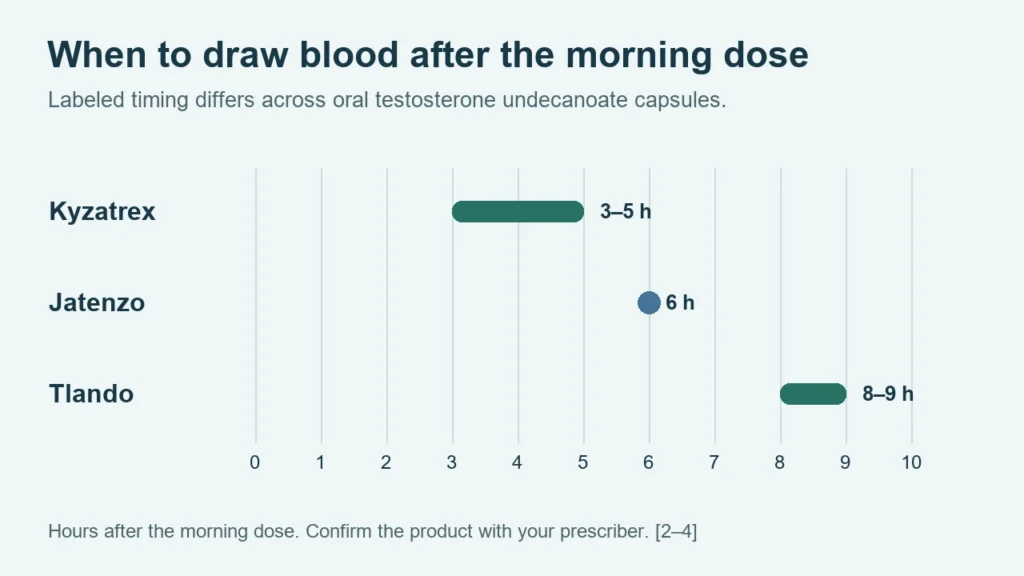
The initial tests used to diagnose testosterone deficiency are separate early-morning measurements before treatment. On-treatment measurements are timed to the medication. Jatenzo and Kyzatrex call for a check after seven days from initiation or dose adjustment. Tlando calls for a first check three to four weeks after starting. A result outside the specified window can be misleading. It does not automatically reflect your natural baseline or justify increasing the dose. [2–6]
Peak timing depends on the formulation, meals, and person. A reported peak at three to four hours or a six- to eight-hour effect from a specific formulation should not be applied to all oral products. Taking a capsule in the morning does not establish that it recreates the body’s natural rhythm. [2–4, 7]
Follow-up can also cover symptoms, blood pressure, hematocrit, and prostate assessment when appropriate. FDA’s 2025 class-wide changes required blood pressure warnings based on postmarketing studies. [2–6, 8]
Can oral testosterone or enclomiphene preserve fertility?
Testosterone from any route can suppress the pituitary signals that help the testes make testosterone and sperm. Enclomiphene has been studied as an alternative for selected men with secondary hypogonadism. Current evidence does not establish that adding it to oral testosterone reliably preserves sperm production or fertility. Discuss pregnancy plans before starting treatment.
LH and FSH are signals from the pituitary. Testosterone therapy can lower both through negative feedback. Normal LH and FSH do not confirm a normal sperm count or predict pregnancy. For men planning fertility in the near term, the Endocrine Society recommends against starting testosterone therapy. A clinician may suggest semen analysis or referral to a reproductive urologist. [2–6, 9]
Enclomiphene modulates estrogen receptor signaling and can increase LH and FSH in some men with secondary hypogonadism. Studies comparing enclomiphene alone with testosterone gel reported different effects on sperm counts. Enclomiphene lacks FDA approval, and those results do not validate taking it together with testosterone. [9, 10]
Two Maximus white papers describe a specific native testosterone formulation. One reported group-average total testosterone rising from about 454 to 790 ng/dL without a statistically significant change in mean LH or FSH. The combination report described preserved gonadotropin signals in participants with an intact hormonal axis. These reports do not establish fertility protection, a universal three- to sevenfold rise, or superiority to injections or gels. [7, 11]
Common questions about PEPLIX HEALTH
Peplix Health offers cash-pay telehealth through a model managed by Monarch Brands LLC. Independent, board-certified physicians review symptoms, laboratory results, medical history, and fertility goals before recommending treatment. When a patient-specific compounded prescription is medically appropriate and eligible, a state-licensed pharmacy can dispense it under Section 503A and applicable state requirements.
Will I need vitamins or amino acids with oral testosterone?
Routine supplementation has no established role in boosting the effect of oral testosterone. A clinician can address dietary or laboratory gaps, including vitamin D, zinc, or magnesium, when appropriate. Vitamin K2 and benfotiamine have no established role in improving oral testosterone absorption. Leucine can participate in muscle protein synthesis signaling, but that mechanism does not establish additional benefit from a specific blend with TRT. [6, 12]
What should I bring to a testosterone consultation?
Bring your prior testosterone labs, symptom history, blood pressure readings if available, medications, supplements, and fertility plans. If you currently use testosterone, include the product, dose schedule, and timing of your dose relative to the blood draw. [2–6]
How does 503A pharmacy fulfillment work?
Section 503A generally requires a valid prescription for an identified patient and restricts regular compounding of essentially identical copies of commercially available drugs. FDA does not review compounded medicines for safety, effectiveness, or quality before marketing. Ask which pharmacy would fill your prescription and what instructions apply to that exact formulation. [13, 14]
For consultation information, see our low testosterone guide or start an online assessment.
This article is for general education. Review treatment decisions with your licensed clinician.
Sources
- FDA. Review of intestinal lymphatic absorption of testosterone undecanoate.
- FDA. Jatenzo prescribing information and food-effect data.
- FDA. Tlando prescribing information.
- FDA. Kyzatrex prescribing information.
- FDA. Testosterone product information.
- Endocrine Society. Testosterone therapy for hypogonadism.
- Maximus. Native oral testosterone monotherapy white paper.
- FDA. Class-wide testosterone labeling changes.
- Wiehle and colleagues. Enclomiphene and sperm counts in men with low testosterone.
- FDA. Advisory committee briefing on enclomiphene.
- Maximus. Oral testosterone and enclomiphene white paper.
- Randomized study. Leucine-enriched amino acids and muscle signaling.
- FDA. Compounding questions and answers.
- U.S. Code. Section 503A pharmacy compounding requirements.
This article is for general education and is not medical advice. Talk with a licensed clinician before starting, stopping or changing any treatment. Compounded medications are not FDA-approved. See our safety information.
Keep reading

Testosterone
What Is Enclomiphene and How Does It Compare With TRT?
Compare enclomiphene, TRT, and Clomid for low testosterone. Learn what trials found about sperm counts, side effects, and FDA approval.

Testosterone
Does Enclomiphene Build Muscle?
Does enclomiphene build muscle? Review the evidence on testosterone, lean mass, fertility, and what to discuss before treatment.

Testosterone
MCT Oil vs. Seed Oils in Injectable Testosterone
Compare MCT, sesame, and cottonseed oil in injectable testosterone. Learn what carriers do and what to ask about irritation or allergies.