Low Testosterone Symptoms: A Checklist for Men
Learn the common signs of low testosterone in men, what else can cause them, and how two morning blood tests help confirm a diagnosis.

Low sex drive, fewer morning erections, and persistent erectile difficulty can be signs of low testosterone. Fatigue, increased body fat, and low mood can occur too, but they have several possible causes. Clinicians diagnose testosterone deficiency when compatible symptoms or signs are present and two separate early-morning blood tests show consistently low levels.
Which low testosterone symptoms are most useful to report?
Tell your clinician about persistent changes in sexual desire, spontaneous erections, or erectile function. Also mention fatigue, reduced strength or lean mass, increased abdominal fat, low mood, trouble focusing, disrupted sleep, or breast changes. Symptoms often overlap with other health problems, so the pattern helps guide testing and evaluation.
| Pattern | What you may notice | What to discuss |
|---|---|---|
| Sexual function | Lower desire, fewer spontaneous erections, trouble getting or keeping an erection, reduced satisfaction. | Timing, medication changes, and cardiovascular or metabolic health. |
| Physical changes | More abdominal fat, less muscle or strength, low bone density, or breast enlargement. | Weight changes, unexplained fractures, and breast tenderness. |
| Energy and mood | Persistent fatigue, low motivation, low mood, anxiety, brain fog, or poor sleep. | Sleep quality, mental health, and whether anemia or another cause could be involved. |
How can low testosterone affect erections, energy, and bone?
Testosterone helps support sexual function, red blood cell production, muscle, and bone. Low levels may contribute to problems in these areas, but symptoms can have more than one cause. An erection problem can also involve blood vessels or nerves, and fatigue may reflect poor sleep, anemia, depression, or another health issue.
What do blood flow and red blood cells have to do with it?
Nitric oxide relaxes smooth muscle in penile tissue so blood can flow in during an erection. Testosterone may influence this signaling. Desire and energy involve additional pathways. Review of testosterone and erectile function
Testosterone supports production of red blood cells, which carry oxygen. Low testosterone can contribute to anemia in some men. A study of men with confirmed hypogonadism found testosterone treatment corrected anemia more often than placebo, although fatigue has other causes. TRAVERSE anemia study
What about body composition, bone, and breast tissue?
Low testosterone can accompany loss of lean mass and more abdominal fat. Excess body fat can also affect hormone regulation. Long-standing deficiency can lower bone density and increase vulnerability to fracture. Endocrine Society guideline
Gynecomastia is growth of glandular breast tissue related to the balance of estrogen and androgen effects. It can cause swelling, tenderness, or enlargement around the areola. A new breast lump or persistent swelling warrants an examination. Cleveland Clinic
Can it affect mood, concentration, or sleep?
Depression, anxiety, and low testosterone can coexist. Reviews have proposed effects on fear, reward processing, threat vigilance, and stress resilience, but these hypotheses do not establish testosterone as an anxiety treatment. A 173-man experiment published online in 2019 found task-specific changes in willingness to compete that depended on status and its stability. It did not test treatment for everyday fatigue. Status-seeking experiment
Older men with low testosterone may report trouble with focus and memory. Research has examined verbal fluency, attention, executive function, memory, and visual-spatial skills, but a randomized trial found no meaningful cognitive improvement from treatment in older men with memory impairment. Testosterone Trials cognition study
Sleep and testosterone may influence one another. A small sleep restriction study found daytime testosterone fell 10% to 15% after a week of five-hour sleep opportunities. Persistent insomnia or possible sleep apnea also deserves its own evaluation. Sleep restriction study
How common is testosterone deficiency, and what can cause it?
The Urology Care Foundation estimates that about 2.1% of men may have testosterone deficiency overall. The figure varies with age, health, and the definition used. Rates generally rise with age, but younger men can also be affected. Clinicians distinguish a problem in the testes from a problem with brain or pituitary signaling.
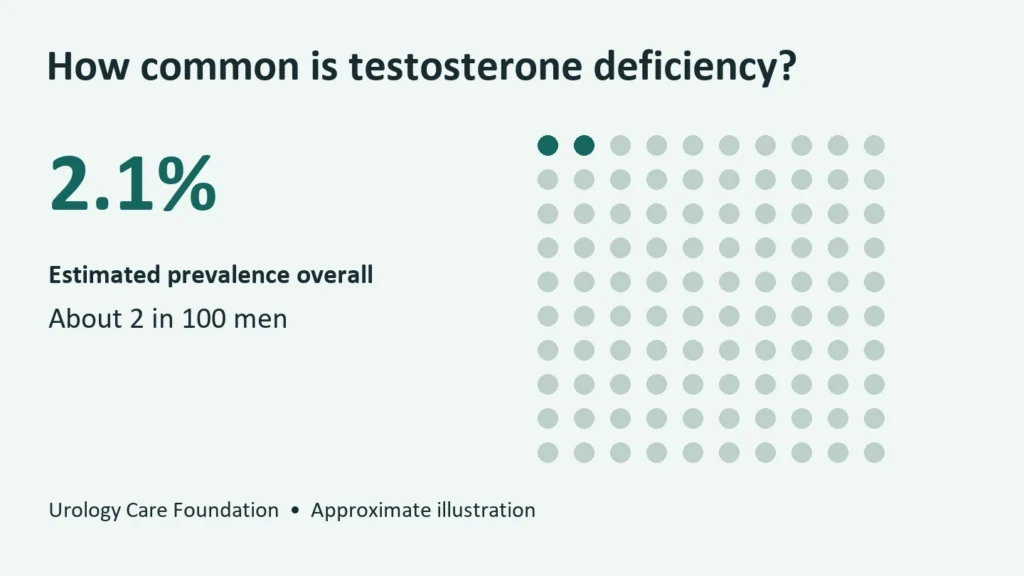
The 2.1% figure is an estimate rather than a count of confirmed diagnoses. Urology Care Foundation
Some studies report lower average testosterone in recent generations, including younger men. Obesity, activity patterns, overall diet, smoking, chronic illness, and exposures to chemicals used in some plastics have been studied. Evidence does not establish one explanation for the population trend. NHANES analysis
| Type | Where it starts | Usual lab pattern |
|---|---|---|
| Primary hypogonadism | The testes cannot produce enough testosterone because of a condition, injury, or other testicular problem. | Low testosterone with typically elevated LH and sometimes elevated FSH. |
| Secondary hypogonadism | The hypothalamus or pituitary sends insufficient signals to the testes. | Low testosterone with low or inappropriately normal LH and FSH. |
How do doctors confirm low testosterone?
The American Urological Association uses total testosterone below 300 ng/dL as a cutoff that supports diagnosis. A clinician checks symptoms and obtains two early-morning results on separate days. If total testosterone is near the lower limit or binding proteins are altered, a reliable free testosterone test can help clarify the picture.
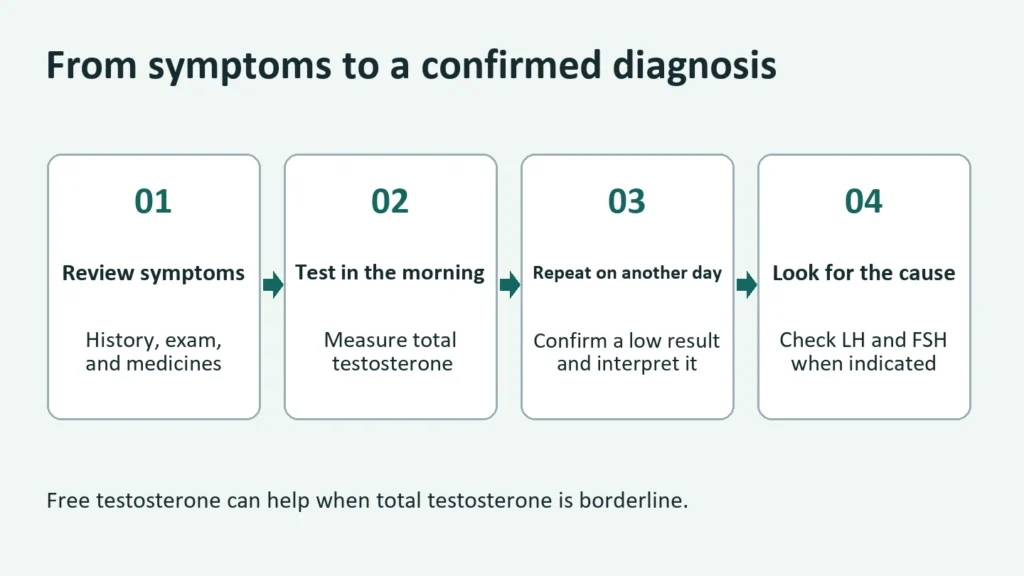
Total testosterone includes bound and unbound hormone. Free testosterone is unbound. Bioavailable testosterone includes the free fraction and testosterone loosely bound to albumin. Labs use different methods and reference populations, so a borderline result can need more context. Age and health affect interpretation, while persistent symptoms with normal labs warrant a search for other causes. AUA guideline
When testosterone is low and LH is low or inappropriately normal, a clinician may also check prolactin and evaluate other causes of impaired signaling. Endocrine Society guideline
What treatments can help if low testosterone is confirmed?
Treatment depends on the cause, the symptoms you want to improve, and whether you plan to have children. Address contributing conditions first when possible. Testosterone replacement can treat confirmed hypogonadism, including primary testicular failure, but can suppress sperm production. Selected men with secondary hypogonadism may discuss approaches that stimulate their own hormone production.
- Address factors that can change. Review medications, sleep disorders, and metabolic health with your clinician.
- Discuss testosterone replacement. Approved products deliver testosterone directly. Consider benefits, risks, monitoring, and alternatives before starting, particularly if fertility matters.
- Ask about specialist alternatives when appropriate. Enclomiphene is a selective estrogen receptor modulator studied in secondary hypogonadism. Reducing estrogen feedback can increase LH and FSH. LH stimulates testosterone production, and FSH supports sperm production. Some short trials preserved sperm counts compared with testosterone gel. Long-term fertility outcomes and symptom benefit are uncertain.
Enclomiphene has no FDA-approved product. Promotional reports about combining it with oral testosterone do not establish that the combination preserves fertility. Enclomiphene comparison trial
Common questions about PEPLIX HEALTH
Peplix Health offers cash-pay hormone, metabolic, and longevity care with management support from Monarch Brands LLC. An independent physician can assess whether persistent symptoms warrant hormone testing, discuss the results, and recommend a plan that accounts for other health conditions. Bring any previous results and explain whether future fertility is important to you.
Who makes treatment decisions at Peplix Health?
An independent, board-certified physician reviews your history, symptoms, and relevant labs, then individualizes treatment, dosing, and follow-up when clinically appropriate. Monarch Brands LLC provides management and administrative support.
Will symptoms alone qualify me for treatment?
The physician considers symptoms, repeat laboratory results, possible causes, and treatment goals before recommending a plan.
How does Section 503A pharmacy fulfillment work?
If a physician determines a compounded drug is appropriate, a state-licensed compounding pharmacy operating under Section 503A can fill a valid patient-specific prescription. Compounded drugs do not receive FDA approval. Discuss the reasons to compound, the benefits and risks, and available alternatives with your clinician. FDA compounding guidance
Learn more in our low testosterone guide, or start an online assessment with a licensed clinician.
This article is for general education. Talk with a licensed healthcare professional about symptoms and the risks and benefits of any treatment.
This article is for general education and is not medical advice. Talk with a licensed clinician before starting, stopping or changing any treatment. Compounded medications are not FDA-approved. See our safety information.
Keep reading

Testosterone
Alcohol and Testosterone: How Drinking Affects Your Hormones
Learn how heavy drinking affects testosterone, sexual function and sperm, what studies found, and how to reduce alcohol intake safely.

Testosterone
Getting TRT Online Legally: Prescriptions, Labs and Red Flags
Learn how legal online TRT prescribing works, how to verify the clinic and pharmacy, and which tests and follow-up to expect.

Testosterone
What Is Enclomiphene and How Does It Compare With TRT?
Compare enclomiphene, TRT, and Clomid for low testosterone. Learn what trials found about sperm counts, side effects, and FDA approval.