Is 300 ng/dL a normal testosterone level?
Is 300 ng/dL low testosterone? Compare diagnostic cutoffs, healthy population data and treatment targets, and learn when to ask about repeat testing.

For an adult man, 300 ng/dL is near a commonly used threshold for low total testosterone. The American Urological Association uses results below 300 ng/dL to support a diagnosis when two early-morning tests are low and symptoms or signs fit. A borderline result deserves context, including the lab method and when the sample was drawn.
What does 300 ng/dL mean on a testosterone test?
The 300 ng/dL cutoff helps clinicians decide whether a result supports testosterone deficiency. A laboratory reference interval describes the values observed in a comparison population, and a treatment target guides dosing after diagnosis. Your clinician interprets each of these numbers alongside symptoms, test timing and the assay used.
| Type of number | Verified example | What it tells you |
|---|---|---|
| Diagnostic cutoff | Below 300 ng/dL in AUA guidance | Supports a diagnosis when early-morning results are repeatedly low and symptoms or signs fit. [1] |
| Laboratory reference interval | 264–916 ng/dL in a harmonized study of healthy, nonobese men aged 19–39 | Describes the middle 95% of that reference population. The interval applies to assays calibrated to the CDC standard. [2] |
| On-treatment target | 450–600 ng/dL in AUA guidance | A practical mid-range target for men receiving treatment, alongside symptom response and safety monitoring. [1] |
A result can be flagged differently across labs because their assays and reference populations differ. The AUA chose 300 ng/dL after reviewing available evidence and weighing likely treatment benefits and risks. There is no established testosterone value that optimizes physical or mental performance for every man. [1,2]
How do testosterone levels compare in healthy younger men?
A national survey analysis found higher median testosterone in lean men who had never smoked and had no selected chronic conditions than in the broader sample. Among men ages 20 to 39, the size of the difference varied across survey periods. These medians describe groups and do not set individual treatment goals.
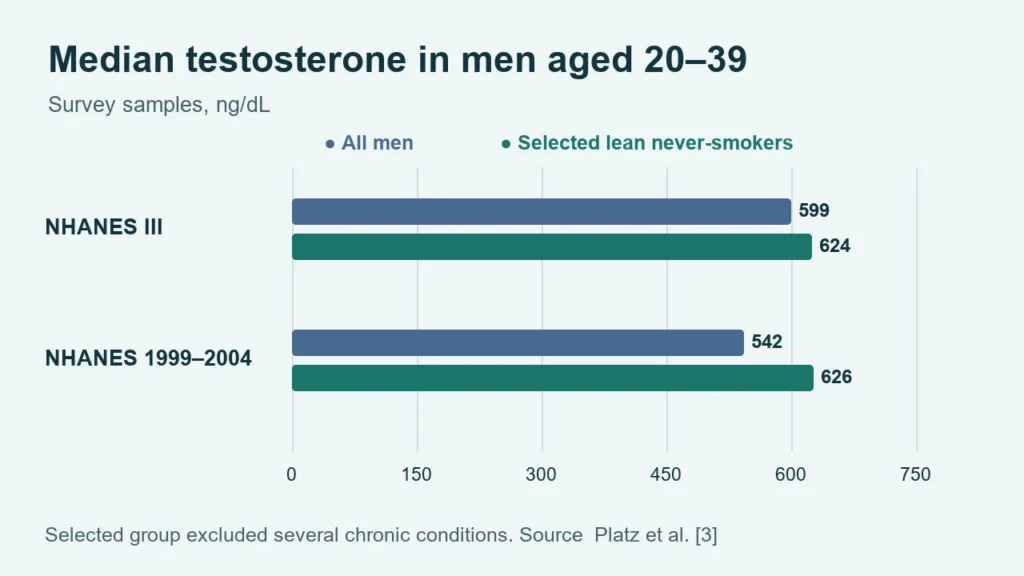
Platz and colleagues reported medians of 624 ng/dL in the selected group and 599 ng/dL among all men aged 20–39 in NHANES III. In continuous NHANES (1999–2004), the corresponding medians were 626 and 542 ng/dL. The study used morning survey samples and excluded men taking hormone-influencing medicines from the selected group. A median is the midpoint of the measured distribution. The study estimated population values and did not test whether treating to a higher level improves health. [3]
What if your testosterone is 380 ng/dL and you have symptoms?
A result around 380 ng/dL is above the AUA cutoff, but persistent symptoms still deserve a medical evaluation. Your clinician can review the timing of the test, decide whether to repeat it, and consider free testosterone when appropriate. Low libido, erectile changes and fatigue can have several causes.
- Confirm the result under comparable conditions. The Endocrine Society recommends two separate fasting morning measurements using a reliable assay when evaluating suspected deficiency. Discuss whether acute illness or medication may have affected the result. [1,2]
- Ask when free testosterone adds information. If total testosterone is near the lower limit or sex hormone–binding globulin (SHBG) may be altered, a clinician may use equilibrium dialysis or calculate free testosterone from total testosterone, SHBG and albumin. [2]
- Look for the cause and review fertility goals. If deficiency is confirmed, luteinizing hormone (LH) and follicle-stimulating hormone (FSH) can help distinguish testicular from pituitary or hypothalamic causes. Review medications, sleep problems and other conditions that could explain symptoms. Exogenous testosterone can suppress sperm production. [1,2]
How do clinicians set goals and monitor testosterone therapy?
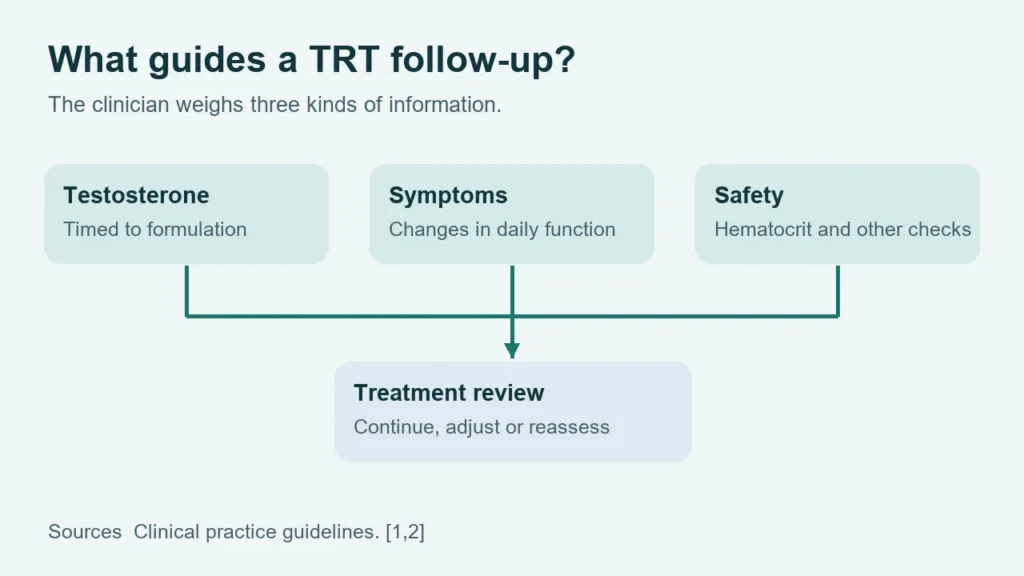
When testosterone replacement therapy is appropriate, clinicians use blood levels, symptom changes and safety measurements to guide dosing. The AUA suggests a mid-range testosterone target and reassessment of symptoms. TRAVERSE found that testosterone gel met its prespecified heart safety comparison with placebo in a defined population, while several other adverse events were more frequent.
How can you track symptoms over time?
Moon and Park’s 2019 editorial used 3–5 ng/mL (300–500 ng/dL) as an illustrative treatment range and called for assessing both blood levels and symptoms. Mohamed and colleagues studied the quantitative Androgen Deficiency in the Aging Male (qADAM) questionnaire, which uses graded responses across ten items, including libido, erections, energy, mood and enjoyment, strength or endurance, and work or sports performance. Its original study involved 57 men preparing for prostate surgery. A symptom record can help you describe what changed. The AUA advises against relying on questionnaires to determine treatment eligibility or monitor treatment response. [1,4,5]
What did TRAVERSE find about heart risk?
TRAVERSE enrolled 5,246 men aged 45–80 with symptoms, two fasting testosterone results below 300 ng/dL, and existing cardiovascular disease or elevated risk. Over roughly 33 months of follow-up, cardiovascular death, nonfatal heart attack or nonfatal stroke occurred in 7.0% with testosterone gel and 7.3% with placebo (hazard ratio 0.96, 95% CI 0.78–1.17). Atrial fibrillation, acute kidney injury and pulmonary embolism occurred more often in the testosterone group. In 2025, the FDA called for removal of the boxed warning language on increased cardiovascular risk and required blood pressure warnings. These findings do not establish the safety of higher treatment targets. [6,7]
Common questions about PEPLIX HEALTH
Peplix Health offers cash-pay evaluation for hormone concerns. Monarch Brands LLC manages nonclinical operations, and independent, board-certified physicians evaluate symptoms, confirmatory labs, medical history and individual risk factors. If treatment is appropriate, the physician individualizes the dose and sets a monitoring plan with you, including when to revisit symptoms and lab work.
Can I discuss symptoms if my testosterone is above 300 ng/dL?
Yes. Bring your results and the time of each blood draw. Describe when symptoms started and how they affect daily life. Your clinician can consider other causes, repeat measurements and additional tests where clinically indicated. A visit does not guarantee a prescription. [1,2]
Who fills a compounded prescription?
When a compounded medicine is clinically appropriate and legally available, a licensed pharmacy operating under Section 503A can fill a valid patient-specific prescription under applicable federal and state requirements. Compounded drugs do not undergo FDA premarket review for safety, effectiveness or quality. [8,9]
For consultation information, see our low testosterone guide or start an online assessment.
This article is for general education and does not replace individualized medical advice.
Sources
- American Urological Association. Evaluation and Management of Testosterone Deficiency
- Endocrine Society. Testosterone Therapy in Men With Hypogonadism
- Platz et al. Nationally Representative Estimates of Serum Testosterone Concentration
- Moon and Park. The Ideal Goal of Testosterone Replacement Therapy
- Mohamed et al. The Quantitative ADAM Questionnaire
- Lincoff et al. Cardiovascular Safety of Testosterone-Replacement Therapy
- FDA. Class-wide labeling changes for testosterone products
- FDA. Compounding and the FDA Questions and Answers
- FDA. FD&C Act provisions that apply to human drug compounding
This article is for general education and is not medical advice. Talk with a licensed clinician before starting, stopping or changing any treatment. Compounded medications are not FDA-approved. See our safety information.
Keep reading

Testosterone
What Is Enclomiphene and How Does It Compare With TRT?
Compare enclomiphene, TRT, and Clomid for low testosterone. Learn what trials found about sperm counts, side effects, and FDA approval.

Testosterone
Does Enclomiphene Build Muscle?
Does enclomiphene build muscle? Review the evidence on testosterone, lean mass, fertility, and what to discuss before treatment.

Testosterone
MCT Oil vs. Seed Oils in Injectable Testosterone
Compare MCT, sesame, and cottonseed oil in injectable testosterone. Learn what carriers do and what to ask about irritation or allergies.