Are at-home testosterone tests accurate?
Compare finger-prick, Tasso and saliva testosterone tests. Learn what can affect accuracy, which labs matter, and when to confirm a home result.

An at-home blood test can give a useful testosterone result when the lab has validated its method for the exact collection device, specimen and shipping conditions. Finger-prick blood, upper-arm capillary blood and saliva have different limitations. If low testosterone is suspected, clinicians typically confirm it with two separate morning serum measurements and a symptom review.
Should you choose finger prick, upper-arm collection or saliva?
Finger-prick and upper-arm kits both collect capillary blood at home. Saliva kits collect a different specimen, and they cannot provide a serum total testosterone value. The most useful option depends on which biomarkers you need and whether the laboratory has validated its assays for the exact specimen you will send.
| Collection method | What the kit collects | What to check before ordering |
|---|---|---|
| Finger prick | Capillary blood on a card, tip or in a tube. | Verify minimum volume and assay validation. Squeezing can dilute the sample. [2–5] |
| Upper-arm device such as Tasso | Lancet and vacuum collect blood into a tube or dried medium. | Volume, comfort, markers and stability vary by model and kit. [6–8] |
| Saliva | Saliva in the specified collector. | Needle-free. Values cannot substitute for serum free testosterone. [9,10] |
| Venous draw | A professional draw, usually processed as serum. | Standard specimen for confirming suspected deficiency. [1] |
What does the research say about at-home test accuracy?
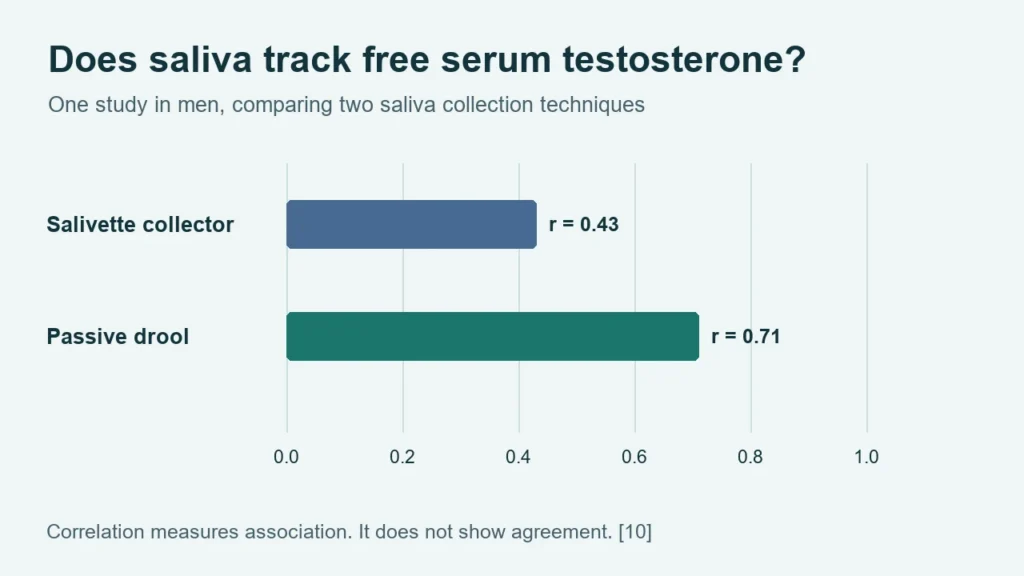
Validation applies to the specific analyte, device and laboratory method studied. Some dried blood testosterone methods have performed well, while others showed systematic differences between capillary and venous samples. Strong correlation means results tend to move together. It does not establish that two tests give interchangeable results near a clinical cutoff.
What can affect blood results?
A finger-prick study found substantial drop-to-drop variation in hemoglobin, platelet and white blood cell measurements. One participant’s hemoglobin dropped by more than 2 g/dL from the first drop to the third, then returned toward baseline. That study measured blood cells and hemoglobin. It did not measure testosterone accuracy. A BMJ report on underestimation of estradiol in a finger-prick service similarly describes a different analyte. [2,3,11]
Studies illustrate why accuracy depends on the method. Fragala and colleagues and Gruenstein each studied testosterone using liquid chromatography–tandem mass spectrometry (LC–MS/MS) on blood microsamples. Marshall and colleagues found that testosterone bias differed between capillary and venous blood in a Mitra microsampling study. Gruenstein reported testosterone stability through 30 days for a specific dried-spot method under study conditions. Tasso studies on antibodies, phosphatidylethanol (an alcohol exposure marker) or liver chemistry do not establish a 28-day testosterone shipping window. Use the kit’s own storage and dispatch instructions. [4–8,12,20,21]
What can affect saliva results?
A saliva study in men found that correlation with free serum testosterone differed by collection technique. Salivary results also vary with collection time. Food, drinks and blood from irritated gums or brushing can affect the specimen. Follow the kit’s directions for timing, oral preparation and whether to rinse. A saliva result cannot supply a serum testosterone panel. [9,10]
Which biomarkers are useful on a testosterone panel?
Total testosterone is usually the starting point. Free testosterone and sex hormone–binding globulin can clarify a borderline result or one affected by binding proteins. LH and FSH can help identify the source of confirmed deficiency. Other markers are selected for a specific question, such as medication monitoring, liver health or kidney function.
What do the hormone markers tell you?
- Total testosterone. Measures circulating testosterone, including the unbound fraction and the amounts carried by albumin and SHBG. It is a concentration, which can change with binding, time of day or illness. [1,13]
- Free testosterone and SHBG. Roughly 1–2% of circulating testosterone is unbound. SHBG, made mainly in the liver, binds testosterone. High SHBG can leave free testosterone low even when total testosterone is within range. Ask if free testosterone was measured by equilibrium dialysis or estimated using total testosterone, SHBG and albumin. [1,13,14]
- LH and FSH. The pituitary releases LH to stimulate Leydig cells to make testosterone and FSH to support sperm production through Sertoli cells. In the setting of confirmed low testosterone, their pattern helps distinguish a testicular cause from a pituitary or hypothalamic one. Hormone levels alone do not measure sperm count. [1,14]
- Estradiol. This form of estrogen supports bone and sexual health in men. A clinician may order it for a specific concern, such as breast symptoms. Fatigue, mood changes, joint pain or fluid retention alone cannot identify whether estradiol is high or low. [14,15]
What do the other markers measure?
- PSA and vitamin D. Prostate-specific antigen can rise for several reasons, including inflammation and benign enlargement. Whether to test depends on age, risk and clinical context. Vitamin D supports bone and immune function, but correcting a deficiency does not reliably increase testosterone. [1,14,16]
- ALT and GGT. ALT can rise with liver-cell injury. GGT can rise with bile duct conditions, alcohol use, fatty liver or certain medications. Both need clinical context and are separate from direct measures of testosterone. [8,14]
- Hematocrit and creatinine. Hematocrit is the proportion of blood occupied by red cells. Testosterone therapy can raise it, dehydration can concentrate it, and anemia or bleeding can lower it. Creatinine comes from normal muscle metabolism and is filtered by the kidneys. Higher values can reflect reduced filtration or greater muscle mass. [1,14]
What should you do with a low or borderline home result?
A low, borderline or unexpected home result is a reason to review the report with a clinician. Confirm the specimen, collection time, method and reference interval. For suspected testosterone deficiency, the Endocrine Society recommends two separate fasting morning total testosterone measurements using a reliable serum assay, alongside compatible symptoms or signs.
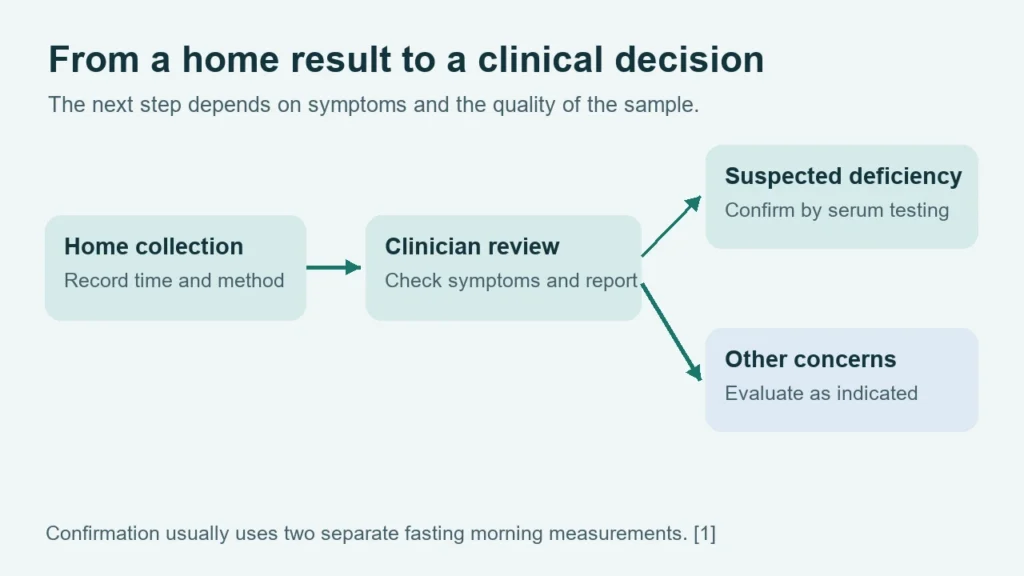
- Before collecting. Ask which lab processes your sample and whether it has CLIA certification. Also ask whether the assay is validated for the kit and sample type. CLIA applies laboratory quality standards, and CDC testosterone standardization assesses specific assays using serum. [1,17,18]
- When returning the kit. Follow the lab’s timing, fill, storage and return instructions. Record the collection time, recent illness and any hormone medicines. If you already use testosterone, your clinician should tell you when to collect relative to your medication. [1]
- When you review the report. Bring the complete result, units and reference range. Persistent symptoms can merit evaluation even when a result falls in range. Use clinician-directed repeat testing before making treatment or dose decisions. [1]
Common questions about PEPLIX HEALTH
Peplix Health offers cash-pay evaluation for hormone concerns. Monarch Brands LLC manages nonclinical operations, and independent, board-certified physicians evaluate medical needs. Bring existing lab results to your consultation. The physician can decide which results are suitable for interpretation, whether to repeat testing and what follow-up fits your symptoms and health history.
Do I need every biomarker to start?
No. Choose tests based on the clinical question and the available collection method. Kit panels, turnaround, ordering requirements and availability vary. Some markers may require a venous draw. Confirm the exact panel before ordering.
Who handles treatment and pharmacy fulfillment?
Your physician decides whether treatment is warranted and individualizes the dose and monitoring. If compounding is clinically appropriate and legally available, a licensed pharmacy operating under Section 503A can fill a valid patient-specific prescription subject to applicable federal and state requirements. Compounded drugs do not undergo FDA premarket review for safety, effectiveness or quality. [19]
For consultation information, see our low testosterone guide or start an online assessment.
This article is for general education and does not replace individualized medical advice.
Sources
- Endocrine Society. Testosterone therapy clinical guideline
- WHO. Capillary sampling guidance
- Bond and Richards-Kortum. Drop-to-drop variation
- Fragala et al. Testosterone in whole-blood microspecimens
- Marshall et al. Testosterone in Mitra microsamples
- FDA. Tasso+ clearance summary
- Tasso. Device and sample format information
- Wickremsinhe et al. Capillary collection for liver chemistry
- Keevil et al. Salivary testosterone by LC–MS/MS
- Fiers et al. Saliva collection and free testosterone comparison
- Mahase. Finger-prick hormone assays and accuracy concerns
- Gruenstein. Dried blood spot testosterone validation
- Li et al. SHBG, albumin and free testosterone fraction
- MedlinePlus. Medical tests and biomarker definitions
- Finkelstein et al. Gonadal steroids and sexual function
- Lerchbaum et al. Vitamin D supplementation and androgens
- CMS. CLIA certification and accreditation
- CDC. Hormone standardization program FAQs
- FDA. Compounding questions and answers
- King et al. Tasso-SST for antibody measurement
- Jett et al. Tasso-M20 for phosphatidylethanol testing
This article is for general education and is not medical advice. Talk with a licensed clinician before starting, stopping or changing any treatment. Compounded medications are not FDA-approved. See our safety information.
Keep reading
Testosterone
What Is Enclomiphene and How Does It Compare With TRT?
Compare enclomiphene, TRT, and Clomid for low testosterone. Learn what trials found about sperm counts, side effects, and FDA approval.

Testosterone
Does Enclomiphene Build Muscle?
Does enclomiphene build muscle? Review the evidence on testosterone, lean mass, fertility, and what to discuss before treatment.
Testosterone
MCT Oil vs. Seed Oils in Injectable Testosterone
Compare MCT, sesame, and cottonseed oil in injectable testosterone. Learn what carriers do and what to ask about irritation or allergies.