Can You Take Enclomiphene Long Term?
Can you take enclomiphene long term? Learn what studies say about safety, fertility, cycling, and how clinicians monitor treatment.

Enclomiphene can raise testosterone over the short term in selected men with secondary hypogonadism. Evidence on its long-term safety and effectiveness remains limited. The often-cited multiyear study examined clomiphene, a different medicine. If a clinician prescribes enclomiphene, continued use should depend on symptoms, lab results, fertility goals, and side effects.
What do we know about long-term enclomiphene safety?
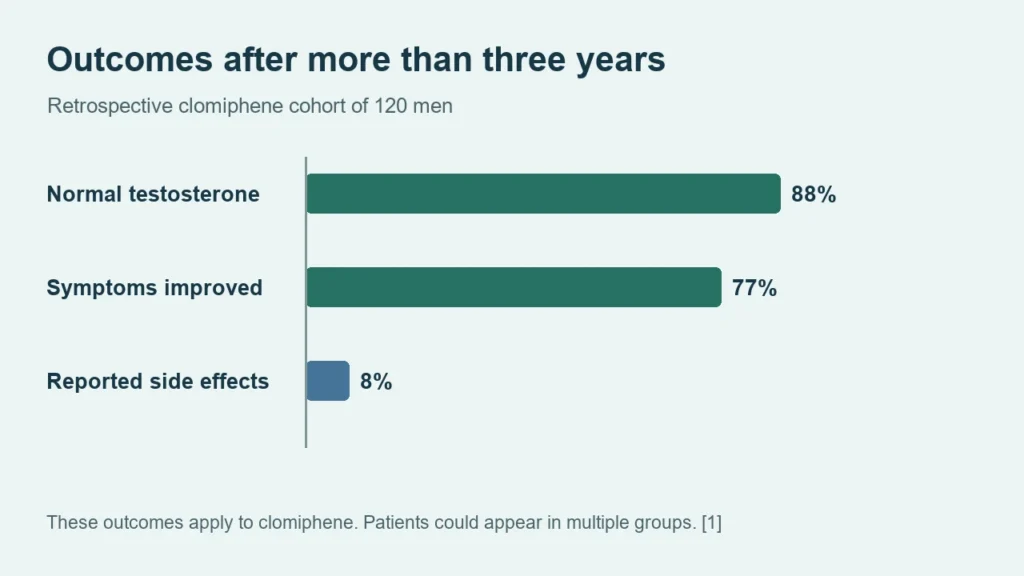
Most controlled enclomiphene studies lasted weeks to months. A retrospective clomiphene study included 400 men, of whom 120 took clomiphene for more than three years. Their results help explain why similar medicines are studied, but they cannot establish the long-term safety, effectiveness, or rate of side effects for enclomiphene on its own.
| Evidence | What it found | What remains uncertain |
|---|---|---|
| Clomiphene chart review | Among 120 men treated for more than three years, 88% reached normal testosterone status, 77% reported symptom improvement, and 8% reported side effects. | Retrospective and specific to clomiphene. These figures are not enclomiphene outcome rates. [1] |
| Enclomiphene controlled trials | Testosterone rose and sperm concentration was generally maintained in selected men compared with testosterone gel. | Short-term semen and hormone measures do not establish long-term fertility or safety. [2–4] |
How quickly does enclomiphene work, and do you need to cycle it?
One study detected higher testosterone within about 14 days. In a pharmacology study, levels remained elevated relative to baseline a week after stopping. Those findings describe blood tests in a study population. They do not establish how quickly symptoms improve, what happens after a missed dose, or whether scheduled breaks have benefits.
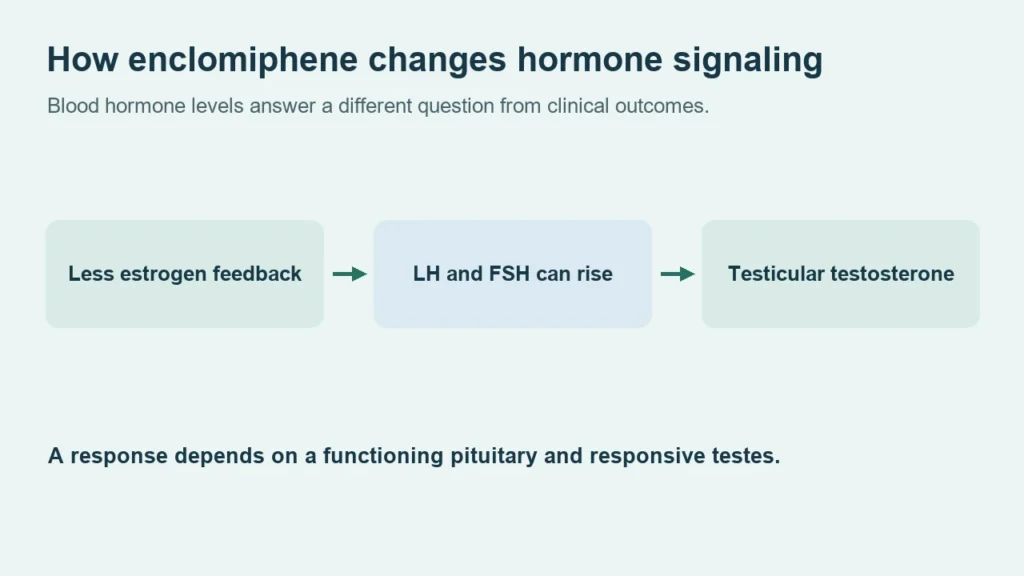
Enclomiphene reduces estrogen feedback in the brain. This can increase luteinizing hormone and follicle-stimulating hormone, which support testosterone and sperm production. How long a response lasts after stopping depends on the individual and the cause of low testosterone. Controlled evidence does not support a specific cycling schedule or establish indefinite effectiveness. Ask the prescriber how to handle missed doses, reassessment, or stopping. [2–4, 6, 7]
How do fertility and side effects compare with TRT?
Testosterone replacement supplies testosterone directly and can reduce the signals that support sperm production. Enclomiphene raises those signals in some men with secondary hypogonadism, but neither hormone levels nor sperm concentration alone establish fertility. If having children matters to you, discuss a semen analysis, your treatment options, and the uncertainty around long-term outcomes.
- Interpret sperm outcomes carefully. A phase II comparison reported low sperm concentration in about 54% of the topical testosterone group. Studies of enclomiphene generally found less suppression of sperm concentration. A separate retrospective comparison with clomiphene reported changes in selected semen markers. These outcomes do not guarantee pregnancy. [2, 3, 8]
- Understand TRT timelines. Testosterone can rise within days with some formulations. Some symptoms may improve within weeks, with sexual interest reported around week three in a review. After stopping, recovery of testosterone and sperm production varies. In a fertility-treatment cohort, older age and longer prior TRT were linked to slower sperm recovery. TRT can also raise hematocrit, reduce testicular size, or cause breast enlargement. [9–12]
- Discuss side effects and monitoring. Headache and nausea have been reported with enclomiphene. Discuss heart or clot history, visual symptoms, and mood changes before or during treatment. The evidence is too limited to quantify long-term risk, including the risk of uncommon events. [4, 6]
The clomiphene study recorded mood changes, blurred vision, and breast tenderness in some long-term users. Clomiphene contains enclomiphene and zuclomiphene. Zuclomiphene has more estrogen-agonist activity and can persist longer. Its presence does not prove it caused those events or that isolated enclomiphene avoids them. [1, 4, 6]
The Maximus company report cataloged 80 possible treatment-related events among 75 people who withdrew with adverse effects. The company report’s selected event categories were nonspecific symptoms (66.25%), weight gain (10%), libido changes (3.75%), allergy, acne, and mood changes (2.5% each), and fatigue, joint pain, increased heart rate, hair loss, and nausea (1.25% each). These are shares of reported events in a withdrawal group. The report did not establish controlled three-year safety. [5]
Common questions about PEPLIX HEALTH
Peplix Health offers cash-pay telehealth through a model managed by Monarch Brands LLC. Independent, board-certified physicians review symptoms, prior tests, and fertility plans before advising on care. When an eligible compounded prescription is medically appropriate, a state-licensed pharmacy can fill it for an identified patient under Section 503A and applicable state requirements.
What should I review before continuing treatment?
Bring your recent testosterone results and a record of symptom changes and side effects. Ask which tests and follow-up would guide a decision to continue, adjust, or stop. If fertility is a priority, ask about semen analysis and whether a reproductive urology referral makes sense. [11, 12]
Is compounded enclomiphene FDA-approved?
There is no FDA-approved enclomiphene product. Section 503A generally requires a valid prescription for an identified patient and compliance with applicable compounding requirements. FDA does not review compounded medicines for safety, effectiveness, or quality before marketing. Ask which licensed pharmacy would dispense an eligible prescription. [6, 13, 14]
For consultation information, see our low testosterone guide or start an online assessment.
Sources
- Krzastek and colleagues. Long-term clomiphene cohort.
- Wiehle and colleagues. Phase II enclomiphene and testosterone gel trial.
- Kim and colleagues. Enclomiphene and sperm counts.
- Review. Enclomiphene in secondary hypogonadism.
- Maximus. Company report on its enclomiphene protocol.
- FDA. Enclomiphene advisory committee briefing.
- Wiehle and colleagues. Enclomiphene pharmacology and washout.
- Thomas and colleagues. Retrospective clomiphene and enclomiphene comparison.
- Shoskes and colleagues. Testosterone preparation pharmacology.
- Saad and colleagues. Onset of testosterone therapy effects.
- Kohn and colleagues. Sperm recovery after testosterone use.
- AUA and ASRM. Male infertility guideline.
- FDA. Compounding questions and answers.
- U.S. Code. Pharmacy compounding under Section 503A.
This article is for general education and is not medical advice. Talk with a licensed clinician before starting, stopping or changing any treatment. Compounded medications are not FDA-approved. See our safety information.
Keep reading

Testosterone
What Is Enclomiphene and How Does It Compare With TRT?
Compare enclomiphene, TRT, and Clomid for low testosterone. Learn what trials found about sperm counts, side effects, and FDA approval.

Testosterone
Does Enclomiphene Build Muscle?
Does enclomiphene build muscle? Review the evidence on testosterone, lean mass, fertility, and what to discuss before treatment.

Testosterone
MCT Oil vs. Seed Oils in Injectable Testosterone
Compare MCT, sesame, and cottonseed oil in injectable testosterone. Learn what carriers do and what to ask about irritation or allergies.