Can a cholesterol panel hint at low testosterone?
Can a cholesterol panel hint at low testosterone? Learn what the AIP study found, how to read triglycerides and HDL, and when to ask about testing.

A high atherogenic index of plasma, or AIP, was linked to lower testosterone in a 2025 study of U.S. men. AIP uses triglycerides and HDL cholesterol. It may provide context for a discussion about metabolic health. A clinician diagnoses testosterone deficiency using symptoms and consistently low morning testosterone results.
What is AIP on a cholesterol panel?
The atherogenic index of plasma is a logarithmic measure of triglycerides relative to HDL cholesterol. It rises when triglycerides increase relative to HDL, and it leaves LDL out of the calculation. Research has linked higher AIP to obesity, metabolic syndrome and cardiovascular disease, including progression of coronary atherosclerosis.
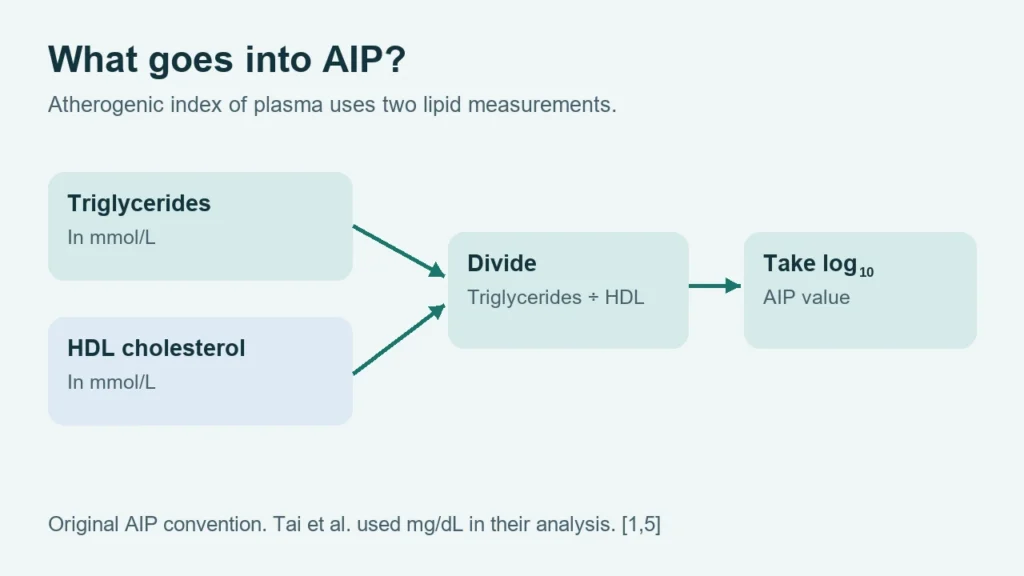
The original convention calculates the base-10 logarithm of triglycerides divided by HDL cholesterol, both in mmol/L. The 2025 NHANES study calculated the ratio using mg/dL. The units shift numerical values by a constant, so a published cutoff needs to be interpreted with the corresponding convention. AIP adds information about the lipid pattern and standard cardiovascular assessment still uses established risk factors and measurements such as LDL and non-HDL cholesterol. [1–5]
What did researchers find about AIP and testosterone?
Among 4,115 U.S. men, the highest AIP quartile had 3.13 times the adjusted odds of total testosterone below 300 ng/dL compared with the lowest quartile. Higher AIP also coincided with lower total testosterone. This survey compared measurements across people and could not determine whether one change caused the other.
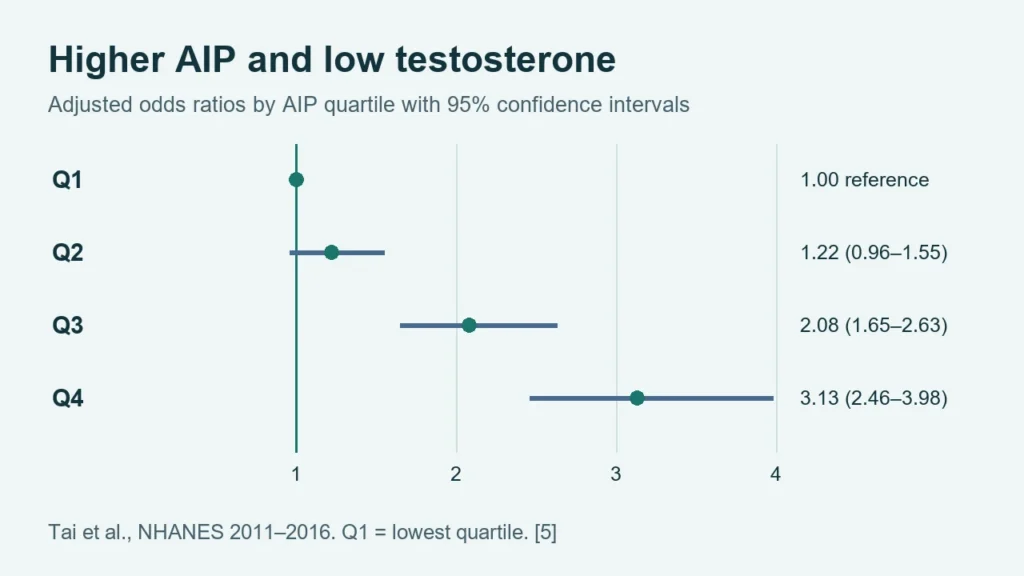
Tai and colleagues used NHANES data from 2011 to 2016 for men aged 20 or older. Their model accounted for factors including age, BMI, diabetes and physical activity. One AIP unit, equivalent to a tenfold increase in the triglyceride-to-HDL ratio, was associated with 111.97 ng/dL lower total testosterone (95% CI, 96.06 to 127.89 lower). This is a group-level estimate from a single study. [5]
| AIP quartile | Adjusted odds ratio | 95% confidence interval |
|---|---|---|
| Lowest quarter | 1.00 | Reference |
| Second quarter | 1.22 | 0.96–1.55 |
| Third quarter | 2.08 | 1.65–2.63 |
| Highest quarter | 3.13 | 2.46–3.98 |
The association was also present among men aged 20–40. Age subgroup differences were statistically inconclusive, and the study could not establish changing rates of testosterone deficiency in younger men. It did not test whether improving AIP would raise testosterone. [5]
When should you ask about a testosterone test?
Ask about evaluation if symptoms such as persistent low libido or other sexual changes accompany a concerning lipid profile. Fatigue and difficulty concentrating can have several causes. A clinician can review those symptoms and decide whether two separate morning testosterone measurements and any additional tests are appropriate for you.
- Bring both sets of results. Share your triglycerides, HDL and LDL, along with prior testosterone results and the time each sample was taken.
- Review symptoms and health history. Discuss sleep, medicines, activity, recent illness, body weight changes and symptoms that affect daily life.
- Confirm a low result. The American Urological Association uses 300 ng/dL as a reasonable cutoff supporting diagnosis in symptomatic men with two early-morning results. Free testosterone can help when total testosterone is near the lower limit or a condition affects sex hormone-binding globulin. [6,7]
Common questions about PEPLIX HEALTH
Peplix Health offers a cash-pay pathway for adults with questions about hormone and metabolic health. Monarch Brands LLC manages nonclinical operations, and independent, board-certified physicians evaluate medical concerns. A physician can review symptoms and existing labs, discuss confirmatory testing, and explain whether treatment or a referral makes sense.
Does a high AIP mean I need testosterone therapy?
AIP alone cannot establish testosterone deficiency. Your physician considers symptoms, repeated morning measurements and potential causes before discussing treatment. Bring existing home lab results if available and ask whether they should be confirmed. [6,7]
Who handles prescriptions and any compounded medication?
The physician individualizes treatment, dosing and follow-up. If a compounded medication is clinically appropriate and legally available, a licensed pharmacy operating under Section 503A may fill a patient-specific prescription subject to applicable federal and state requirements. Compounded products do not undergo FDA premarket review for safety, effectiveness or quality. [8]
For consultation information, see our low testosterone guide or start an online assessment.
This article is for general education and does not replace individualized medical advice.
Sources
- Dobiášová and Frohlich. Original AIP definition
- Zhu et al. AIP and obesity
- Li et al. AIP and metabolic syndrome
- Won et al. AIP and coronary atherosclerosis progression
- Tai et al. AIP and testosterone deficiency in U.S. men
- American Urological Association. Testosterone deficiency guideline
- Endocrine Society. Testosterone therapy guideline
- FDA. Compounding questions and answers
This article is for general education and is not medical advice. Talk with a licensed clinician before starting, stopping or changing any treatment. Compounded medications are not FDA-approved. See our safety information.
Keep reading

Testosterone
What Is Enclomiphene and How Does It Compare With TRT?
Compare enclomiphene, TRT, and Clomid for low testosterone. Learn what trials found about sperm counts, side effects, and FDA approval.

Testosterone
Does Enclomiphene Build Muscle?
Does enclomiphene build muscle? Review the evidence on testosterone, lean mass, fertility, and what to discuss before treatment.

Testosterone
MCT Oil vs. Seed Oils in Injectable Testosterone
Compare MCT, sesame, and cottonseed oil in injectable testosterone. Learn what carriers do and what to ask about irritation or allergies.