Tesamorelin vs. Sermorelin
Compare tesamorelin and sermorelin by FDA status, visceral fat evidence, dosing, side effects, and the labs a clinician may check.

Tesamorelin and sermorelin both stimulate the pituitary to release growth hormone. FDA-approved tesamorelin reduces excess abdominal fat in adults with HIV-associated lipodystrophy. Sermorelin’s former FDA approvals covered specific pediatric treatment and diagnostic uses. Evidence for choosing either medication for routine weight loss, better sleep, workout recovery, or healthy aging is insufficient.
How do tesamorelin and sermorelin work?
Both medications mimic growth hormone-releasing hormone and act at the pituitary. The growth hormone released then signals the liver and other tissues to make IGF-1. Tesamorelin has a chemically modified 44-amino-acid sequence. Sermorelin uses the first 29 amino acids of that natural signal. A shared mechanism does not establish comparable benefits or risks.
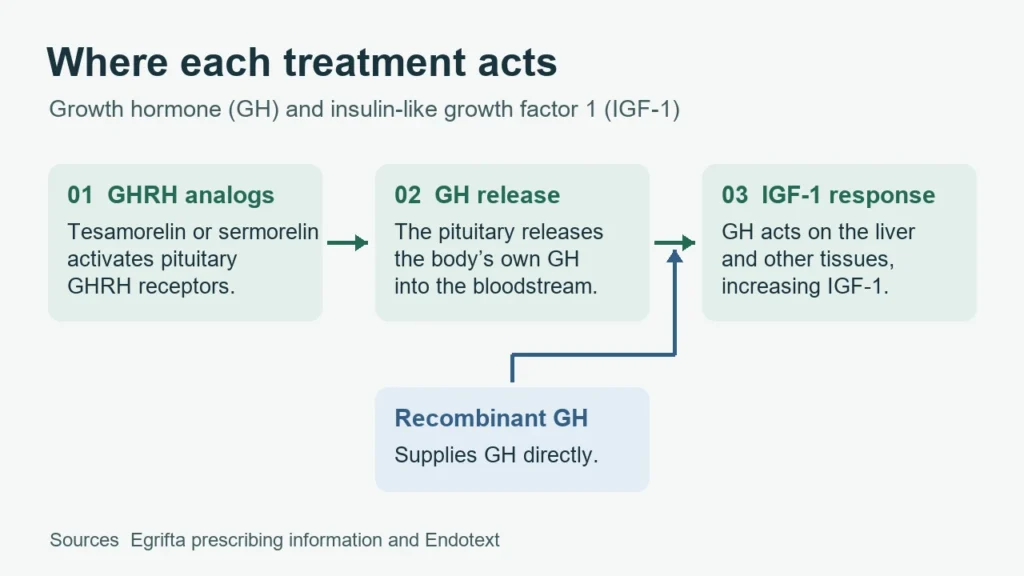
Growth hormone (GH) is released in pulses, including during deep sleep, and secretion generally declines with age. Endotext describes an approximate 14–15% decline per decade after age 30. That is a population estimate. Symptoms or age alone cannot diagnose adult growth hormone deficiency. [1, 2]
The tesamorelin modification is a trans-3-hexenoyl group that increases resistance to breakdown by DPP-4 compared with native GHRH. GH has direct effects on tissues and also acts through insulin-like growth factor 1 (IGF-1). Feedback still operates with GHRH analogs, but tesamorelin can raise IGF-1 above the reference range. Recombinant GH supplies the hormone directly and has clinical uses in confirmed deficiency. GH therapy can also cause fluid retention, joint pain, and reduced insulin sensitivity. [2–5]
What did tesamorelin trials show for visceral fat?
At week 26 of a randomized trial in 412 adults with HIV and excess abdominal fat, CT-measured visceral fat decreased 15.2% with tesamorelin and increased 5.0% with placebo. IGF-1 rose and triglycerides fell in the tesamorelin group. The findings apply to the studied population and do not establish general weight-loss or exercise benefits.
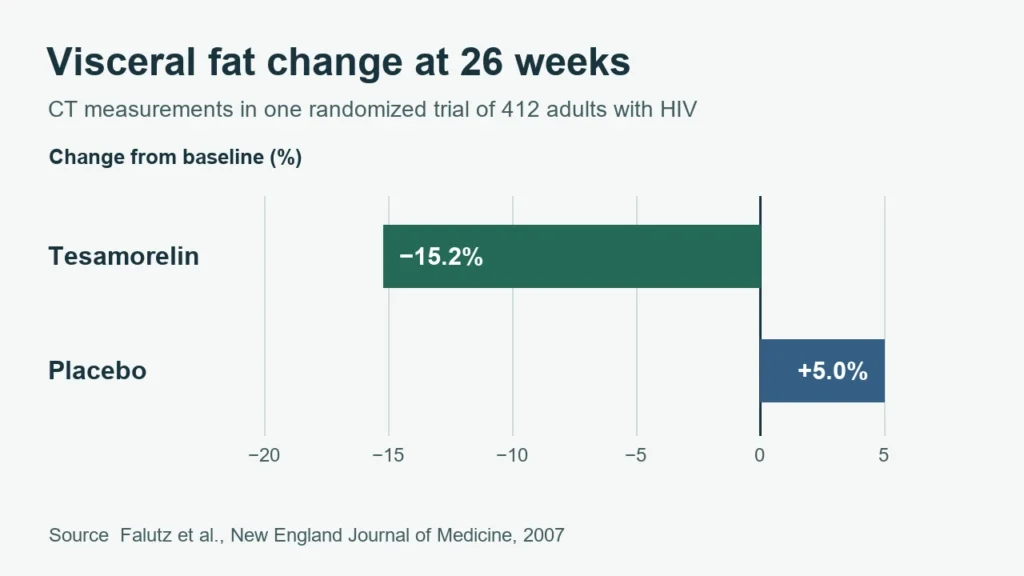
Visceral fat sits around internal organs. Subcutaneous fat is the layer just under the skin. The trial found changes in deep abdominal fat and in blood markers. Triglycerides changed by −50 versus +9 mg/dL, total-to-HDL cholesterol ratio by −0.31 versus +0.21, and IGF-1 by +81% versus −5% (tesamorelin versus placebo, p < 0.001 for each comparison). [6]
A separate short pharmacology study in the original FDA review found an approximately 84% increase in mean pre-dose IGF-1 by day 14 versus day 1 in one dose group. Study population, doses, and endpoints matter when reading these numbers. Neither study compared tesamorelin with sermorelin. An IGF-1 change cannot rank the two medicines or tell an individual how much fat they will lose. [5, 6]
Egrifta received initial U.S. approval in 2010. Its label describes a weight-neutral effect and excludes weight management as an indication. Some patients regained visceral fat after stopping in the extension trials. Evidence does not establish a switch to sermorelin as maintenance, a time to visible results, or benefit for losing the last few pounds. [3, 6]
How do their uses, dosing, and side effects compare?
Egrifta SV and WR are injected under the skin once daily, using formulation-specific preparation and rotating abdominal injection sites. Former Geref sermorelin products have been discontinued. Clinicians should assess evidence for the intended use, the exact product, and a monitoring plan. Comparative side-effect rates in similar adults remain unknown.
| Question | Tesamorelin | Sermorelin |
|---|---|---|
| What is its U.S. status? | Egrifta is FDA approved for excess abdominal fat in adults with HIV-associated lipodystrophy. [3, 7] | Geref had FDA-approved diagnostic and pediatric treatment uses. FDA determined the discontinued products were not withdrawn for safety or effectiveness reasons. [8, 9] |
| How is it prepared? | SV uses supplied sterile water and is injected immediately after mixing. WR uses supplied bacteriostatic water, with one mixed vial providing seven daily doses. [3, 7] | If an eligible compounded preparation is prescribed, follow the product-specific instructions from the dispensing pharmacist and prescribing physician. [10, 11] |
| What safety effects are documented? | Fluid retention, joint pain, hand or wrist symptoms associated with carpal tunnel syndrome, injection reactions, and elevated blood glucose or IGF-1. [3, 7] | Historical Geref studies reported local pain, redness or swelling and occasional flushing. Those data do not establish comparative safety for adults using compounded preparations. [8] |
Egrifta’s labels give no required wait after meals, no required delay before eating afterward, and no preferred morning or bedtime window. Their once-daily schedules do not include two days off. For compounded prescriptions, ask the pharmacist to confirm the diluent, storage, dose, and injection site. Report persistent or worsening reactions. [3, 7, 10]
Egrifta is contraindicated during pregnancy and in people with active malignancy, disruption of the hypothalamic-pituitary axis, or a known allergy to the drug or its ingredients. Acute critical illness is a warning in the prescribing information. The label advises against breastfeeding while receiving Egrifta. [3, 7]
What should you discuss before choosing a treatment?
Start with the concern you want evaluated, such as a change in abdominal fat, persistent fatigue, or poor sleep. Your physician can look for contributing factors and decide whether testing or treatment is indicated. If tesamorelin is appropriate, agree on a measurable goal, the monitoring schedule, and when to reassess benefit.
- Ask what a lab result means. IGF-1 is interpreted in clinical context and may be affected by factors including oral estrogen. Adult growth hormone deficiency often requires stimulation testing. A single IGF-1 value or being a woman does not determine which drug to use. [2]
- Review glucose and IGF-1 monitoring. Egrifta labeling calls for glucose assessment before and during treatment and IGF-1 monitoring during therapy. In trials, 5% on tesamorelin and 1% on placebo reached HbA1c of at least 6.5% by week 26. Your clinician can decide whether thyroid tests or other labs are warranted. [2, 3, 7]
- Discuss what you would track. Resistance training, adequate nutrition, sleep, and stress management can support general health. A three-month minimum, a fixed timeline for cosmetic or fitness benefits, and added benefit from combining either medicine with testosterone therapy lack established clinical evidence. [1–3, 6–9]
Common questions about PEPLIX HEALTH
Peplix Health is a cash-pay telehealth service managed by Monarch Brands LLC. Independent, board-certified physicians evaluate your health history, goals, and relevant labs. If treatment is appropriate, the physician individualizes dosing and follow-up. An eligible compounded medicine can be dispensed by a state-licensed pharmacy when the prescription meets applicable Section 503A and state requirements.
Can I use sermorelin for sleep or workout recovery?
The historical FDA approvals do not establish that sermorelin improves sleep or speeds workout recovery in healthy adults. The same applies to claims about energy, skin elasticity, hair quality, and nail growth. Discuss persistent symptoms and other possible causes with your physician. [1, 2, 8, 9]
Can a Peplix Health physician prescribe tesamorelin for belly fat?
A physician can assess the cause of your abdominal changes and discuss options. FDA-approved tesamorelin treats excess abdominal fat in adults with HIV-associated lipodystrophy. Other uses are off-label. The evidence from HIV trials does not establish that it works for routine body recomposition. [3, 6, 7]
What does a Section 503A pharmacy do?
When all applicable requirements are met, a state-licensed pharmacy can fill a patient-specific prescription for a compounded preparation. Ingredient eligibility, applicable quality standards, and restrictions on copying commercially available products apply. Compounded medicines do not undergo FDA premarket review for safety, effectiveness, or quality. [10, 11]
How do I start a Peplix Health assessment?
Bring your goals, medication list, and recent lab results. An independent physician can advise whether further testing, treatment, or another form of care makes sense.
See our longevity guide or start an online assessment.
Sources
- Endotext. Growth Hormone and Aging.
- Endocrine Society. Evaluation and treatment of adult growth hormone deficiency.
- DailyMed. Egrifta WR prescribing information and instructions.
- EMA. Egrifta assessment report, pharmacokinetics and metabolism.
- FDA. Egrifta clinical pharmacology and biopharmaceutics review.
- Falutz et al. Metabolic effects of a GHRH analog in patients with HIV.
- DailyMed. Egrifta SV prescribing information and instructions.
- FDA. Egrifta medical review, including the Geref approval history.
- Federal Register. FDA determination on discontinued Geref products.
- FDA. Compounding questions and answers.
- U.S. Code. Section 503A pharmacy compounding conditions.
This article is for general education and is not medical advice. Talk with a licensed clinician before starting, stopping or changing any treatment. Compounded medications are not FDA-approved. See our safety information.
Keep reading

Peptides & Longevity
BPC-157 and Growth Hormone in Tendon Recovery
Learn what BPC-157 studies found in rat tendon cells, what IGF-1 can tell you, and why tesamorelin has no proven role in tendon recovery.

Peptides & Longevity
Growth Hormone Secretagogues and the Evidence Behind Them
Compare tesamorelin, sermorelin, CJC-1295, ipamorelin and MK-677. Learn what studies found about GH, IGF-1, safety and FDA status.

Peptides & Longevity
What the FDA Peptide Compounding Review Means for Patients
See what the July 2026 FDA advisory votes and HHS draft mean for BPC-157, TB-500, Semax, and other peptides considered for 503A compounding.