Does Oral Testosterone Preserve Fertility?
Review the oral testosterone chart study, what LH and FSH can tell you, and why sperm testing matters when you are planning a family.

A 34-person chart review reported that LH and FSH stayed above its chosen cutoff during short-term use of one oral testosterone formulation. The report did not establish that sperm counts or fertility were preserved. Oral testosterone can suppress reproductive signaling, so discuss your plans for children before starting any testosterone treatment.
What did the oral testosterone chart review find?
The company-sponsored report tracked 34 men using unesterified oral testosterone without enclomiphene. Over just over two months on average, total testosterone rose about 74%, calculated free testosterone rose about 130%, and SHBG declined 24%. Mean LH and FSH fell about 10% and 11%, respectively. Neither average decline was statistically significant.
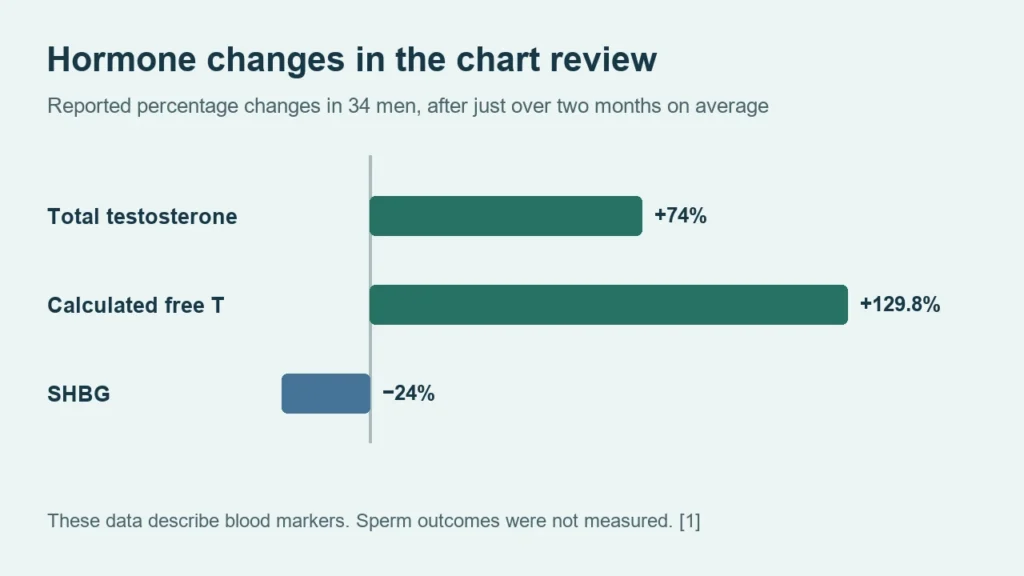
The white paper included men with symptoms such as low energy or libido, body-composition concerns, and low qADAM symptom scores. Some had baseline total testosterone in the usual laboratory range. The report describes 600 mg daily alongside a meal with at least 30 g of fat for its particular formulation. These are historical study details and do not translate to approved capsule dosing. [1, 2]
| Marker | Baseline average | Follow-up average |
|---|---|---|
| Total testosterone | 453.9 ng/dL | 790.1 ng/dL |
| Calculated free testosterone | 86.0 pg/mL | 197.6 pg/mL |
| Sex hormone-binding globulin (SHBG) | 40.8 nmol/L | 31.0 nmol/L |
| Luteinizing hormone (LH) | 8.8 mIU/mL | 7.9 mIU/mL |
| Follicle-stimulating hormone (FSH) | 7.5 mIU/mL | 6.7 mIU/mL |
Why don’t LH and FSH prove that sperm production is protected?
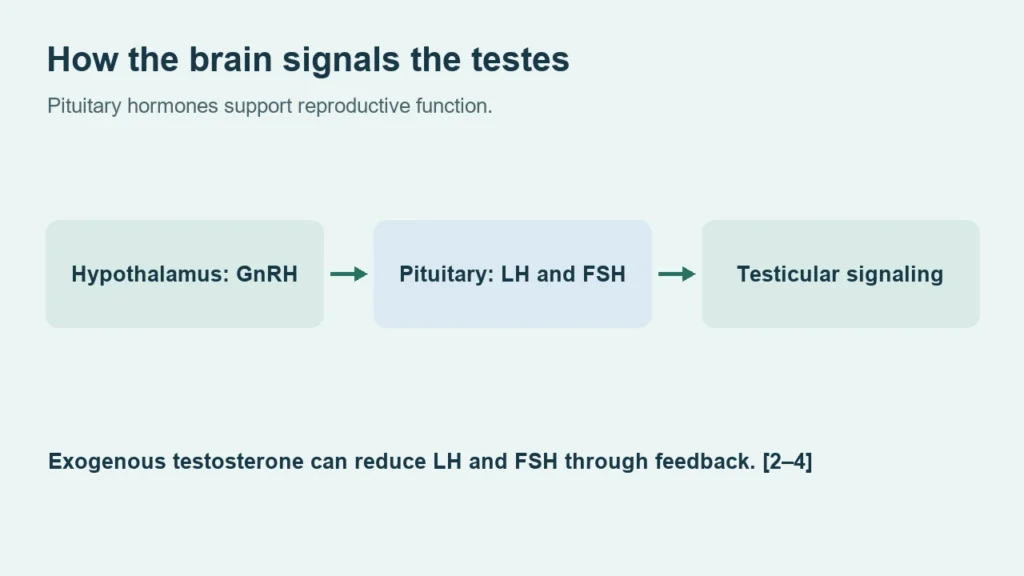
LH and FSH are pituitary signals involved in testosterone and sperm production. Exogenous testosterone can suppress both by negative feedback, regardless of the route. A hormone panel does not count sperm or assess their motility. Semen analysis and your reproductive history help a specialist evaluate fertility directly when it matters for your care.
The authors reported LH and FSH above 2.0 mIU/mL at follow-up in all 34 men, including participants whose total testosterone exceeded 1,000 ng/dL. The cohort was small, follow-up was short, and there was no untreated group or direct comparison with injections or gels. The cutoff is not a validated guarantee of fertility. [1, 3]
The hypothalamus releases GnRH, prompting the pituitary to release LH and FSH. LH stimulates testosterone production in the testes, and FSH helps support sperm production. The study tracked blood hormones and did not establish intratesticular testosterone levels, semen quality, pregnancies, or long-term fertility. [1–4]
The authors proposed that fat-assisted intestinal lymphatic transport, shorter exposure, and meal timing may influence feedback. Lymphatic transport can reduce initial liver metabolism for certain oral preparations. The chart review did not compare absorption pathways or establish that their formulation reproduces normal hormone rhythms or reliably allows recovery between doses. [1, 2, 5]
What does enclomiphene evidence mean for family planning?
Enclomiphene can increase pituitary signaling in selected men with secondary hypogonadism. Studies of enclomiphene alone and company reports on combination therapy answer different questions. Neither establishes that combining it with oral testosterone is the best way to preserve fertility. Guidelines advise against exogenous testosterone when current or future fertility is a priority.
- Separate the studies. A related company report described LH and FSH remaining in range in participants with an intact hormone axis after oral testosterone plus enclomiphene. It reported that all participants met its LH and FSH cutoffs. That report does not establish fertility or superiority over monotherapy. [6]
- Ask about alternatives. Trials comparing enclomiphene alone with gel measured sperm counts. The FDA has not approved enclomiphene. A reproductive specialist can evaluate the cause of low testosterone and discuss clinically appropriate options. [3, 7, 8]
Common questions about PEPLIX HEALTH
Peplix Health offers cash-pay telehealth through a model managed by Monarch Brands LLC. An independent, board-certified physician can review symptoms, prior labs, and plans for children. A state-licensed pharmacy may fill an eligible, medically appropriate patient-specific compounded prescription under Section 503A and applicable state requirements when compounding is needed.
What should I bring to the visit?
Bring dated testosterone results, medication and supplement lists, and prior semen analyses if you have them. Share your plans for children before starting or changing testosterone. An evaluation for deficiency generally starts with symptoms and repeated morning testosterone measurements. [3, 4]
What can a 503A pharmacy verify?
Ask which pharmacy would dispense your prescription, why the specific formulation is needed, and how timing and monitoring are handled. Compounded drugs do not receive FDA premarket review for safety, effectiveness, or quality. [9, 10]
For consultation information, see our low testosterone guide or start an online assessment.
Sources
- Maximus. Native oral testosterone monotherapy chart review.
- FDA. Jatenzo prescribing information.
- AUA and ASRM. Diagnosis and treatment of male infertility.
- Endocrine Society. Testosterone therapy for hypogonadism.
- FDA. Testosterone undecanoate absorption review.
- Maximus. Oral testosterone plus enclomiphene company report.
- Wiehle and colleagues. Enclomiphene and sperm counts.
- FDA. Advisory committee briefing on enclomiphene.
- FDA. Compounding questions and answers.
- U.S. Code. Pharmacy compounding under Section 503A.
This article is for general education and is not medical advice. Talk with a licensed clinician before starting, stopping or changing any treatment. Compounded medications are not FDA-approved. See our safety information.
Keep reading

Testosterone
What Is Enclomiphene and How Does It Compare With TRT?
Compare enclomiphene, TRT, and Clomid for low testosterone. Learn what trials found about sperm counts, side effects, and FDA approval.

Testosterone
Does Enclomiphene Build Muscle?
Does enclomiphene build muscle? Review the evidence on testosterone, lean mass, fertility, and what to discuss before treatment.

Testosterone
MCT Oil vs. Seed Oils in Injectable Testosterone
Compare MCT, sesame, and cottonseed oil in injectable testosterone. Learn what carriers do and what to ask about irritation or allergies.