Can Testosterone Affect Focus and Leadership at Work?
What can testosterone and cortisol tell you about work and leadership? Review the evidence and learn when persistent fatigue deserves evaluation.

Testosterone and cortisol have been linked to some behaviors that matter at work, including risk-taking and status seeking. Research does not show that raising testosterone improves productivity, leadership, or promotion prospects. If fatigue, poor concentration, or low libido persists, a clinical evaluation can identify possible causes and whether hormone testing is appropriate.
What did the testosterone and leadership study find?
A study of 78 male executives examined testosterone, cortisol, and managerial rank. Among executives with lower cortisol, higher testosterone was associated with managing more people. Among those with higher cortisol, there was no clear association. The study measured rank at one point in time, so it cannot predict promotion or leadership ability.
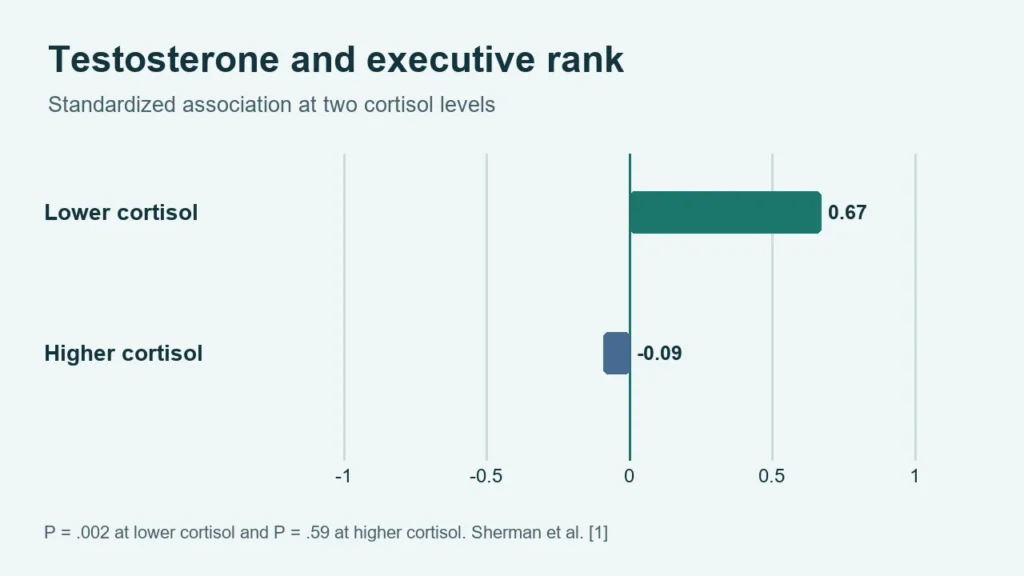
The researchers defined rank by the number of direct and indirect reports. Executives had an average age in the late forties, with participants between 33 and 65. In this sample, testosterone and cortisol were positively correlated. A favorable association with rank at lower cortisol therefore does not mean the two hormones always move in opposite directions. Neither income nor education showed the same pattern. [1]
What is the dual-hormone hypothesis?
The hypothesis proposes that the association between testosterone and status-related behaviors depends in part on cortisol. In some studies, an association with status seeking or assertion appears stronger when cortisol is lower. A synthesis of 33 studies involving more than 8,500 people found a very small average interaction and noted sensitivity to study design. Confidence, collaboration, emotional intelligence, experience, and organizational context can all affect how people lead. [1,2]
How do testosterone and cortisol relate to decisions and stress?
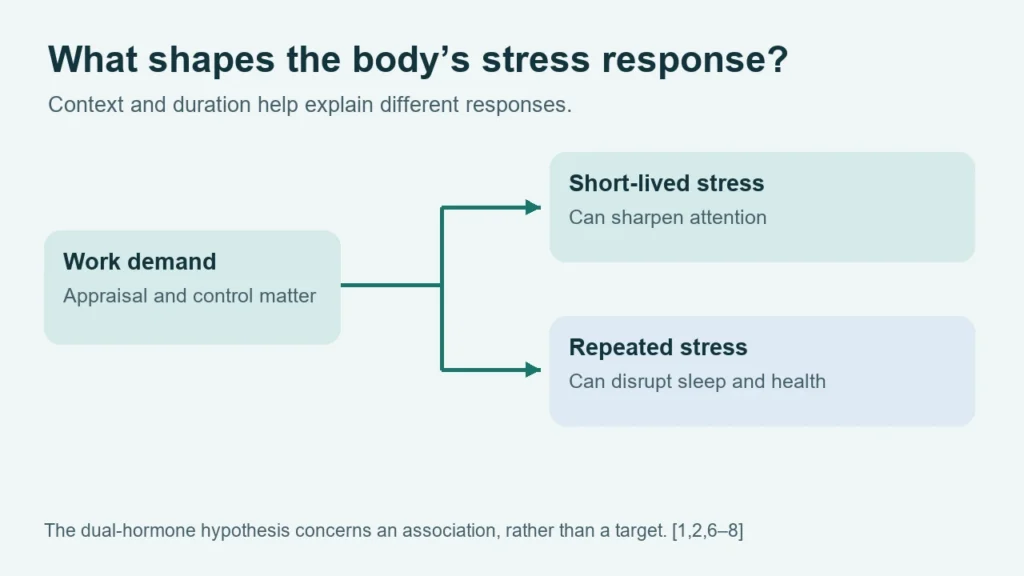
Some small studies connect testosterone with responses to threat, willingness to take risks, and certain judgments in laboratory tasks. Effects depend on the person and situation. Cortisol is one part of the stress response, and acute and chronic stress can have different effects on attention, immunity, and cardiovascular health.
| Research question | What studies observed | What it means for work |
|---|---|---|
| Risk-taking or decision-making | Some laboratory tasks link testosterone with greater risk tolerance or shifts in responses to dilemmas. | A risk can be useful or costly depending on experience, incentives, and circumstances. Workplace productivity and choice of performance metrics were not established. |
| Aggression and self-control | A meta-analysis found weak associations. One controlled study suggested personality and self-control may matter. | A hormone level cannot predict how an individual will handle conflict. |
| Leadership and stress | A 2012 study found leaders had lower average cortisol and reported less anxiety. Sense of control helped explain the association in a related sample. | Rank and workplace control can be linked. The data do not establish that leadership lowers stress. |
Studies have explored links between testosterone and lower fear reactivity, competitiveness, assertion, or utilitarian choices. Effects vary by task. Biological cross-talk between the adrenal and reproductive systems may influence androgen signaling, but complex workplace decisions cannot be inferred from a hormone value. Brief stress can temporarily sharpen attention or redistribute immune activity. Chronic stress may impair cognition, immune regulation, and cardiovascular health. Feeling a sense of control can shape the stress experience. [3–8]
Could low testosterone explain fatigue at work?
Persistent tiredness, concentration trouble, memory lapses, low motivation, low mood, and irritability can affect work. These symptoms have many causes. Low libido, fewer spontaneous erections, or other signs of testosterone deficiency may make testing more relevant. Diagnosis generally requires compatible symptoms and low values on two separate early-morning blood draws.
Sleep apnea, depression or anxiety, medication effects, anemia, thyroid disorders, and chronic illness can overlap with these symptoms. Difficulty concentrating can affect deadlines and decisions, and mood changes can strain teamwork. Bring a short symptom timeline and medication list to your visit. Trials of testosterone treatment in older men did not show a meaningful improvement on key cognition and vitality endpoints, so treatment expectations should be specific. [9–11]
What habits support energy and healthy hormone function?
Regular movement, resistance exercise, sufficient sleep, and a balanced diet can support general health and workday energy. Treating sleep apnea or managing weight when medically appropriate may also help. If you’re relying on caffeine through the afternoon, review sleep and workload first. Hormone therapy has no established role in advancing a career.
- Make exercise repeatable. Include regular strength work and aerobic activity you can sustain. Weight loss in some men with obesity raises testosterone, but the amount varies and an average claim of a 30% boost does not apply to everyone. [9,12]
- Use food, sleep, and hydration to support the day. Include leafy greens, eggs, fish, unsaturated fats such as avocado, and suitable protein sources. Drink water through the day and protect time for sleep. Excess caffeine can interfere with sleep or increase jitteriness. [9]
- Address deficiencies and chronic stress. Outdoor activity may support healthy routines. Vitamin D status is influenced by UV exposure, but supplementation does not reliably raise testosterone. Consider where you can gain control over schedules or workloads and get help for continuing stress or low mood. [6,8,13]
Common questions about PEPLIX HEALTH
At Peplix Health, independent licensed clinicians make decisions about testing, treatment, and follow-up. Monarch Brands LLC manages the practice’s administrative services. If a physician determines that a compounded medicine is appropriate for an individual patient, a state-licensed pharmacy operating under Section 503A may fill the prescription when applicable requirements are met.
Does Peplix Health use testosterone to improve job performance?
A licensed physician can evaluate symptoms and possible testosterone deficiency. Evidence does not support prescribing testosterone to raise productivity, improve leadership, or increase an otherwise healthy person’s odds of promotion.
How do I know who prescribes and fills a medication?
Ask the independent, board-certified physician performing your evaluation about expected benefits, individualized dosing, and follow-up. Ask who will fill the prescription and whether an FDA-approved option is suitable. Compounded drugs do not undergo FDA premarket review for safety, effectiveness, or quality.
This article is for education. Discuss medical decisions with a licensed clinician.
For consultation information, see our low testosterone guide or start an online assessment.
Sources
- Sherman et al. — attained status in male executives
- Dekkers et al. — dual-hormone hypothesis meta-analysis
- Stanton et al. — testosterone and Iowa gambling task performance
- Geniole et al. — testosterone and human aggression meta-analysis
- Carré et al. — aggression and individual characteristics
- Sherman et al. — leadership, cortisol, and stress
- Viau — cross-talk of reproductive and adrenal hormone axes
- Dhabhar — short-term stress and immune effects
- Endocrine Society — diagnosis and treatment of testosterone deficiency
- Resnick et al. — testosterone and cognitive function
- Snyder et al. — testosterone trials and vitality
- Corona et al. — weight loss and testosterone
- Lerchbaum et al. — vitamin D and testosterone randomized trial
- FDA — compounding and FDA approval
This article is for general education and is not medical advice. Talk with a licensed clinician before starting, stopping or changing any treatment. Compounded medications are not FDA-approved. See our safety information.
Keep reading

Testosterone
What Is Enclomiphene and How Does It Compare With TRT?
Compare enclomiphene, TRT, and Clomid for low testosterone. Learn what trials found about sperm counts, side effects, and FDA approval.

Testosterone
Does Enclomiphene Build Muscle?
Does enclomiphene build muscle? Review the evidence on testosterone, lean mass, fertility, and what to discuss before treatment.

Testosterone
MCT Oil vs. Seed Oils in Injectable Testosterone
Compare MCT, sesame, and cottonseed oil in injectable testosterone. Learn what carriers do and what to ask about irritation or allergies.