Exogenous vs Endogenous Testosterone: What’s the Difference?
Learn where your testosterone comes from, how TRT changes hormone signals and fertility, and what testing can help guide treatment decisions.

Endogenous testosterone is made in your body. Exogenous testosterone comes from medication or another outside source. Prescription replacement can treat confirmed hypogonadism, but it may suppress your own testosterone and sperm production. The decision starts with symptoms, repeat blood tests, an assessment of the cause, and a discussion of fertility goals.
How does your body produce its own testosterone?
The hypothalamus and pituitary signal the testes through a system called the hypothalamic-pituitary-gonadal axis. Luteinizing hormone stimulates Leydig cells to make most of the testosterone in men. Follicle-stimulating hormone and high local testosterone support Sertoli cells and sperm development. The brain adjusts its signals in response to circulating hormones.
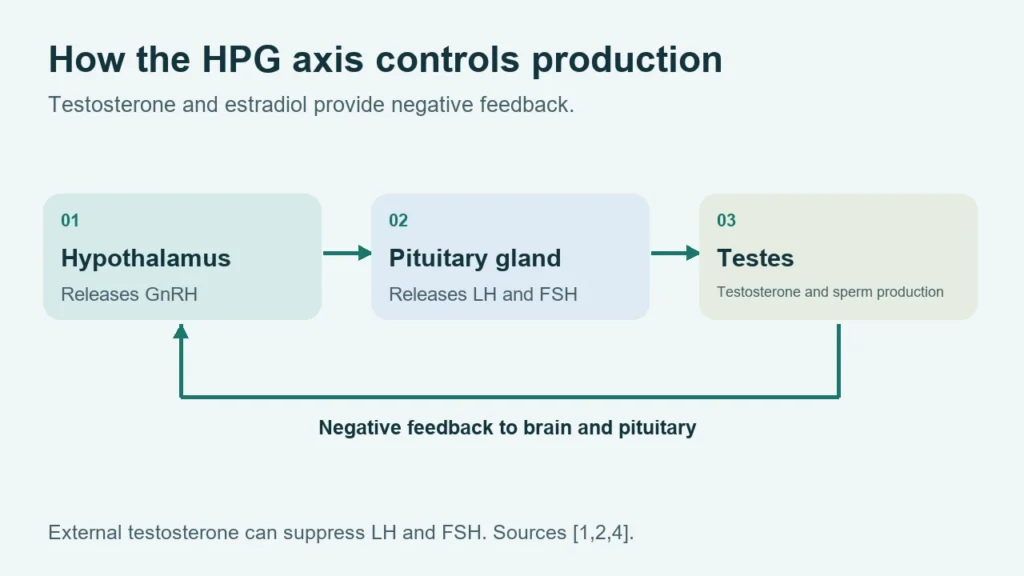
The adrenal glands contribute smaller amounts of androgens and precursors. Testosterone and its metabolites support male reproductive development and puberty, including prostate development, body hair, a deeper voice, and increased muscle mass. They also help regulate sexual function, fat distribution, red blood cell production, and bone density. Mood and cognition can be affected by many factors, and low testosterone sometimes accompanies mood symptoms or impaired concentration. [1–3]
What changes when you take exogenous testosterone?
Prescription testosterone raises blood levels directly. That rise signals the brain and pituitary to reduce LH and FSH. Testosterone inside the testes can then fall even when blood levels look normal, and sperm counts may fall significantly. Men who plan to conceive should discuss fertility-preserving approaches before starting replacement therapy.
| Question | Endogenous testosterone | Exogenous testosterone |
|---|---|---|
| Where does it come from? | Mainly Leydig cells in the testes. | A formulation such as an injection, gel, oral capsule, or implanted pellet. |
| What happens to fertility? | Normal testicular testosterone and FSH help support sperm production. | LH and FSH can decline, reducing sperm production and sometimes testicular size. |
| How is it evaluated? | Symptoms, repeat morning total testosterone, and selected follow-up tests. | Product-specific hormone testing and monitoring of symptoms and safety. |
Some formulations have also been delivered through transdermal patches or buccal systems, depending on availability. Gels and patches can irritate skin, injections can be uncomfortable, and buccal systems can affect taste or irritate gums. Dosing depends on the exact product. Sperm production may recover after treatment stops, but recovery can take many months or longer and is not assured. Testosterone is not reliable contraception. [1,4,5]
Anabolic steroid misuse is different from supervised replacement for hypogonadism. High doses or nonmedical use can suppress natural hormone production and raise cardiovascular risks. Certain anabolic steroids can also cause liver injury. Testosterone is a prescription-controlled medication in the United States. [1,6]
What benefits and risks has testosterone replacement shown?
Testosterone replacement can improve libido and some aspects of sexual function in selected men with confirmed deficiency. It can increase lean mass and improve some bone density measures. Benefits for fatigue, strength, and cognition vary. Treatment can raise red blood cell counts and blood pressure, so monitoring and individual risk assessment matter.
- Sexual health and body composition. Testosterone supports protein synthesis. Replacement may improve lean mass, libido, and some sexual symptoms. Erectile problems, fatigue, sleep issues, and mood changes can have separate causes. Clinical trials have not established broad benefits for memory or cognition, and TRT is not a performance-enhancing treatment for healthy men. [1,7,8]
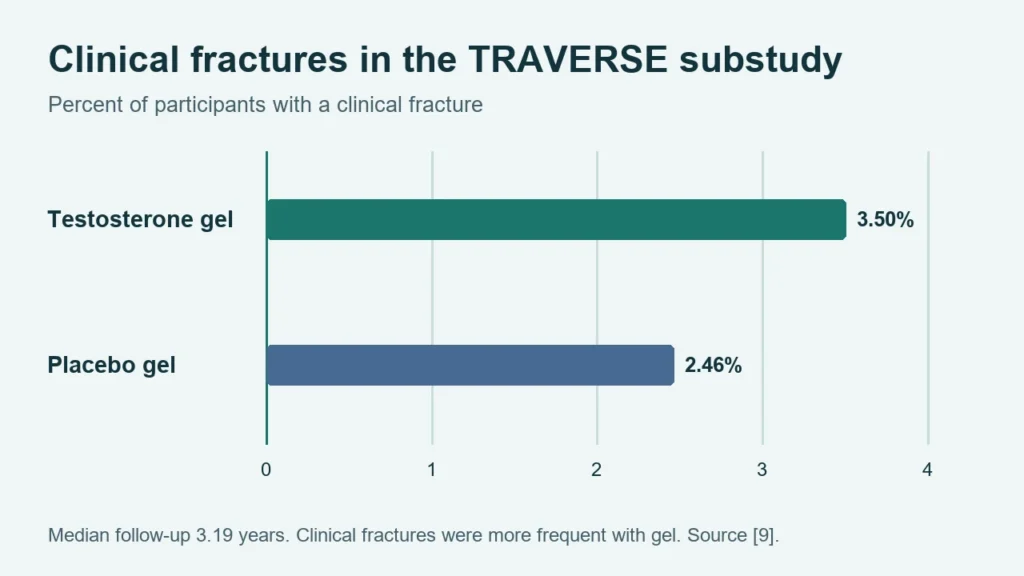
- Bone. Low testosterone can contribute to low bone density. TRT can improve bone density, but a large trial found more clinical fractures with testosterone gel than placebo, 3.50% versus 2.46% over a median 3.19 years. Men with osteoporosis need an appropriate bone-health plan. [1,9]
- Circulation and red blood cells. TRT can increase hematocrit. Your physician may adjust or pause treatment if it rises too far. In the studied TRAVERSE population, testosterone gel met the trial’s cardiovascular noninferiority criterion for major events, but pulmonary embolism and atrial fibrillation occurred more often. FDA labeling also calls for blood pressure warnings. [1,10,11]
How do you decide whether testosterone therapy is appropriate?
If symptoms persist, a clinician may order two separate morning total testosterone tests and use selected additional labs to determine why levels are low. Treating sleep problems, improving nutrition, exercising, and addressing weight or underlying illness may support natural production in some men. Confirmed hypogonadism can require separate treatment.
LH and FSH can help locate the problem in the testes or in the hypothalamus and pituitary. Free testosterone and SHBG can help in borderline cases or when binding is altered. Estradiol may be ordered when clinically relevant. Ask whether your home collection method is validated and if a venous result is needed for confirmation. Age and genetic factors can also affect endogenous levels. [1,2]
Common questions about PEPLIX HEALTH
Independent, board-certified physicians review symptoms, medical history, fertility goals, and lab findings before discussing treatment. Monarch Brands LLC provides management services for Peplix Health. The evaluating physician determines whether testing, treatment, or a referral is appropriate. Ask what cash-pay services and follow-up are available in your state.
Can I discuss alternatives if I want children?
Yes. Raise fertility goals early. An independent physician can discuss diagnostic testing and whether referral to a reproductive specialist is appropriate before starting testosterone.
Who chooses my dose and pharmacy?
The prescriber individualizes the formulation, dose, and monitoring. A state-licensed pharmacy operating under Section 503A can fill a valid patient-specific compounded prescription when clinically appropriate and lawful. Compounded products do not have FDA approval. [12]
This article is educational. Discuss treatment and fertility decisions with a licensed healthcare professional.
For consultation information, see our low testosterone guide or start an online assessment.
Sources
- Endocrine Society — testosterone therapy guideline
- StatPearls — testosterone physiology
- NIH — testosterone and estradiol in men
- Review — exogenous testosterone and fertility
- Liu et al. — recovery of spermatogenesis
- Review — anabolic-androgenic steroid misuse
- Snyder et al. — effects of testosterone in older men
- Resnick et al. — testosterone and cognitive function
- Snyder et al. — fracture trial
- Lincoff et al. — cardiovascular safety in TRAVERSE
- FDA — testosterone labeling and blood pressure
- FDA — compounding and FDA approval
This article is for general education and is not medical advice. Talk with a licensed clinician before starting, stopping or changing any treatment. Compounded medications are not FDA-approved. See our safety information.
Keep reading
Testosterone
What Is Enclomiphene and How Does It Compare With TRT?
Compare enclomiphene, TRT, and Clomid for low testosterone. Learn what trials found about sperm counts, side effects, and FDA approval.

Testosterone
Does Enclomiphene Build Muscle?
Does enclomiphene build muscle? Review the evidence on testosterone, lean mass, fertility, and what to discuss before treatment.
Testosterone
MCT Oil vs. Seed Oils in Injectable Testosterone
Compare MCT, sesame, and cottonseed oil in injectable testosterone. Learn what carriers do and what to ask about irritation or allergies.