Can men in their 20s and 30s take testosterone?
Can men in their 20s and 30s take testosterone? Learn how low testosterone is diagnosed and what TRT may mean for sperm production and fertility.

Younger adults can receive testosterone replacement therapy when a clinician confirms hypogonadism and determines that treatment is appropriate. Evaluation usually requires compatible symptoms or signs and repeatedly low morning testosterone. Tell your clinician early if you want children, because taking testosterone from outside the body can sharply reduce sperm production.
What can cause low testosterone before age 40?
Low testosterone in younger men can reflect a testicular or pituitary condition, the effects of medication or substance use, or factors such as obesity and inadequate sleep. One U.S. survey analysis reported low lab values in about one fifth of males aged 15 to 39, a group that includes adolescents.
That NHANES analysis, reported at the 2020 AUA meeting and in European Urology Focus, used a blood-level threshold. It did not establish the prevalence of confirmed symptomatic hypogonadism in men in their 20s. Differences in assay, survey periods and participant characteristics limit inferences about trends and causes. [1]
- Sleep, stress and training. In a small experiment, a week with five hours in bed nightly lowered daytime testosterone by about 10–15% in young healthy men. Chronic stress can influence hormone signaling. Studies of some long-term endurance athletes reported resting levels around 50–85% of comparison levels. Low energy availability and inadequate recovery can contribute. [2–4]
- Obesity and metabolic health. Obesity is often associated with lower SHBG and total testosterone. Severe obesity can also lower free testosterone through suppression of hormonal signaling. Fat tissue can convert androgens to estrogens via aromatase, one of several possible mechanisms. Weight loss can raise testosterone in men with obesity. [5]
- Medications and exposures. Opioids, heavy alcohol use and anabolic steroids can suppress production. Evidence on effects of tobacco or nicotine, cannabis and amphetamines on hormones or semen varies. Studies link some exposure to phthalates, BPA and PFAS to reproductive outcomes. These exposures may affect hormone signaling, but an individual result cannot identify the cause. [6,7]
- Medical history. Pituitary or hypothalamic disease, testicular injury or tumors, cancer treatment, diabetes, liver disease and HIV-related illness can play a role. Genetic or congenital conditions such as Klinefelter, Kallmann and Prader–Willi syndromes warrant specialist evaluation. Down syndrome can also be associated with gonadal dysfunction. [8,9,18]
What tests confirm low testosterone in younger men?
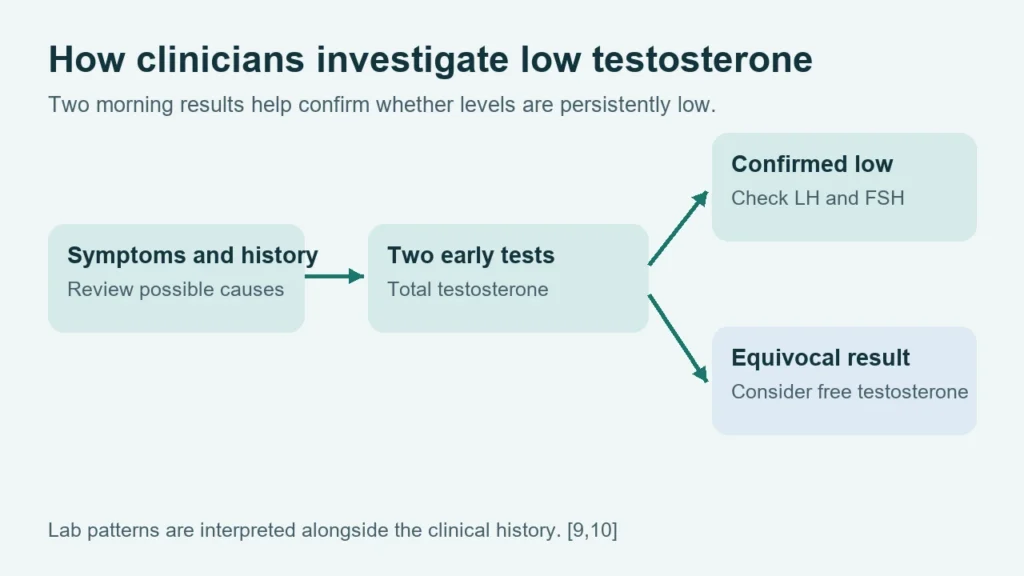
Clinicians start with symptoms, history and total testosterone on two separate mornings, typically between 7 and 10 a.m. Related tests can clarify why levels are low or whether a change in testosterone binding affects the result. Appropriate testing helps identify when testosterone treatment, another option or a referral makes sense.
| Test | When it may help | What it can show |
|---|---|---|
| Total testosterone | Two separate early-morning samples, fasting per Endocrine Society guidance | Confirms whether total levels are repeatedly low. [9–11] |
| LH and FSH | After low testosterone is confirmed | High values suggest a testicular cause. Low or inappropriately normal values suggest a pituitary or hypothalamic cause. [9] |
| Free testosterone and SHBG | If total is borderline or binding is likely altered | SHBG binds testosterone. Roughly 1–2% circulates unbound, and albumin-bound testosterone is also generally considered bioavailable. [9,17] |
| Other tests as indicated | Based on history, risks and planned treatment | A1C for glucose, ALT for liver assessment, and hematocrit before TRT. PSA is based on age and risk. [9,10] |
Can you take TRT and still have children?
Testosterone replacement can reduce sperm counts substantially, sometimes to zero, by lowering the pituitary signals that drive sperm production. Recovery after stopping often takes months and can take a year or longer. A reproductive specialist can help weigh options before you start, especially if you plan to conceive soon.
Exogenous testosterone suppresses signaling in the hypothalamic-pituitary-gonadal axis, reducing LH, FSH and testosterone inside the testes. The extent of suppression and speed of recovery vary with exposure history and other individual factors. Guidelines advise against prescribing exogenous testosterone to men actively trying to conceive. [9,10,12]
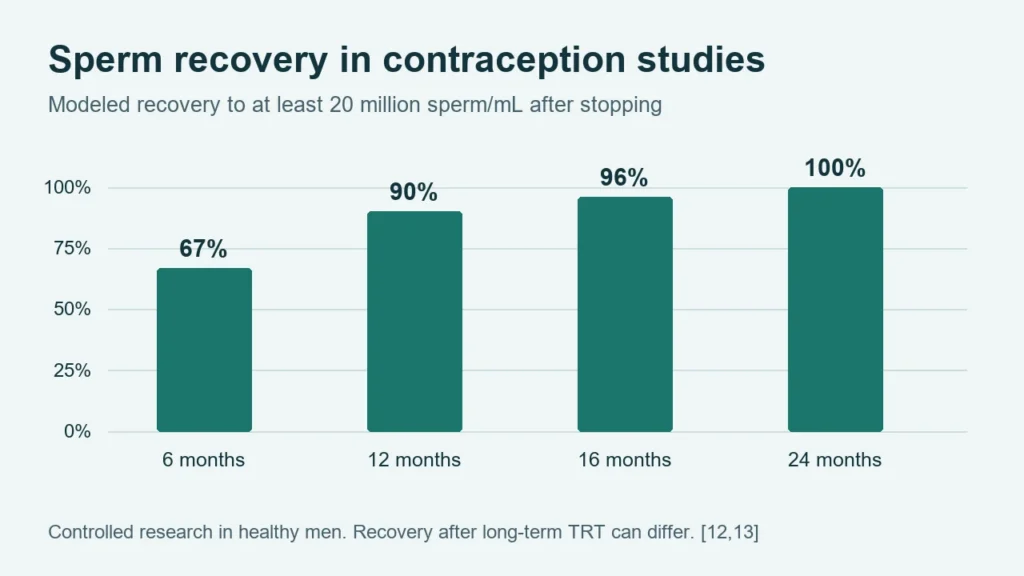
In pooled hormonal male contraception studies, recovery to 20 million sperm/mL had a median of 3.4 months. Modeled recovery was 67% at six months, 90% at 12, 96% at 16, and 100% at 24. These estimates are from monitored research regimens in healthy men. They cannot guarantee recovery after long-term TRT or anabolic steroid use. [12,13]
When might a clinician discuss enclomiphene?
Enclomiphene is a selective estrogen receptor modulator. Reducing estrogen feedback at the hypothalamus can increase GnRH signaling, which leads the pituitary to release more LH and FSH. Trials in men with secondary hypogonadism found higher serum testosterone and maintained sperm counts relative to testosterone gel. Preserved counts do not establish pregnancy or live birth benefits. Enclomiphene itself has no FDA approval. [14,15]
When is TRT appropriate and how can you prepare?
A licensed clinician may prescribe TRT when low levels and symptoms are confirmed, the cause is evaluated, and the expected benefits outweigh the risks. Sexual desire or erectile function may improve in some appropriately selected patients. Effects on energy, motivation and strength vary. Monitoring helps assess response, blood levels and adverse effects.
- Bring a short symptom history. Note changes in libido, erectile function, energy, mood, focus, sleep or training recovery, and when they started.
- Share your routine and medications. Include alcohol, supplements, prior hormone use, dieting or heavy training. Tell your doctor if you are recovering from an illness or dealing with prolonged stress.
- Make your goals explicit. Discuss future fertility, what improvement would matter to you and how follow-up would work. Seek a second opinion if your symptoms or results remain unexplained. [8–10]
Common questions about PEPLIX HEALTH
Peplix Health offers cash-pay evaluations for hormone and metabolic concerns. Monarch Brands LLC manages nonclinical operations, and independent, board-certified physicians evaluate symptoms, laboratory results and medical history. When treatment is indicated, your physician can individualize dosing and monitoring or refer you to an endocrinologist or a reproductive urologist.
Can I ask for an evaluation before age 40?
Yes. Adults can ask about persistent symptoms and bring past lab results. Age alone does not determine eligibility. Diagnosis and treatment depend on confirmed findings, health history and reproductive plans. [9,10]
Where can an individualized compounded prescription be filled?
If clinically appropriate and legally available, a licensed pharmacy operating under Section 503A can fill a valid patient-specific prescription under federal and state requirements. Compounded preparations do not undergo FDA premarket review for safety, effectiveness or quality. [16]
For consultation information, see our low testosterone guide or start an online assessment.
This article is for general education and does not replace individualized medical advice.
Sources
- Lokeshwar et al. Testosterone levels in adolescent and young adult men
- Leproult and Van Cauter. Sleep restriction in young men
- Hackney and Hackney. Exercise hypogonadal male condition
- Xiong et al. Chronic stress and testosterone synthesis (preclinical)
- Grossmann. Testosterone in male obesity
- Duca et al. Substance abuse and male hypogonadism
- Rodprasert et al. Endocrine-disrupting chemicals and reproductive health
- Cohen et al. Low testosterone in adolescents and young adults
- Endocrine Society. Testosterone therapy guideline
- AUA. Testosterone deficiency guideline
- MedlinePlus. Testosterone levels test and sample timing
- McBride and Coward. Sperm recovery after TRT or steroid use
- Liu et al. Recovery after hormonal male contraception
- Kim et al. Enclomiphene and sperm counts
- Operation Supplement Safety. Enclomiphene regulatory status
- FDA. Compounding and the FDA
- Research review. Testosterone binding and free fraction
- Hsiang et al. Gonadal function in Down syndrome
This article is for general education and is not medical advice. Talk with a licensed clinician before starting, stopping or changing any treatment. Compounded medications are not FDA-approved. See our safety information.
Keep reading

Testosterone
What Is Enclomiphene and How Does It Compare With TRT?
Compare enclomiphene, TRT, and Clomid for low testosterone. Learn what trials found about sperm counts, side effects, and FDA approval.

Testosterone
Does Enclomiphene Build Muscle?
Does enclomiphene build muscle? Review the evidence on testosterone, lean mass, fertility, and what to discuss before treatment.

Testosterone
MCT Oil vs. Seed Oils in Injectable Testosterone
Compare MCT, sesame, and cottonseed oil in injectable testosterone. Learn what carriers do and what to ask about irritation or allergies.