What is sermorelin, and how does it work?
Learn what sermorelin is, how it affects growth hormone and IGF-1, how it differs from HGH, and when low growth hormone warrants evaluation.

Sermorelin is a synthetic peptide that mimics part of growth hormone–releasing hormone. It signals a responsive pituitary gland to release growth hormone, which can increase IGF-1. That mechanism differs from injecting growth hormone directly. Evidence remains limited for using sermorelin to improve sleep, fat loss or recovery in generally healthy adults.
What is sermorelin made of?
Sermorelin reproduces the first 29 amino acids of the 44-amino-acid human growth hormone–releasing hormone sequence and adds an amide at the end. The abbreviated peptide can activate GHRH receptors on pituitary cells. It was previously marketed in the United States for certain pediatric treatment and growth hormone diagnostic uses.
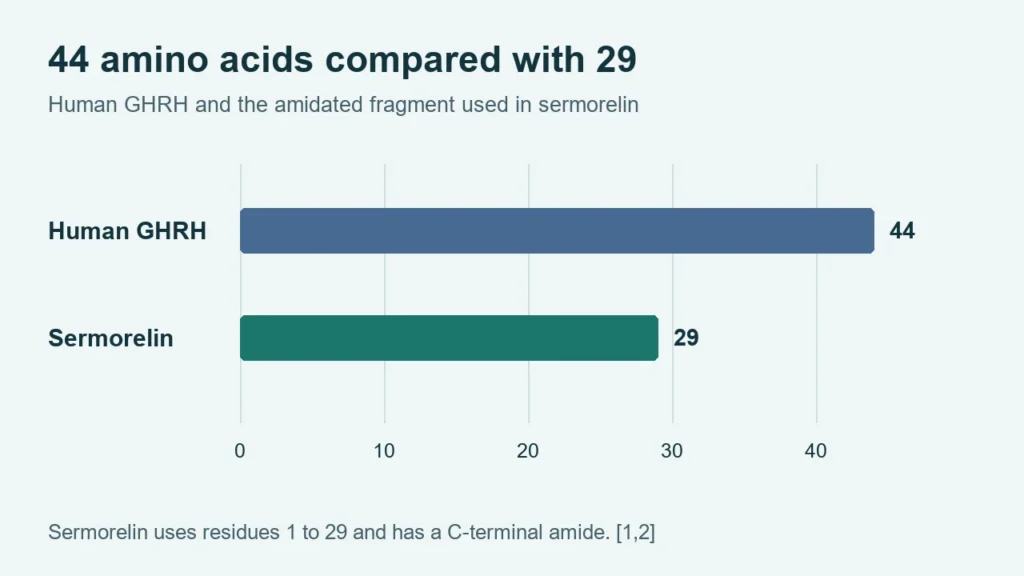
The amidated fragment is written as GHRH(1–29)-NH₂. A pharmacology review reports a subcutaneous half-life of approximately 11–12 minutes, within the commonly cited range of about 10–20 minutes. Half-life describes how quickly the measured drug level falls by half, separate from the duration of the downstream hormone response. A short half-life alone does not establish safety or a dosing schedule. [1,2]
How is sermorelin different from HGH?
Sermorelin activates receptors on a responsive anterior pituitary and stimulates release of the body’s own growth hormone. Somatropin supplies recombinant human growth hormone directly. Both can affect insulin-like growth factor 1, or IGF-1. A drug’s mechanism alone cannot establish whether it is more effective or safer for long-term use.
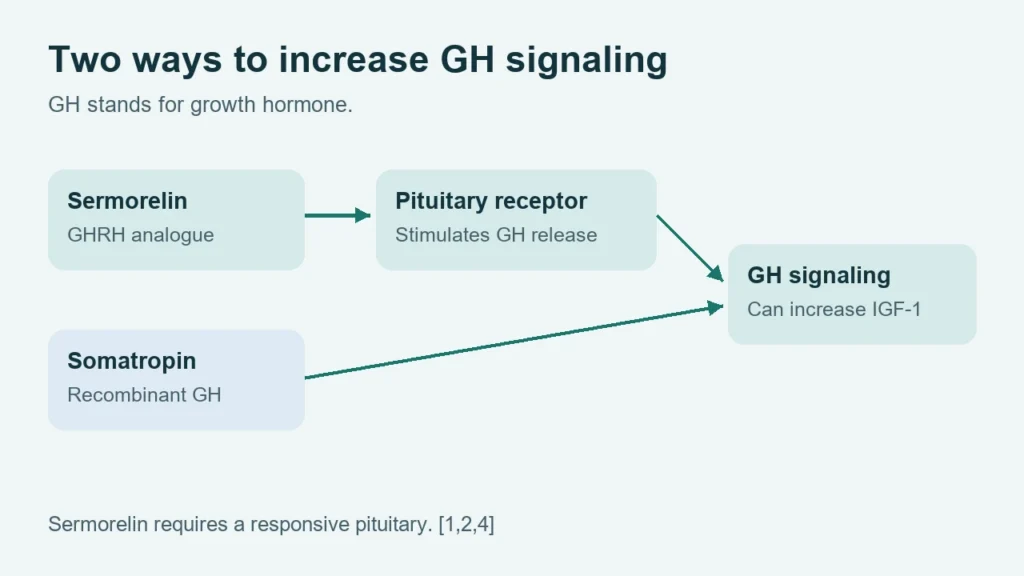
| Feature | Sermorelin | Somatropin (recombinant HGH) |
|---|---|---|
| Signal | Stimulates pituitary GH release. | Supplies GH directly. |
| Pituitary response | Depends on a responsive pituitary. | Supplies GH independently of pituitary release. |
| U.S. indication | Historical products were marketed for specific pediatric and diagnostic uses. | Some products have approval for adult GH deficiency and other specific indications. |
Growth hormone signals the liver and other tissues to make IGF-1. Together these hormones influence protein synthesis, lean tissue, fat metabolism and tissue repair. Natural GH release occurs in pulses and is closely linked to slow-wave sleep. Direct GH can cause fluid retention and affect glucose regulation. Evidence does not establish a long-term safety advantage for sermorelin in generally healthy adults. [1–5]
Who should be evaluated for low growth hormone?
Growth hormone output often declines with age, with substantial variation between people. Persistent fatigue, changes in body composition, poor sleep and slower recovery can have multiple causes. An endocrinology evaluation for adult growth hormone deficiency is most relevant when medical history raises suspicion, such as pituitary disease, surgery or radiation.
- Start with the medical history. Discuss known pituitary or hypothalamic problems, prior treatment, medications, sleep patterns and when symptoms began. [4,5]
- Interpret IGF-1 in context. An age-adjusted IGF-1 level can inform evaluation. A normal result does not exclude growth hormone deficiency, and a low result can have other causes. Most suspected cases require a supervised stimulation test to confirm the diagnosis. [4]
- Ask what a study actually measured. A small six-week study in older men found increased night-time GH with GHRH(1–29), without significant changes in IGF-1 or body composition. Reliable timelines for sleep, fat loss, recovery, cognition, or changes in skin, hair and nails remain unestablished in generally healthy adults. [5,6]
Common questions about PEPLIX HEALTH
Peplix Health offers cash-pay consultations for hormone and metabolic concerns. Monarch Brands LLC manages nonclinical operations. Independent, board-certified physicians make clinical decisions, including whether labs, additional evaluation or referral are appropriate. Patients can bring prior results and discuss their symptoms, goals, and what evidence supports the options under consideration.
How is dosing determined if a medication is prescribed?
The physician tailors treatment and follow-up to the indication and formulation. When a medication is prescribed, the dispensing pharmacist can confirm the labeled concentration, administration and storage instructions. Research has not established a general three-to-six-month sermorelin course for healthy adults. [2,5]
What does Section 503A mean for fulfillment?
When a compounded preparation is clinically appropriate and legally available, a licensed pharmacy operating under Section 503A may fill a patient-specific prescription. Applicable federal and state requirements govern compounding. These preparations do not undergo FDA premarket review for safety, effectiveness or quality. [7]
For consultation information, see our longevity guide or start an online assessment.
This article is for general education and does not replace individualized medical advice.
Sources
- FDA. Historical Geref withdrawal determination
- Sigalos and Pastuszak. GH secretagogues and pharmacology
- Zadik et al. Age and 24-hour GH secretion
- Endocrine Society. Adult GH deficiency guideline
- Endocrine Society. Hormones and aging scientific statement
- Vittone et al. GHRH(1–29) in healthy older men
- FDA. Compounding questions and answers
This article is for general education and is not medical advice. Talk with a licensed clinician before starting, stopping or changing any treatment. Compounded medications are not FDA-approved. See our safety information.
Keep reading

Peptides & Longevity
BPC-157 and Growth Hormone in Tendon Recovery
Learn what BPC-157 studies found in rat tendon cells, what IGF-1 can tell you, and why tesamorelin has no proven role in tendon recovery.

Peptides & Longevity
Growth Hormone Secretagogues and the Evidence Behind Them
Compare tesamorelin, sermorelin, CJC-1295, ipamorelin and MK-677. Learn what studies found about GH, IGF-1, safety and FDA status.

Peptides & Longevity
What the FDA Peptide Compounding Review Means for Patients
See what the July 2026 FDA advisory votes and HHS draft mean for BPC-157, TB-500, Semax, and other peptides considered for 503A compounding.